 |
PDBsum entry 2h2h

|
|
|
|
|
 |
Contents |
 |
|
|
|
|
|
|
|
|
|
|
|
|
|
|
* Residue conservation analysis
|
|
|
|
|
|
|
|
|
|
|
Enzyme class:
|
|
E.C.2.3.1.286
- protein acetyllysine N-acetyltransferase.
|
|
|
|
|
|
|
Reaction:
|
|
N6-acetyl-L-lysyl-[protein] + NAD+ + H2O = 2''-O-acetyl-ADP-D-ribose + nicotinamide + L-lysyl-[protein]
|
|
|
|
|
|
N(6)-acetyl-L-lysyl-[protein]
|
+
|
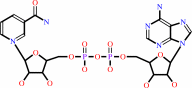 NAD(+)
|
+
|
H2O
|
=
|
2''-O-acetyl-ADP-D-ribose
|
+
|
 nicotinamide
|
+
|
L-lysyl-[protein]
Bound ligand (Het Group name = )
matches with 66.67% similarity
|
|
|
|
|
|
|
|
|
|
|
|
|
Molecule diagrams generated from .mol files obtained from the
KEGG ftp site
|
|
|
|
|
|
|
|
|
|
|
|
|
|
 |
|
|
|
|
|
|
| |
|
|
| |
|
DOI no:
|
Biochemistry
45:7511-7521
(2006)
|
|
PubMed id:
|
|
|
|
|
|
| |
|
The structural basis of sirtuin substrate affinity.
|
|
M.S.Cosgrove,
K.Bever,
J.L.Avalos,
S.Muhammad,
X.Zhang,
C.Wolberger.
|
|
|
|
|
| |
ABSTRACT
|
|
|
|
| |
|
|
Sirtuins comprise a family of enzymes that catalyze the deacetylation of
acetyllysine side chains in a reaction that consumes NAD+. Although several
crystal structures of sirtuins bound to non-native acetyl peptides have been
determined, relatively little about how sirtuins discriminate among different
substrates is understood. We have carried out a systematic structural and
thermodynamic analysis of several peptides bound to a single sirtuin, the Sir2
homologue from Thermatoga maritima (Sir2Tm). We report structures of five
different forms of Sir2Tm: two forms bound to the p53 C-terminal tail in the
acetylated and unacetylated states, two forms bound to putative acetyl peptide
substrates derived from the structured domains of histones H3 and H4, and one
form bound to polypropylene glycol (PPG), which resembles the apoenzyme. The
structures reveal previously unobserved complementary side chain interactions
between Sir2Tm and the first residue N-terminal to the acetyllysine (position
-1) and the second residue C-terminal to the acetyllysine (position +2).
Isothermal titration calorimetry was used to compare binding constants between
wild-type and mutant forms of Sir2Tm and between additional acetyl peptide
substrates with substitutions at positions -1 and +2. The results are consistent
with a model in which peptide positions -1 and +2 play a significant role in
sirtuin substrate binding. This model provides a framework for identifying
sirtuin substrates.
|
|
|
|
|
|
|
|
|
|
|
|
|
|
|
|
|
|
 |
 |
 |
|
Literature references that cite this PDB file's key reference
|
|
|
| |
PubMed id
|
|
Reference
|
|
|
|
|
|
G.Schreiber,
and
A.E.Keating
(2011).
Protein binding specificity versus promiscuity.
|
| |
Curr Opin Struct Biol,
21,
50-61.
|
|
|
|
|
|
|
P.Bheda,
J.T.Wang,
J.C.Escalante-Semerena,
and
C.Wolberger
(2011).
Structure of Sir2Tm bound to a propionylated peptide.
|
| |
Protein Sci,
20,
131-139.
|
|
|
PDB code:
|
|
|
|
|
|
|
|
A.K.Verma,
and
R.Pratap
(2010).
The biological potential of flavones.
|
| |
Nat Prod Rep,
27,
1571-1593.
|
|
|
|
|
|
|
H.Wurtele,
S.Tsao,
G.Lépine,
A.Mullick,
J.Tremblay,
P.Drogaris,
E.H.Lee,
P.Thibault,
A.Verreault,
and
M.Raymond
(2010).
Modulation of histone H3 lysine 56 acetylation as an antifungal therapeutic strategy.
|
| |
Nat Med,
16,
774-780.
|
|
|
|
|
|
|
K.S.Makarova,
Y.I.Wolf,
J.van der Oost,
and
E.V.Koonin
(2009).
Prokaryotic homologs of Argonaute proteins are predicted to function as key components of a novel system of defense against mobile genetic elements.
|
| |
Biol Direct,
4,
29.
|
|
|
|
|
|
|
L.Jin,
W.Wei,
Y.Jiang,
H.Peng,
J.Cai,
C.Mao,
H.Dai,
W.Choy,
J.E.Bemis,
M.R.Jirousek,
J.C.Milne,
C.H.Westphal,
and
R.B.Perni
(2009).
Crystal structures of human SIRT3 displaying substrate-induced conformational changes.
|
| |
J Biol Chem,
284,
24394-24405.
|
|
|
PDB codes:
|
|
|
|
|
|
|
|
W.F.Hawse,
and
C.Wolberger
(2009).
Structure-based mechanism of ADP-ribosylation by sirtuins.
|
| |
J Biol Chem,
284,
33654-33661.
|
|
|
|
|
|
|
O.Okhrimenko,
and
I.Jelesarov
(2008).
A survey of the year 2006 literature on applications of isothermal titration calorimetry.
|
| |
J Mol Recognit,
21,
1.
|
|
|
|
|
|
|
A.L.Holme,
and
S.Pervaiz
(2007).
Resveratrol in cell fate decisions.
|
| |
J Bioenerg Biomembr,
39,
59-63.
|
|
|
|
|
|
|
A.Schuetz,
J.Min,
T.Antoshenko,
C.L.Wang,
A.Allali-Hassani,
A.Dong,
P.Loppnau,
M.Vedadi,
A.Bochkarev,
R.Sternglanz,
and
A.N.Plotnikov
(2007).
Structural basis of inhibition of the human NAD+-dependent deacetylase SIRT5 by suramin.
|
| |
Structure,
15,
377-389.
|
|
|
PDB code:
|
|
|
|
|
|
|
|
M.S.Cosgrove
(2007).
Histone proteomics and the epigenetic regulation of nucleosome mobility.
|
| |
Expert Rev Proteomics,
4,
465-478.
|
|
|
|
|
|
The most recent references are shown first.
Citation data come partly from CiteXplore and partly
from an automated harvesting procedure. Note that this is likely to be
only a partial list as not all journals are covered by
either method. However, we are continually building up the citation data
so more and more references will be included with time.
Where a reference describes a PDB structure, the PDB
code is
shown on the right.
|
|


 Links
Links


