
|
|
|
|
|
 |
Contents |
 |
|
|
|
|
|
|
|
|
|
|
|
 235 a.a.
|
|
|
|
|
|
|
|
|
|
|
 281 a.a.
|
|
|
|
|
|
|
|
|
|
|
 300 a.a.
|
|
|
|
|
|
|
|
|
|
|
|
|
* Residue conservation analysis
|
|
|
|
|
|
PDB id:
|
|
|
|
| Name: |
|
Photosynthesis
|
|
|
Title:
|
|
The crystallization of reaction center from rhodobacter sphaeroides occurs via a new route
|
|
Structure:
|
|
Reaction center protein h chain. Chain: h. Fragment: reaction center protein h chain, cytoplasmic domain, residue 11-245. Synonym: photosynthetic reaction center h subunit. Reaction center protein l chain. Chain: l. Synonym: photosynthetic reaction center l subunit. Reaction center protein m chain.
|
|
Source:
|
|
Rhodobacter sphaeroides. Organism_taxid: 1063. Strain: r26. Other_details: lacking carotenoids. Other_details: lacking carotenoids
|
|
Biol. unit:
|
|
Trimer (from
)
|
|
Resolution:
|
|
|
2.20Å
|
R-factor:
|
0.200
|
R-free:
|
0.246
|
|
|
Authors:
|
|
P.Wadsten,A.B.Woehri,A.Snijder,G.Katona,A.T.Gardiner,R.J.Cogdell, R.Neutze,S.Engstroem
|
Key ref:

|
|
P.Wadsten
et al.
(2006).
Lipidic sponge phase crystallization of membrane proteins.
J Mol Biol,
364,
44-53.
PubMed id:
DOI:

|
|
|
Date:
|
|
|
11-Apr-06
|
Release date:
|
07-Nov-06
|
|
|
|
|
|
|
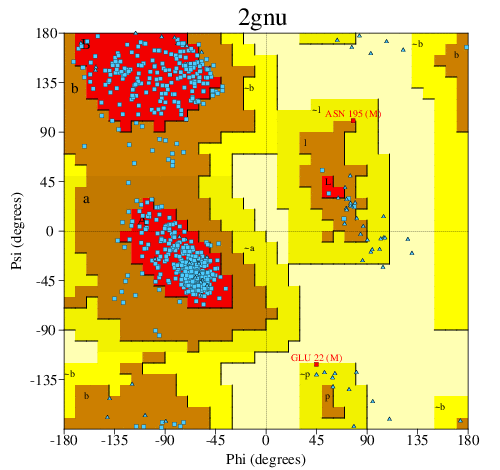
PROCHECK
|
|
|
|
|
|
Headers
|
|
|
|
References
|
|
|
|
|
|

|
|
Q7B302
(Q7B302_CERSP) -
Photosynthetic reaction center subunit H from Cereibacter sphaeroides
|
|
|
|
Seq:
Struc:
|
|
|
|
260 a.a.
235 a.a.
|
|

|

|
|
|
|
|
|
|
|
|
|
|
|
|
|
|
|
|
|
|
|
|
|
 |
|
|
|
|
|
|
| |
|
DOI no:
|
J Mol Biol
364:44-53
(2006)
|
|
PubMed id:
|
|
|
|
|
|
| |
|
Lipidic sponge phase crystallization of membrane proteins.
|
|
P.Wadsten,
A.B.Wöhri,
A.Snijder,
G.Katona,
A.T.Gardiner,
R.J.Cogdell,
R.Neutze,
S.Engström.
|
|
|
|
|
| |
ABSTRACT
|
|
|
|
| |
|
|
Bicontinuous lipidic cubic phases can be used as a host for growing crystals of
membrane proteins. Since the cubic phase is stiff, handling is difficult and
time-consuming. Moreover, the conventional cubic phase may interfere with the
hydrophilic domains of membrane proteins due to the limited size of the aqueous
pores. Here, we introduce a new crystallization method that makes use of a
liquid analogue of the cubic phase, the sponge phase. This phase facilitates a
considerable increase in the allowed size of aqueous domains of membrane
proteins, and is easily generalised to a conventional vapour diffusion
crystallisation experiment, including the use of nanoliter drop crystallization
robots. The appearance of the sponge phase was confirmed by visual inspection,
small-angle X-ray scattering and NMR spectroscopy. Crystals of the reaction
centre from Rhodobacter sphaeroides were obtained by a conventional hanging-drop
experiment, were harvested directly without the addition of lipase or
cryoprotectant, and the structure was refined to 2.2 Angstroms resolution. In
contrast to our earlier lipidic cubic phase reaction centre structure, the
mobile ubiquinone could be built and refined. The practical advantages of the
sponge phase make it a potent tool for crystallization of membrane proteins.
|
|
|
|
|
|
| |
Selected figure(s)
|
|
|
|
| |
|
|

|
|

|
|
Figure 2.
Figure 2. Crystals grown directly from the L[3] phase using
MO and buffer solution. (a) RC crystal fished directly from the
L[3] phase. (b) and (c) Crystals of RC grown in 20% jeffamine
M600 (pH 8.1).
|
|
Figure 4.
Figure 4. Q[B] binding sites of RCsph. All pictures are
represented in stereoview. (a) Arrangement of the cofactors Q[A]
and Q[B], subunits H, L, M and the location of the membrane in
RCsph. The colouring scheme is: H, L, M subunit (dark grey),
cofactors Q[A] (red), Q[B] (orange). The approximate position of
the membrane is indicated by the light grey square. (b) Refined
electron density for the Q[B] binding pocket. The 2F[o] – F[c]
map is contoured at 1σ. (c) Simulated-annealing omit map
omitting Q[B] contoured at 1σ. (d) Superposition of ubiquinone
in the Q[B] binding pocket. Colour code and PDB entries: red,
1YST;^43 light green, 1AIG;^45 dark green, 1AIJ;^45 blue,
1RG5;^44 orange, present structure 2GNU.
|
|
|
|
|
|
| |
The above figures are
reprinted
by permission from Elsevier:
J Mol Biol
(2006,
364,
44-53)
copyright 2006.
|
|
| |
Figures were
selected
by the author.
|
|
|
|
|
|
|
|
|
|
|
|
|
|
|
|
 |
 |
 |
|
Literature references that cite this PDB file's key reference
|
|
|
| |
PubMed id
|
|
Reference
|
|
|
|
|
|
C.V.Kulkarni,
W.Wachter,
G.Iglesias-Salto,
S.Engelskirchen,
and
S.Ahualli
(2011).
Monoolein: a magic lipid?
|
| |
Phys Chem Chem Phys,
13,
3004-3021.
|
|
|
|
|
|
|
D.J.Kissick,
E.J.Gualtieri,
G.J.Simpson,
and
V.Cherezov
(2010).
Nonlinear optical imaging of integral membrane protein crystals in lipidic mesophases.
|
| |
Anal Chem,
82,
491-497.
|
|
|
|
|
|
|
L.Li,
Q.Fu,
C.A.Kors,
L.Stewart,
P.Nollert,
P.D.Laible,
and
R.F.Ismagilov
(2010).
A Plug-Based Microfluidic System for Dispensing Lipidic Cubic Phase (LCP) Material Validated by Crystallizing Membrane Proteins in Lipidic Mesophases.
|
| |
Microfluid Nanofluidics,
8,
789-798.
|
|
|
|
|
|
|
M.Reffay,
Y.Gambin,
H.Benabdelhak,
G.Phan,
N.Taulier,
A.Ducruix,
R.S.Hodges,
and
W.Urbach
(2009).
Tracking membrane protein association in model membranes.
|
| |
PLoS ONE,
4,
e5035.
|
|
|
|
|
|
|
S.Raunser,
and
T.Walz
(2009).
Electron crystallography as a technique to study the structure on membrane proteins in a lipidic environment.
|
| |
Annu Rev Biophys,
38,
89.
|
|
|
|
|
|
|
A.B.Wöhri,
L.C.Johansson,
P.Wadsten-Hindrichsen,
W.Y.Wahlgren,
G.Fischer,
R.Horsefield,
G.Katona,
M.Nyblom,
F.Oberg,
G.Young,
R.J.Cogdell,
N.J.Fraser,
S.Engström,
and
R.Neutze
(2008).
A lipidic-sponge phase screen for membrane protein crystallization.
|
| |
Structure,
16,
1003-1009.
|
|
|
|
|
|
|
J.G.Mala,
and
S.Takeuchi
(2008).
Understanding structural features of microbial lipases-an overview.
|
| |
Anal Chem Insights,
3,
9.
|
|
|
|
|
|
The most recent references are shown first.
Citation data come partly from CiteXplore and partly
from an automated harvesting procedure. Note that this is likely to be
only a partial list as not all journals are covered by
either method. However, we are continually building up the citation data
so more and more references will be included with time.
|
 |
|


 Links
Links


