 |
PDBsum entry 2fwf

|
|
|
|
|
|

|

|

|

|
|

|
|

|
|

|
|

|
|
|
 |

|

|
|
|
|
|
|
|
|
|
|
|
|
|
|
|
|
|
|
|
|
|
|
|
|
|
|
|
|
|
|
|
|
|
Oxidoreductase
|
PDB id
|
|
|
|
2fwf
|
|
|
|
|
|
|
|
|
|
|
|
|
|
|

|

|

|
|
|
|
|
|
|
|
 |
Contents |
 |
|
|
|
|
|
|
|
|
|
|
|
|
* Residue conservation analysis
|
|
|
|
|
|
PDB id:
|
|
|
|
| Name: |
|
Oxidoreductase
|
|
|
Title:
|
|
High resolution crystal structure of thE C-terminal domain of the electron transfer catalyst dsbd (reduced form)
|
|
Structure:
|
|
Thiol:disulfide interchange protein dsbd. Chain: a. Fragment: c-terminal domain, residues 419-546. Synonym: protein-disulfide reductase, disulfide reductase, c-type cytochrome biogenesis protein cycz, inner membrane copper tolerance protein. Engineered: yes
|
|
Source:
|
|
Escherichia coli. Organism_taxid: 562. Gene: dsbd, dipz, cycz, cuta2, b4136. Expressed in: escherichia coli. Expression_system_taxid: 562.
|
|
Resolution:
|
|
|
1.30Å
|
R-factor:
|
0.170
|
R-free:
|
0.196
|
|
|
Authors:
|
|
C.U.Stirnimann,A.Rozhkova,U.Grauschopf,R.A.Boeckmann,R.Glockshuber, G.Capitani,M.G.Gruetter
|
Key ref:

|
|
C.U.Stirnimann
et al.
(2006).
High-resolution structures of Escherichia coli cDsbD in different redox states: A combined crystallographic, biochemical and computational study.
J Mol Biol,
358,
829-845.
PubMed id:
DOI:

|
|
|
Date:
|
|
|
02-Feb-06
|
Release date:
|
13-Jun-06
|
|
|
|
|
|
|
PROCHECK
|

|
|
|
|
|
Headers
|
|
|
|
References
|
|
|
|
|
|

|
|
P36655
(DSBD_ECOLI) -
Thiol:disulfide interchange protein DsbD from Escherichia coli (strain K12)
|
|
|
|
Seq:
Struc:
|
|
|
|
565 a.a.
123 a.a.
|
|

|

|
|
|
|
|
|
|
|
|
|
|
|
Key: |
|
 |
Secondary structure |
|
 |
CATH domain |
|
|
|
|
|
|
|
|
|
|
|
|
|
Enzyme class:
|
|
E.C.1.8.1.8
- protein-disulfide reductase.
|
|
|
|
|
|
|
Reaction:
|
|
|
1.
|
[protein]-dithiol + NAD+ = [protein]-disulfide + NADH + H+
|
|
2.
|
[protein]-dithiol + NADP+ = [protein]-disulfide + NADPH + H+
|
|
|
|
|
|
|
[protein]-dithiol
|
+
|
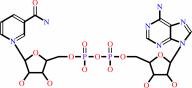 NAD(+)
|
=
|
[protein]-disulfide
|
+
|
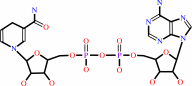 NADH
NADH
|
+
|
H(+)
|
|
|
|
|
|
|
[protein]-dithiol
|
+
|
 NADP(+)
|
=
|
[protein]-disulfide
|
+
|
 NADPH
NADPH
|
+
|
H(+)
|
|
|
|
|
|
|
|
|
|
|
|
|
Molecule diagrams generated from .mol files obtained from the
KEGG ftp site
|
|
|
|
|
|
|
|
|
|
|
|
|
|
 |
|
|
|
|
|
|
| |
|
|
| |
|
DOI no:
|
J Mol Biol
358:829-845
(2006)
|
|
PubMed id:
|
|
|
|
|
|
| |
|
High-resolution structures of Escherichia coli cDsbD in different redox states: A combined crystallographic, biochemical and computational study.
|
|
C.U.Stirnimann,
A.Rozhkova,
U.Grauschopf,
R.A.Böckmann,
R.Glockshuber,
G.Capitani,
M.G.Grütter.
|
|
|
|
|
| |
ABSTRACT
|
|
|
|
| |
|
|
Escherichia coli DsbD transports electrons from cytoplasmic thioredoxin to
periplasmic target proteins. DsbD is composed of an N-terminal (nDsbD) and a
C-terminal (cDsbD) periplasmic domain, connected by a central transmembrane
domain. Each domain possesses two cysteine residues essential for electron
transport. The transport proceeds via disulfide exchange reactions from
cytoplasmic thioredoxin to the central transmembrane domain and via cDsbD to
nDsbD, which then reduces the periplasmic target proteins. We determined four
high-resolution structures of cDsbD: oxidized (1.65 A resolution), chemically
reduced (1.3 A), photo-reduced (1.1 A) and chemically reduced at pH increased
from 4.6 to 7. The latter structure was refined at 0.99 A resolution, the
highest achieved so far for a thioredoxin superfamily member. The data reveal
unprecedented structural details of cDsbD, demonstrating that the domain is very
rigid and undergoes hardly any conformational change upon disulfide reduction or
interaction with nDsbD. In full agreement with the crystallographic results,
guanidinium chloride-induced unfolding and refolding experiments indicate that
oxidized and reduced cDsbD are equally stable. We confirmed the structural
rigidity of cDsbD by molecular dynamics simulations. A remarkable feature of
cDsbD is the pKa of 9.3 for the active site Cys461: this value, determined using
two different experimental methods, surprisingly was around 2.5 units higher
than expected on the basis of the redox potential. Additionally, taking
advantage of the very high quality of the cDsbD structures, we carried out pKa
calculations, which gave results in agreement with the experimental findings. In
conclusion, our wide-scope analysis of cDsbD, encompassing atomic-resolution
crystallography, computational chemistry and biophysical measurements,
highlighted two so far unrecognized key aspects of this domain: its unusual
redox properties and extreme rigidity. Both are likely to be correlated to the
role of cDsbD as a covalently linked electron shuttle between the membrane
domain and the N-terminal periplasmic domain of DsbD.
|
|
|
|
|
|
| |
Selected figure(s)
|
|
|
|
| |
|
|

|
|

|
|
Figure 2.
Figure 2. Mechanism of disulfide opening in crystals
induced by synchrotron radiation (adapted from Weik et al.37 and
Fauvodon et al.40).
|
|
Figure 6.
Figure 6. Reduced DsbA active site (green and atom colors)
superimposed onto the active site of cDsbD[red] (magenta and
atom colors).
|
|
|
|
|
|
| |
The above figures are
reprinted
by permission from Elsevier:
J Mol Biol
(2006,
358,
829-845)
copyright 2006.
|
|
| |
Figures were
selected
by an automated process.
|
|
|
|
|
|
|
|
|
|
|
|
|
|
|
|
 |
 |
 |
|
Literature references that cite this PDB file's key reference
|
|
|
| |
PubMed id
|
|
Reference
|
|
|
|
|
|
G.W.Tang,
and
R.B.Altman
(2011).
Remote thioredoxin recognition using evolutionary conservation and structural dynamics.
|
| |
Structure,
19,
461-470.
|
|
|
|
|
|
|
B.L.Schulz,
C.U.Stirnimann,
J.P.Grimshaw,
M.S.Brozzo,
F.Fritsch,
E.Mohorko,
G.Capitani,
R.Glockshuber,
M.G.Grütter,
and
M.Aebi
(2009).
Oxidoreductase activity of oligosaccharyltransferase subunits Ost3p and Ost6p defines site-specific glycosylation efficiency.
|
| |
Proc Natl Acad Sci U S A,
106,
11061-11066.
|
|
|
PDB codes:
|
|
|
|
|
|
|
|
D.A.Mavridou,
J.M.Stevens,
A.D.Goddard,
A.C.Willis,
S.J.Ferguson,
and
C.Redfield
(2009).
Control of Periplasmic Interdomain Thiol:Disulfide Exchange in the Transmembrane Oxidoreductase DsbD.
|
| |
J Biol Chem,
284,
3219-3226.
|
|
|
|
|
|
|
D.S.Berkholz,
H.R.Faber,
S.N.Savvides,
and
P.A.Karplus
(2008).
Catalytic cycle of human glutathione reductase near 1 A resolution.
|
| |
J Mol Biol,
382,
371-384.
|
|
|
PDB codes:
|
|
|
|
|
|
|
|
K.Maeda,
P.Hägglund,
C.Finnie,
B.Svensson,
and
A.Henriksen
(2008).
Crystal structures of barley thioredoxin h isoforms HvTrxh1 and HvTrxh2 reveal features involved in protein recognition and possibly in discriminating the isoform specificity.
|
| |
Protein Sci,
17,
1015-1024.
|
|
|
PDB codes:
|
|
|
|
|
|
|
|
B.Heras,
M.Kurz,
S.R.Shouldice,
and
J.L.Martin
(2007).
The name's bond......disulfide bond.
|
| |
Curr Opin Struct Biol,
17,
691-698.
|
|
|
|
|
|
|
K.O.Håkansson,
and
J.R.Winther
(2007).
Structure of glutaredoxin Grx1p C30S mutant from yeast.
|
| |
Acta Crystallogr D Biol Crystallogr,
63,
288-294.
|
|
|
PDB codes:
|
|
|
|
|
|
|
|
A.Lewin,
A.Crow,
A.Oubrie,
and
N.E.Le Brun
(2006).
Molecular basis for specificity of the extracytoplasmic thioredoxin ResA.
|
| |
J Biol Chem,
281,
35467-35477.
|
|
|
PDB codes:
|
|
|
|
|
|
|
The most recent references are shown first.
Citation data come partly from CiteXplore and partly
from an automated harvesting procedure. Note that this is likely to be
only a partial list as not all journals are covered by
either method. However, we are continually building up the citation data
so more and more references will be included with time.
Where a reference describes a PDB structure, the PDB
codes are
shown on the right.
|
|


 Links
Links


