 |
PDBsum entry 2f3r

|
|
|
|
|
 |
Contents |
 |
|
|
|
|
|
|
|
|
|
|
|
|
* Residue conservation analysis
|
|
|
|
|
|
|
|
|
|
|
Enzyme class:
|
|
E.C.2.7.4.8
- guanylate kinase.
|
|
|
|
|
|
|
Reaction:
|
|
GMP + ATP = GDP + ADP
|
|
|
|
|
|
GMP
Bound ligand (Het Group name = )
matches with 53.45% similarity
|
+
|
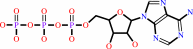 ATP
ATP
|
=
|
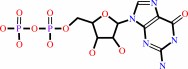 GDP
GDP
|
+
|
 ADP
ADP
|
|
|
|
|
|
|
|
|
|
|
|
|
Molecule diagrams generated from .mol files obtained from the
KEGG ftp site
|
|
|
|
|
|
|
|
|
|
|
|
|
|
 |
|
|
|
|
|
|
| |
|
|
| |
|
DOI no:
|
Biochimie
88:1157-1164
(2006)
|
|
PubMed id:
|
|
|
|
|
|
| |
|
Crystal structures of GMP kinase in complex with ganciclovir monophosphate and Ap5G.
|
|
G.Hible,
P.Daalova,
A.M.Gilles,
J.Cherfils.
|
|
|
|
|
| |
ABSTRACT
|
|
|
|
| |
|
|
Guanosine monophosphate kinases (GMPK), by catalyzing the phosphorylation of GMP
or dGMP, are of dual potential in assisting the activation of anti-viral
prodrugs or as candidates for antibiotic strategies. Human GMPK is an obligate
step for the activation of acyclic guanosine analogs, such as ganciclovir, which
necessitate efficient phosphorylation, while GMPK from bacterial pathogens, in
which this enzyme is essential, are potential targets for therapeutic
inhibition. Here we analyze these two aspects of GMPK activity with the crystal
structures of Escherichia coli GMPK in complex with ganciclovir-monophosphate
(GCV-MP) and with a bi-substrate inhibitor, Ap5G. GCV-MP binds as GMP to the
GMP-binding domain, which is identical in E. coli and human GMPKs, but unlike
the natural substrate fails to stabilize the closed, catalytically-competent
conformation of this domain. Comparison with GMP- and GDP-bound GMPK structures
identifies the 2'hydroxyl of the ribose moiety as responsible for hooking the
GMP-binding domain onto the CORE domain. Absence of this hydroxyl in GCV-MP
impairs the stabilization of the active conformation, and explains why GCV-MP is
phosphorylated less efficiently than GMP, but as efficiently as dGMP. In
contrast, Ap5G is an efficient inhibitor of GMPK. The crystal structure shows
that Ap5G locks an incompletely closed conformation of the enzyme, in which the
adenine moiety is located outside its expected binding site. Instead, it binds
at a subunit interface that is unique to the bacterial enzyme, which is in
equilibrium between a dimeric and an hexameric form in solution. This suggests
that inhibitors could be designed to bind at this interface such as to prevent
nucleotide-induced domain closure. Altogether, these complexes point to domain
motions as critical components to be evaluated in therapeutic strategies
targeting NMP kinases, with opposite effects depending on whether efficient
phosphorylation or inhibition is being sought after.
|
|
|
|
|
|
|
|
|
|
|
|
|
|
|
|
|
|
 |
 |
 |
|
Literature references that cite this PDB file's key reference
|
|
|
| |
PubMed id
|
|
Reference
|
|
|
|
|
|
M.Kandeel,
and
Y.Kitade
(2011).
Binding dynamics and energetic insight into the molecular forces driving nucleotide binding by guanylate kinase.
|
| |
J Mol Recognit,
24,
322-332.
|
|
|
|
|
|
The most recent references are shown first.
Citation data come partly from CiteXplore and partly
from an automated harvesting procedure. Note that this is likely to be
only a partial list as not all journals are covered by
either method. However, we are continually building up the citation data
so more and more references will be included with time.
|
|


 Links
Links


