 |
PDBsum entry 2dv6

|
|
|
|
|
|

|

|

|

|
|

|
|

|
|

|
|

|
|

|
|
|
 |

|

|
|
|
|
|
|
|
|
|
|
|
|
|
|
|
|
|
|
|
|
|
|
|
|
|
|
|
|
|
|
|
|
|
|
Oxidoreductase
|
PDB id
|
|
|
|
2dv6
|
|
|
|
|
|
|
|
|
|
|
|
|
|
|

|

|

|
|
|
|
|
|
|
|
 |
Contents |
 |
|
|
|
|
|
|
|
|
|
|
|
|
* Residue conservation analysis
|
|
|
|
|
|
PDB id:
|
|
|
|
| Name: |
|
Oxidoreductase
|
|
|
Title:
|
|
Crystal structure of nitrite reductase from hyphomicrobium denitrificans
|
|
Structure:
|
|
Nitrite reductase. Chain: a, b, c, d, e, f. Ec: 1.7.2.1
|
|
Source:
|
|
Hyphomicrobium denitrificans. Organism_taxid: 53399. Strain: a3151
|
|
Resolution:
|
|
|
2.20Å
|
R-factor:
|
0.152
|
R-free:
|
0.165
|
|
|
Authors:
|
|
M.Nojiri,Y.Xie,T.Yamamoto,T.Inoue,S.Suzuki,Y.Kai
|
Key ref:

|
|
M.Nojiri
et al.
(2007).
Structure and function of a hexameric copper-containing nitrite reductase.
Proc Natl Acad Sci U S A,
104,
4315-4320.
PubMed id:
DOI:

|
|
|
Date:
|
|
|
28-Jul-06
|
Release date:
|
20-Feb-07
|
|
|
|
|
|
|
PROCHECK
|

|
|
|
|
|
Headers
|
|
|
|
References
|
|
|
|
|
|

|
|
Q8KKH4
(Q8KKH4_9HYPH) -
Copper-containing nitrite reductase from Hyphomicrobium denitrificans
|
|
|
|
Seq:
Struc:
|
|
|
|
486 a.a.
422 a.a.
|
|

|

|

|
|
|
|
|
|
|
|
|
|
|
Key: |
 |
PfamA domain |
|
|
 |
Secondary structure |
|
 |
CATH domain |
|
|
|
|
|
|
|
|
|
|
|
|
|
Enzyme class:
|
|
E.C.1.7.2.1
- nitrite reductase (NO-forming).
|
|
|
|
|
|
|
Reaction:
|
|
nitric oxide + Fe(III)-[cytochrome c] + H2O = Fe(II)-[cytochrome c] + nitrite + 2 H+
|
|
|
|
|
|
 nitric oxide
|
+
|
Fe(III)-[cytochrome c]
|
+
|
H2O
|
=
|
Fe(II)-[cytochrome c]
|
+
|
 nitrite
|
+
|
2
×
H(+)
|
|
|
|
|
|
|
|
|
|
Cofactor:
|
|
Cu cation or Fe cation; FAD
|
|
|
|
|
|
Cu cation
|
or
|
Fe cation
|
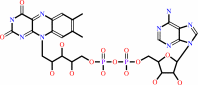 FAD
FAD
|
|
|
|
|
|
|
Molecule diagrams generated from .mol files obtained from the
KEGG ftp site
|
|
|
|
|
|
|
|
|
|
|
|
|
|
 |
|
|
|
|
|
|
| |
|
|
| |
|
DOI no:
|
Proc Natl Acad Sci U S A
104:4315-4320
(2007)
|
|
PubMed id:
|
|
|
|
|
|
| |
|
Structure and function of a hexameric copper-containing nitrite reductase.
|
|
M.Nojiri,
Y.Xie,
T.Inoue,
T.Yamamoto,
H.Matsumura,
K.Kataoka,
Deligeer,
K.Yamaguchi,
Y.Kai,
S.Suzuki.
|
|
|
|
|
| |
ABSTRACT
|
|
|
|
| |
|
|
Dissimilatory nitrite reductase (NIR) is a key enzyme in denitrification,
catalyzing the first step that leads to gaseous products (NO, N(2)O, and N(2)).
We have determined the crystal structure of a Cu-containing NIR from a
methylotrophic denitrifying bacterium, Hyphomicrobium denitrificans, at 2.2-A
resolution. The overall structure of this H. denitrificans NIR reveals a
trigonal prism-shaped molecule in which a monomer consisting of 447 residues and
three Cu atoms is organized into a unique hexamer (i.e., a tightly associated
dimer of trimers). Each monomer is composed of an N-terminal region containing a
Greek key beta-barrel folding domain, cupredoxin domain I, and a C-terminal
region containing cupredoxin domains II and III. Both cupredoxin domains I and
II bind one type 1 Cu and are combined with a long loop comprising 31 amino acid
residues. The type 2 Cu is ligated at the interface between domain II of one
monomer and domain III of an adjacent monomer. Between the two trimeric
C-terminal regions are three interfaces formed by an interaction between the
domains I, and the type 1 Cu in the domain is required for dimerization of the
trimer. The type 1 Cu in domain II functions as an electron acceptor from an
electron donor protein and then transfers an electron to the type 2 Cu, binding
the substrate to reduce nitrite to NO. The discussion of the intermolecular
electron transfer process from cytochrome c(550) to the H. denitrificans NIR is
based on x-ray crystallographic and kinetic results.
|
|
|
|
|
|
| |
Selected figure(s)
|
|
|
|
| |
|
|

|
|

|
|
Figure 2.
Fig. 2. Cu centers in HdNIR. (a) Arrangement of the type 1
Cu[N], type 1 Cu[C], and type 2 Cu in the HdNIR molecule shown
in the same orientation as in Fig. 1a. Blue, green, and gray
spheres represent the type 1 Cu[N], type 1 Cu[C], and type 2 Cu,
respectively. The figure was created by using PyMOL. (b and c
Left) 2F[o] – F[c] difference maps for the Cu sites contoured
at the 1.0  (light blue) and 6.5
levels (dark blue).
(Right) Ball-and-stick representation of the same sites. The
His-416 residue comes from the adjacent cupredoxin domain III.
The figures were created by using TURBO-FRODO
(www.afmb.univ-mrs.fr/-TURBO). Wat, Water molecule. (light blue) and 6.5
levels (dark blue).
(Right) Ball-and-stick representation of the same sites. The
His-416 residue comes from the adjacent cupredoxin domain III.
The figures were created by using TURBO-FRODO
(www.afmb.univ-mrs.fr/-TURBO). Wat, Water molecule.
|
|
Figure 6.
Fig. 6. The molecular surface accessible for an electron
donor protein. (a) The negatively and positively charged
surfaces are shown in red and blue, respectively. (b) The blue,
green, and gray spheres represent the type 1 Cu[N], type 1
Cu[C], and type 2 Cu, respectively. The Gln-76 and Glu-172
residues are located on the molecular surfaces of the N-terminal
and C-terminal regions, respectively, which belong in the
different monomers. The figure was created by using PyMOL.
Surface electrostatic potential was calculated by using PyMOL
APBS (http://apbs.sourceforge.net) tools.
|
|
|
|
| |
Figures were
selected
by an automated process.
|
|
|
|
|
|
|
|
|
|
|
|
|
|
|
|
 |
 |
 |
|
Literature references that cite this PDB file's key reference
|
|
|
| |
PubMed id
|
|
Reference
|
|
|
|
|
|
R.Bartossek,
G.W.Nicol,
A.Lanzen,
H.P.Klenk,
and
C.Schleper
(2010).
Homologues of nitrite reductases in ammonia-oxidizing archaea: diversity and genomic context.
|
| |
Environ Microbiol,
12,
1075-1088.
|
|
|
|
|
|
|
D.Hira,
M.Nojiri,
and
S.Suzuki
(2009).
Crystallization and preliminary X-ray diffraction analysis of a complex between the electron-transfer partners hexameric Cu-containing nitrite reductase and pseudoazurin.
|
| |
Acta Crystallogr Sect F Struct Biol Cryst Commun,
65,
116-119.
|
|
|
|
|
|
|
M.Nojiri,
F.Shirota,
D.Hira,
and
S.Suzuki
(2009).
Expression, purification, crystallization and preliminary X-ray diffraction analysis of the soluble domain of PPA0092, a putative nitrite reductase from Propionibacterium acnes.
|
| |
Acta Crystallogr Sect F Struct Biol Cryst Commun,
65,
123-127.
|
|
|
|
|
|
|
S.Ghosh,
A.Dey,
Y.Sun,
C.P.Scholes,
and
E.I.Solomon
(2009).
Spectroscopic and computational studies of nitrite reductase: proton induced electron transfer and backbonding contributions to reactivity.
|
| |
J Am Chem Soc,
131,
277-288.
|
|
|
|
|
|
|
C.M.Jones,
B.Stres,
M.Rosenquist,
and
S.Hallin
(2008).
Phylogenetic analysis of nitrite, nitric oxide, and nitrous oxide respiratory enzymes reveal a complex evolutionary history for denitrification.
|
| |
Mol Biol Evol,
25,
1955-1966.
|
|
|
|
|
|
|
M.J.Ellis,
J.G.Grossmann,
R.R.Eady,
and
S.S.Hasnain
(2007).
Genomic analysis reveals widespread occurrence of new classes of copper nitrite reductases.
|
| |
J Biol Inorg Chem,
12,
1119-1127.
|
|
|
|
|
|
The most recent references are shown first.
Citation data come partly from CiteXplore and partly
from an automated harvesting procedure. Note that this is likely to be
only a partial list as not all journals are covered by
either method. However, we are continually building up the citation data
so more and more references will be included with time.
|
|


 Links
Links


