|
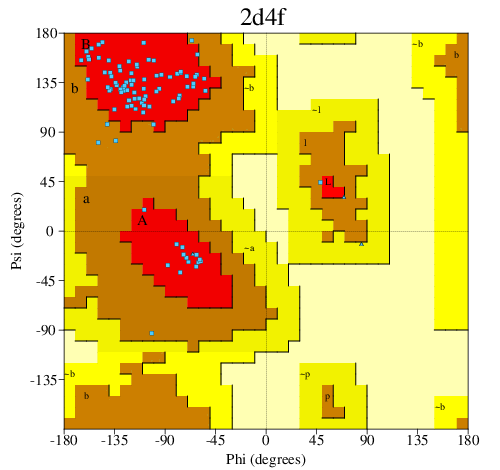
PDBsum entry 2d4f

|
|
|
|
|
|

|

|

|

|
|

|
|

|
|

|
|
|
 |

|

|
|
|
|
|
|
|
|
|
|
|
|
|
|
|
|
|
|
|
|
|
|
|
|
|
|
|
|
|
|
|
|
Immune system
|
PDB id
|
|
|
|
2d4f
|
|
|
|
|
|
|
|
|
|
|
|
|
|
|

|

|

|
|
|
|
|
|
|
|
 |
Contents |
 |
|
|
|
|
|
|
|
|
|
|
|
|
* Residue conservation analysis
|
|
|
|
|
|
|
|
|
|
|
|
|
|
|
 |
|
|
|
|
|
|
| |
|
DOI no:
|
J Biol Chem
281:31061-31069
(2006)
|
|
PubMed id:
|
|
|
|
|
|
| |
|
Conformation of amyloid fibrils of beta2-microglobulin probed by tryptophan mutagenesis.
|
|
M.Kihara,
E.Chatani,
K.Iwata,
K.Yamamoto,
T.Matsuura,
A.Nakagawa,
H.Naiki,
Y.Goto.
|
|
|
|
|
| |
ABSTRACT
|
|
|
|
| |
|
|
Beta2-microglobulin (beta2-m), a protein responsible for dialysis-related
amyloidosis, adopts an immunoglobulin domain fold in its native state. Although
beta2-m has Trp residues at positions 60 and 95, both are located near the
surface of the domain. Hence, beta2-m does not have a conserved Trp common to
other immunoglobulin domains, which is buried in close proximity to the
disulfide bond. To study the structure of amyloid fibrils in relation to their
native fold, we prepared a series of Trp mutants. Trp60 and Trp95 were both
replaced with Phe, and a single Trp was introduced at various positions. Among
various mutants, W39-beta2-m, in which a Trp was introduced at the position
corresponding to the conserved Trp, exhibited a remarkable quenching of
fluorescence in the native state, as observed for other immunoglobulin domains.
An x-ray structural analysis revealed that W39-beta2-m assumes the native fold
with Trp39 located in the vicinity of the disulfide bond. Comparison of the
fluorescence spectra of various mutants for the native and fibrillar forms
indicated that, while the Trp residues introduced in the middle of the beta2-m
sequence tend to be buried in the fibrils, those located in the C-terminal
region are more exposed. In addition, the fluorescence spectra of fibrils
prepared at pH 2.5 and 7.0 revealed a large difference in the fluorescence
intensity for W60-beta2-m, implying a major structural difference between them.
|
|
|
|
|
|
| |
Selected figure(s)
|
|
|
|
| |
|
|

|
|

|
|
Figure 1.
FIGURE 1. Structure of  2-m and location of
mutations introduced. A, amino acid sequence. Trp^60 and Trp^95
are indicated in red and orange, respectively. Residues mutated
to Trp are Leu^39 (green), Ser^33 (cyan), Val^49 (blue), and
Tyr^78 (purple). A Met is always present at the N terminus of
all the 2-ms, which is indicated
as M0. B, schematic structure. Side chains of Trp^60 and Trp^95
and the residues mutated to Trp are indicated with the same
colors as in A. Secondary structures are indicated by hydrogen
bonds (A) and the numbering of -strands (A and B). The
schematic structure was produced using MOLMOL (43) with our
structure (PDB code 2D4F). 2-m and location of
mutations introduced. A, amino acid sequence. Trp^60 and Trp^95
are indicated in red and orange, respectively. Residues mutated
to Trp are Leu^39 (green), Ser^33 (cyan), Val^49 (blue), and
Tyr^78 (purple). A Met is always present at the N terminus of
all the 2-ms, which is indicated
as M0. B, schematic structure. Side chains of Trp^60 and Trp^95
and the residues mutated to Trp are indicated with the same
colors as in A. Secondary structures are indicated by hydrogen
bonds (A) and the numbering of -strands (A and B). The
schematic structure was produced using MOLMOL (43) with our
structure (PDB code 2D4F).
|
|
Figure 7.
FIGURE 7. AFM and total internal reflection fluorescence
microscopic images of amyloid fibrils. A-D, AFM images of
amyloid fibrils of wild-type 2-m (A and B) and W39-
2-m
(C and D) prepared at pH 2.5 (A and C)or pH 7.0 (B and D). E and
F, total internal reflection fluorescence microscopic images of
W39- 2-m prepared at pH 2.5
(E)or pH 7.0 (F). The side of an AFM image is 5-µm long
and that of a fluorescence micrograph is 20 µm.
|
|
|
|
|
|
| |
The above figures are
reprinted
by permission from the ASBMB:
J Biol Chem
(2006,
281,
31061-31069)
copyright 2006.
|
|
| |
Figures were
selected
by an automated process.
|
|
|
|
|
|
|
|
|
|
|
|
|
|
|
|
 |
 |
 |
|
Literature references that cite this PDB file's key reference
|
|
|
| |
PubMed id
|
|
Reference
|
|
|
|
|
|
A.Corazza,
E.Rennella,
P.Schanda,
M.C.Mimmi,
T.Cutuil,
S.Raimondi,
S.Giorgetti,
F.Fogolari,
P.Viglino,
L.Frydman,
M.Gal,
V.Bellotti,
B.Brutscher,
and
G.Esposito
(2010).
Native-unlike long-lived intermediates along the folding pathway of the amyloidogenic protein beta2-microglobulin revealed by real-time two-dimensional NMR.
|
| |
J Biol Chem,
285,
5827-5835.
|
|
|
|
|
|
|
C.L.Ladner,
M.Chen,
D.P.Smith,
G.W.Platt,
S.E.Radford,
and
R.Langen
(2010).
Stacked sets of parallel, in-register beta-strands of beta2-microglobulin in amyloid fibrils revealed by site-directed spin labeling and chemical labeling.
|
| |
J Biol Chem,
285,
17137-17147.
|
|
|
|
|
|
|
C.Santambrogio,
S.Ricagno,
M.Colombo,
A.Barbiroli,
F.Bonomi,
V.Bellotti,
M.Bolognesi,
and
R.Grandori
(2010).
DE-loop mutations affect beta2 microglobulin stability, oligomerization, and the low-pH unfolded form.
|
| |
Protein Sci,
19,
1386-1394.
|
|
|
|
|
|
|
V.L.Mendoza,
K.Antwi,
M.A.Barón-Rodríguez,
C.Blanco,
and
R.W.Vachet
(2010).
Structure of the preamyloid dimer of beta-2-microglobulin from covalent labeling and mass spectrometry.
|
| |
Biochemistry,
49,
1522-1532.
|
|
|
|
|
|
|
G.W.Platt,
and
S.E.Radford
(2009).
Glimpses of the molecular mechanisms of beta2-microglobulin fibril formation in vitro: aggregation on a complex energy landscape.
|
| |
FEBS Lett,
583,
2623-2629.
|
|
|
|
|
|
|
L.J.Gourlay,
I.Santi,
A.Pezzicoli,
G.Grandi,
M.Soriani,
and
M.Bolognesi
(2009).
Group B streptococcus pullulanase crystal structures in the context of a novel strategy for vaccine development.
|
| |
J Bacteriol,
191,
3544-3552.
|
|
|
PDB codes:
|
|
|
|
|
|
|
The most recent references are shown first.
Citation data come partly from CiteXplore and partly
from an automated harvesting procedure. Note that this is likely to be
only a partial list as not all journals are covered by
either method. However, we are continually building up the citation data
so more and more references will be included with time.
Where a reference describes a PDB structure, the PDB
codes are
shown on the right.
|
|


 Links
Links