
|
|
|
|
|
 |
Contents |
 |
|
|
|
|
|
|
|
|
|
|
|
 93 a.a.
|
|
|
|
|
|
|
|
|
|
|
 110 a.a.
|
|
|
|
|
|
|
|
|
|
|
 66 a.a.
|
|
|
|
|
|
|
|
|
|
|
 100 a.a.
|
|
|
|
|
|
|
|
|
* Residue conservation analysis
|
|
|
|
|
|
PDB id:
|
|
|
|
| Name: |
|
Ribosome
|
|
|
Title:
|
|
Structure of ribosome binding domain of the trigger factor on the 50s ribosomal subunit from d. Radiodurans
|
|
Structure:
|
|
23s ribosomal RNA. Chain: 0. 50s ribosomal protein l23. Chain: r. 50s ribosomal protein l24. Chain: s. 50s ribosomal protein l29. Chain: w. Trigger factor.
|
|
Source:
|
|
Deinococcus radiodurans. Organism_taxid: 1299. Expressed in: escherichia coli. Expression_system_taxid: 562
|
|
Biol. unit:
|
|
Pentamer (from
)
|
|
Resolution:
|
|
|
3.35Å
|
R-factor:
|
0.299
|
R-free:
|
0.322
|
|
|
Authors:
|
|
F.Schluenzen,D.N.Wilson,H.A.Hansen,P.Tian,J.M.Harms,S.J.Mcinnes, R.Albrecht,J.Buerger,S.M.Wilbanks,P.Fucini
|
Key ref:

|
|
F.Schlünzen
et al.
(2005).
The binding mode of the trigger factor on the ribosome: implications for protein folding and SRP interaction.
Structure (Camb),
13,
1685-1694.
PubMed id:
DOI:

|
|
|
Date:
|
|
|
30-Sep-05
|
Release date:
|
06-Dec-05
|
|
|
|
|
|
|
PROCHECK
|

|
|
|
|
|
Headers
|
|
|
|
References
|
|
|
|
|
|

|
|
Q9RXK0
(RL23_DEIRA) -
Large ribosomal subunit protein uL23 from Deinococcus radiodurans (strain ATCC 13939 / DSM 20539 / JCM 16871 / CCUG 27074 / LMG 4051 / NBRC 15346 / NCIMB 9279 / VKM B-1422 / R1)
|
|
|
|
Seq:
Struc:
|
|
|
|
95 a.a.
93 a.a.
|
|

|

|
|
|
|
|
|
|
|
|
|
|
|
|

|
|
Q9RXJ1
(RL24_DEIRA) -
Large ribosomal subunit protein uL24 from Deinococcus radiodurans (strain ATCC 13939 / DSM 20539 / JCM 16871 / CCUG 27074 / LMG 4051 / NBRC 15346 / NCIMB 9279 / VKM B-1422 / R1)
|
|
|
|
Seq:
Struc:
|
|
|
|
115 a.a.
110 a.a.
|
|
|

|
|
|
|
|
|
|
|
|
|
|
|
|
|
|
|
|
|
Enzyme class 1:
|
|
Chain 1:
E.C.5.2.1.8
- peptidylprolyl isomerase.
|
|
|
|
|
|
|
Reaction:
|
|
[protein]-peptidylproline (omega=180) = [protein]-peptidylproline (omega=0)
|
|
|
|
|
|
 Peptidylproline (omega=180)
|
=
|
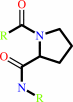 peptidylproline (omega=0)
|
|
|
|
|
|
|
|
|
|
Enzyme class 2:
|
|
Chains R, S, W:
E.C.?
|
|
|
|
|
|
|
|
|
|
Note, where more than one E.C. class is given (as above), each may
correspond to a different protein domain or, in the case of polyprotein
precursors, to a different mature protein.
|
|
|
|
Molecule diagrams generated from .mol files obtained from the
KEGG ftp site
|
|
|
|
|
|
|
|
|
|
|
|
|
|
 |
|
|
|
|
|
|
| |
|
|
| |
|
DOI no:
|
Structure (Camb)
13:1685-1694
(2005)
|
|
PubMed id:
|
|
|
|
|
|
| |
|
The binding mode of the trigger factor on the ribosome: implications for protein folding and SRP interaction.
|
|
F.Schlünzen,
D.N.Wilson,
P.Tian,
J.M.Harms,
S.J.McInnes,
H.A.Hansen,
R.Albrecht,
J.Buerger,
S.M.Wilbanks,
P.Fucini.
|
|
|
|
|
| |
ABSTRACT
|
|
|
|
| |
|
|
This study presents the X-ray structure of the N-terminal binding domain of the
D. radiodurans trigger factor (TF) in complex with the D. radiodurans large
ribosomal subunit. At 3.35 A, a complete description of the interactions with
ribosomal proteins L23, L29, and 23S rRNA are disclosed, many of which differ
from those found previously for a heterologous bacterial-archaeal TF-ribosome
complex. The beta hairpin loop of eubacterial L24, which is shorter in archaeal
ribosomes, contacts the TF and severely diminishes the molecular cradle proposed
to exist between the TF and ribosome. Bound to the ribosome, TF exposes a
hydrophobic crevice large enough to accommodate the nascent polypeptide chain.
Superimposition of the full-length TF and the signal-recognition particle (SRP)
onto the complex shows that simultaneous cohabitation is possible, in agreement
with biochemical data, and suggests a model for the interplay of TF, SRP, and
the nascent chain during translation.
|
|
|
|
|
|
| |
Selected figure(s)
|
|
|
|
| |
|
|

|
|
Figure 5.
Figure 5. Model for Interplay between the TF, SRP, and the
Nascent Chain during Translation
Schematic view of the
bottom of the ribosome, showing ribosomal proteins L23, (green),
L24 (yellow), and L29 (orange), and with the tunnel exit site
indicated with an arrow. (A) TF is the first chaperone to bind
to the bacterial ribosome as the nascent chain emerges from the
tunnel. Direct contact between L24 and the TF results in
conformational changes in the TF-BD that expose a hydrophobic
crevice located in the TF-BD, through which the polypeptide
chain can pass. (B) The SRP particle binds to the ribosome in
the presence of the TF, initially through contacts with L29. The
M domain of the SRP covers the hydrophobic cavity in the TF-BD
and monitors for the presence of a signal sequence in the
nascent chain. (C) Interaction between the signal
sequence-containing nascent chain and the M domain of the SRP
enables the M domain to establish contact with H24 of the 23S
rRNA. This interaction stabilizes the SRP particle on the
ribosome and could lead to dissociation of the TF. (D) In the
absence of a signal sequence, the M domain cannot establish
contact with the 23S rRNA, and the SRP dissociates from the
ribosome. Continued translation leads to elongation of the
nascent chain, which is channeled through the hydrophobic cavity
into the central cavity (body) of the TF. The restricted size of
the cavity due to the presence of L24 limits the possibility for
folding of entire protein domains. The PPIase domain (head) of
the TF may recognize the nascent chain as it emerges from the
head side, monitoring for proline residues that need to be
isomerized (arrowed).
|
|
|
|
|
|
| |
The above figure is
reprinted
by permission from Cell Press:
Structure (Camb)
(2005,
13,
1685-1694)
copyright 2005.
|
|
| |
Figure was
selected
by an automated process.
|
|
|
|
|
|
|
|
|
|
|
|
|
|
|
|
 |
 |
 |
|
Literature references that cite this PDB file's key reference
|
|
|
| |
PubMed id
|
|
Reference
|
|
|
|
|
|
A.Hoffmann,
and
B.Bukau
(2009).
Trigger factor finds new jobs and contacts.
|
| |
Nat Struct Mol Biol,
16,
1006-1008.
|
|
|
|
|
|
|
A.Yonath
(2009).
Large facilities and the evolving ribosome, the cellular machine for genetic-code translation.
|
| |
J R Soc Interface,
6,
S575-S585.
|
|
|
|
|
|
|
C.Giglione,
S.Fieulaine,
and
T.Meinnel
(2009).
Cotranslational processing mechanisms: towards a dynamic 3D model.
|
| |
Trends Biochem Sci,
34,
417-426.
|
|
|
|
|
|
|
F.U.Hartl,
and
M.Hayer-Hartl
(2009).
Converging concepts of protein folding in vitro and in vivo.
|
| |
Nat Struct Mol Biol,
16,
574-581.
|
|
|
|
|
|
|
G.Kramer,
D.Boehringer,
N.Ban,
and
B.Bukau
(2009).
The ribosome as a platform for co-translational processing, folding and targeting of newly synthesized proteins.
|
| |
Nat Struct Mol Biol,
16,
589-597.
|
|
|
|
|
|
|
I.A.Buskiewicz,
J.Jöckel,
M.V.Rodnina,
and
W.Wintermeyer
(2009).
Conformation of the signal recognition particle in ribosomal targeting complexes.
|
| |
RNA,
15,
44-54.
|
|
|
|
|
|
|
J.L.Miller,
H.Cimen,
H.Koc,
and
E.C.Koc
(2009).
Phosphorylated proteins of the mammalian mitochondrial ribosome: implications in protein synthesis.
|
| |
J Proteome Res,
8,
4789-4798.
|
|
|
|
|
|
|
O.O.Panasenko,
F.P.David,
and
M.A.Collart
(2009).
Ribosome association and stability of the nascent polypeptide-associated complex is dependent upon its own ubiquitination.
|
| |
Genetics,
181,
447-460.
|
|
|
|
|
|
|
F.Merz,
D.Boehringer,
C.Schaffitzel,
S.Preissler,
A.Hoffmann,
T.Maier,
A.Rutkowska,
J.Lozza,
N.Ban,
B.Bukau,
and
E.Deuerling
(2008).
Molecular mechanism and structure of Trigger Factor bound to the translating ribosome.
|
| |
EMBO J,
27,
1622-1632.
|
|
|
PDB code:
|
|
|
|
|
|
|
|
K.Peisker,
D.Braun,
T.Wölfle,
J.Hentschel,
U.Fünfschilling,
G.Fischer,
A.Sickmann,
and
S.Rospert
(2008).
Ribosome-associated complex binds to ribosomes in close proximity of Rpl31 at the exit of the polypeptide tunnel in yeast.
|
| |
Mol Biol Cell,
19,
5279-5288.
|
|
|
|
|
|
|
T.A.Steitz
(2008).
A structural understanding of the dynamic ribosome machine.
|
| |
Nat Rev Mol Cell Biol,
9,
242-253.
|
|
|
|
|
|
|
E.Martinez-Hackert,
and
W.A.Hendrickson
(2007).
Structures of and interactions between domains of trigger factor from Thermotoga maritima.
|
| |
Acta Crystallogr D Biol Crystallogr,
63,
536-547.
|
|
|
PDB codes:
|
|
|
|
|
|
|
|
S.K.Lakshmipathy,
S.Tomic,
C.M.Kaiser,
H.C.Chang,
P.Genevaux,
C.Georgopoulos,
J.M.Barral,
A.E.Johnson,
F.U.Hartl,
and
S.A.Etchells
(2007).
Identification of nascent chain interaction sites on trigger factor.
|
| |
J Biol Chem,
282,
12186-12193.
|
|
|
|
|
|
|
Y.Shi,
D.J.Fan,
S.X.Li,
H.J.Zhang,
S.Perrett,
and
J.M.Zhou
(2007).
Identification of a potential hydrophobic peptide binding site in the C-terminal arm of trigger factor.
|
| |
Protein Sci,
16,
1165-1175.
|
|
|
|
|
|
|
A.Hoffmann,
F.Merz,
A.Rutkowska,
B.Zachmann-Brand,
E.Deuerling,
and
B.Bukau
(2006).
Trigger factor forms a protective shield for nascent polypeptides at the ribosome.
|
| |
J Biol Chem,
281,
6539-6545.
|
|
|
|
|
|
|
C.M.Kaiser,
H.C.Chang,
V.R.Agashe,
S.K.Lakshmipathy,
S.A.Etchells,
M.Hayer-Hartl,
F.U.Hartl,
and
J.M.Barral
(2006).
Real-time observation of trigger factor function on translating ribosomes.
|
| |
Nature,
444,
455-460.
|
|
|
|
|
|
|
G.Eisner,
M.Moser,
U.Schäfer,
K.Beck,
and
M.Müller
(2006).
Alternate recruitment of signal recognition particle and trigger factor to the signal sequence of a growing nascent polypeptide.
|
| |
J Biol Chem,
281,
7172-7179.
|
|
|
|
|
|
|
M.Halic,
M.Blau,
T.Becker,
T.Mielke,
M.R.Pool,
K.Wild,
I.Sinning,
and
R.Beckmann
(2006).
Following the signal sequence from ribosomal tunnel exit to signal recognition particle.
|
| |
Nature,
444,
507-511.
|
|
|
PDB codes:
|
|
|
|
|
|
|
|
J.H.Cate
(2005).
The ins and outs of protein synthesis.
|
| |
Structure,
13,
1584-1585.
|
|
|
|
|
|
The most recent references are shown first.
Citation data come partly from CiteXplore and partly
from an automated harvesting procedure. Note that this is likely to be
only a partial list as not all journals are covered by
either method. However, we are continually building up the citation data
so more and more references will be included with time.
Where a reference describes a PDB structure, the PDB
code is
shown on the right.
|

| |


 Links
Links


