 |
PDBsum entry 2c6c

|
|
|
|
|
 |
Contents |
 |
|
|
|
|
|
|
|
|
|
|
|
|
|
|
* Residue conservation analysis
|
|
|
|
|
|
PDB id:
|
|
|
|
| Name: |
|
Hydrolase
|
|
|
Title:
|
|
Membrane-bound glutamate carboxypeptidase ii (gcpii) in complex with gpi-18431 (s)-2-(4-iodobenzylphosphonomethyl)-pentanedioic acid
|
|
Structure:
|
|
Glutamate carboxypeptidase ii. Chain: a. Synonym: membrane glutamate carboxypeptidase, mgcp, n-acetylated- alpha-linked acidic dipeptidase i, naaladase i, pteroylpoly-gamma- glutamate carboxypeptidase, folylpoly-gamma-glutamate carboxypeptidase, fgcp, folate hydrolase 1, prostate-specific membrane antigen, psma, psm. Engineered: yes
|
|
Source:
|
|
Homo sapiens. Human. Organism_taxid: 9606. Organ: brain. Expressed in: drosophila melanogaster. Expression_system_taxid: 7227. Expression_system_cell_line: schneider's cells
|
|
Biol. unit:
|
|
 Dimer (from PDB file)
|
|
Resolution:
|
|
|
2.00Å
|
R-factor:
|
0.191
|
R-free:
|
0.225
|
|
|
Authors:
|
|
J.R.Mesters,C.Barinka,W.Li,T.Tsukamoto,P.Majer,B.S.Slusher, J.Konvalinka,R.Hilgenfeld
|
Key ref:

|
|
J.R.Mesters
et al.
(2006).
Structure of glutamate carboxypeptidase II, a drug target in neuronal damage and prostate cancer.
EMBO J,
25,
1375-1384.
PubMed id:
DOI:

|
|
|
Date:
|
|
|
09-Nov-05
|
Release date:
|
15-Feb-06
|
|
|
|
|
|
|
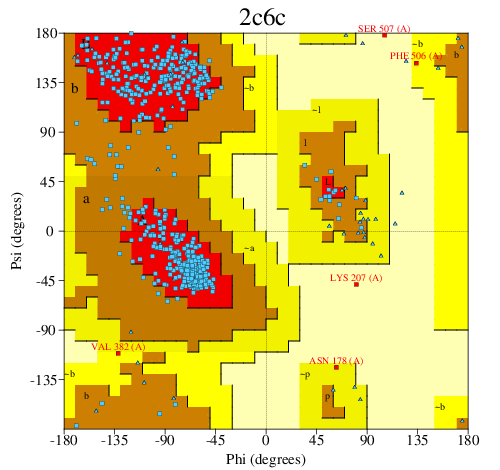
PROCHECK
|
|
|
|
|
|
Headers
|
|
|
|
References
|
|
|
|
|
|

|
|
Q04609
(FOLH1_HUMAN) -
Glutamate carboxypeptidase 2 from Homo sapiens
|
|
|
|
Seq:
Struc:
|
|
|
|
750 a.a.
682 a.a.
|
|

|

|
|
|
|
|
|
|
|
|
|
|
|
Key: |
 |
PfamA domain |
|
|
 |
Secondary structure |
|
 |
CATH domain |
|
|
|
|
|
|
|
|
|
|
|
|
|
Enzyme class:
|
|
E.C.3.4.17.21
- glutamate carboxypeptidase Ii.
|
|
|
|
|
|
|
Reaction:
|
|
Release of an unsubstituted, C-terminal glutamyl residue, typically from Ac-Asp-Glu or folylpoly-gamma-glutamates.
|
|
|
|
|
|
Cofactor:
|
|
Zn(2+)
|
|
|
|
|
|
|
|
|
|
|
|
|
|
|
|
|
|
 |
|
|
|
|
|
|
| |
|
DOI no:
|
EMBO J
25:1375-1384
(2006)
|
|
PubMed id:
|
|
|
|
|
|
| |
|
Structure of glutamate carboxypeptidase II, a drug target in neuronal damage and prostate cancer.
|
|
J.R.Mesters,
C.Barinka,
W.Li,
T.Tsukamoto,
P.Majer,
B.S.Slusher,
J.Konvalinka,
R.Hilgenfeld.
|
|
|
|
|
| |
ABSTRACT
|
|
|
|
| |
|
|
Membrane-bound glutamate carboxypeptidase II (GCPII) is a zinc metalloenzyme
that catalyzes the hydrolysis of the neurotransmitter
N-acetyl-L-aspartyl-L-glutamate (NAAG) to N-acetyl-L-aspartate and L-glutamate
(which is itself a neurotransmitter). Potent and selective GCPII inhibitors have
been shown to decrease brain glutamate and provide neuroprotection in
preclinical models of stroke, amyotrophic lateral sclerosis, and neuropathic
pain. Here, we report crystal structures of the extracellular part of GCPII in
complex with both potent and weak inhibitors and with glutamate, the product of
the enzyme's hydrolysis reaction, at 2.0, 2.4, and 2.2 A resolution,
respectively. GCPII folds into three domains: protease-like, apical, and
C-terminal. All three participate in substrate binding, with two of them
directly involved in C-terminal glutamate recognition. One of the carbohydrate
moieties of the enzyme is essential for homodimer formation of GCPII. The
three-dimensional structures presented here reveal an induced-fit
substrate-binding mode of this key enzyme and provide essential information for
the design of GCPII inhibitors useful in the treatment of neuronal diseases and
prostate cancer.
|
|
|
|
|
|
| |
Selected figure(s)
|
|
|
|
| |
|
|

|
|

|
|
Figure 3.
Figure 3 Surface representation of the  20
Å deep funnel leading to the catalytic site. Blue,
side-chain nitrogens of Arg and Lys residues; red, side-chain
oxygens of Asp and Glu; green, side-chain carbons of Tyr and Phe
residues. Yellow, Zn^2+ ions; inhibitors shown as stick models.
(A) Complex with GPI-18431; (B) complex with phosphate. Note the
difference in the shape of the pocket because of withdrawal of
the 'glutarate sensor' (Y700) in the phosphate complex. 20
Å deep funnel leading to the catalytic site. Blue,
side-chain nitrogens of Arg and Lys residues; red, side-chain
oxygens of Asp and Glu; green, side-chain carbons of Tyr and Phe
residues. Yellow, Zn^2+ ions; inhibitors shown as stick models.
(A) Complex with GPI-18431; (B) complex with phosphate. Note the
difference in the shape of the pocket because of withdrawal of
the 'glutarate sensor' (Y700) in the phosphate complex.
|
|
Figure 4.
Figure 4 2F[o]–F[c] electron density maps (stereo) contoured
at 1.2  ,
for the GCPII complex with GPI-18431 (A), phosphate (B), and
L-glutamate (C). Zinc ions are shown in dark green, chloride in
yellow. Ligands are shown using green sticks and atom-color
spheres. Note the different conformation of the 'glutarate
sensor' (Lys699 and Tyr700) in (B), which is caused by the
absence of a glutarate moiety in the phosphate complex. ,
for the GCPII complex with GPI-18431 (A), phosphate (B), and
L-glutamate (C). Zinc ions are shown in dark green, chloride in
yellow. Ligands are shown using green sticks and atom-color
spheres. Note the different conformation of the 'glutarate
sensor' (Lys699 and Tyr700) in (B), which is caused by the
absence of a glutarate moiety in the phosphate complex.
|
|
|
|
|
|
| |
The above figures are
reprinted
from an Open Access publication published by Macmillan Publishers Ltd:
EMBO J
(2006,
25,
1375-1384)
copyright 2006.
|
|
| |
Figures were
selected
by an automated process.
|
|
|
|
|
|
|
|
|
|
|
|
|
|
|
|
 |
 |
 |
|
Literature references that cite this PDB file's key reference
|
|
|
| |
PubMed id
|
|
Reference
|
|
|
|
|
|
B.R.Blank,
P.Alayoglu,
W.Engen,
J.K.Choi,
C.E.Berkman,
and
M.O.Anderson
(2011).
N-Substituted Glutamyl Sulfonamides as Inhibitors of Glutamate Carboxypeptidase II (GCP2).
|
| |
Chem Biol Drug Des,
77,
241-247.
|
|
|
|
|
|
|
C.H.Küchenthal,
and
W.Maison
(2010).
Antibody recruiting small molecules: a new option for prostate tumor therapy by PSMA targeting.
|
| |
Chembiochem,
11,
1052-1054.
|
|
|
|
|
|
|
H.Wang,
Y.Byun,
C.Barinka,
M.Pullambhatla,
H.E.Bhang,
J.J.Fox,
J.Lubkowski,
R.C.Mease,
and
M.G.Pomper
(2010).
Bioisosterism of urea-based GCPII inhibitors: Synthesis and structure-activity relationship studies.
|
| |
Bioorg Med Chem Lett,
20,
392-397.
|
|
|
PDB code:
|
|
|
|
|
|
|
|
K.Alt,
S.Wiehr,
W.Ehrlichmann,
G.Reischl,
P.Wolf,
B.J.Pichler,
U.Elsässer-Beile,
and
P.Bühler
(2010).
High-resolution animal PET imaging of prostate cancer xenografts with three different 64Cu-labeled antibodies against native cell-adherent PSMA.
|
| |
Prostate,
70,
1413-1421.
|
|
|
|
|
|
|
E.Bitto,
C.A.Bingman,
L.Bittova,
N.L.Houston,
R.S.Boston,
B.G.Fox,
and
G.N.Phillips
(2009).
X-ray structure of ILL2, an auxin-conjugate amidohydrolase from Arabidopsis thaliana.
|
| |
Proteins,
74,
61-71.
|
|
|
PDB code:
|
|
|
|
|
|
|
|
K.Hlouchova,
C.Barinka,
J.Konvalinka,
and
J.Lubkowski
(2009).
Structural insight into the evolutionary and pharmacologic homology of glutamate carboxypeptidases II and III.
|
| |
FEBS J,
276,
4448-4462.
|
|
|
PDB codes:
|
|
|
|
|
|
|
|
P.Bühler,
P.Wolf,
and
U.Elsässer-Beile
(2009).
Targeting the prostate-specific membrane antigen for prostate cancer therapy.
|
| |
Immunotherapy,
1,
471-481.
|
|
|
|
|
|
|
V.Humblet,
P.Misra,
K.R.Bhushan,
K.Nasr,
Y.S.Ko,
T.Tsukamoto,
N.Pannier,
J.V.Frangioni,
and
W.Maison
(2009).
Multivalent scaffolds for affinity maturation of small molecule cell surface binders and their application to prostate tumor targeting.
|
| |
J Med Chem,
52,
544-550.
|
|
|
|
|
|
|
C.Barinka,
K.Hlouchova,
M.Rovenska,
P.Majer,
M.Dauter,
N.Hin,
Y.S.Ko,
T.Tsukamoto,
B.S.Slusher,
J.Konvalinka,
and
J.Lubkowski
(2008).
Structural basis of interactions between human glutamate carboxypeptidase II and its substrate analogs.
|
| |
J Mol Biol,
376,
1438-1450.
|
|
|
PDB codes:
|
|
|
|
|
|
|
|
J.A.Rumbaugh,
J.Steiner,
N.Sacktor,
and
A.Nath
(2008).
Developing neuroprotective strategies for treatment of HIV-associated neurocognitive dysfunction.
|
| |
Futur HIV Ther,
2,
271-280.
|
|
|
|
|
|
|
L.Y.Wu,
J.C.Do,
M.Kazak,
H.Page,
Y.Toriyabe,
M.O.Anderson,
and
C.E.Berkman
(2008).
Phosphoramidate derivatives of hydroxysteroids as inhibitors of prostate-specific membrane antigen.
|
| |
Bioorg Med Chem Lett,
18,
281-284.
|
|
|
|
|
|
|
M.Rovenská,
K.Hlouchová,
P.Sácha,
P.Mlcochová,
V.Horák,
J.Zámecník,
C.Barinka,
and
J.Konvalinka
(2008).
Tissue expression and enzymologic characterization of human prostate specific membrane antigen and its rat and pig orthologs.
|
| |
Prostate,
68,
171-182.
|
|
|
|
|
|
|
P.Wolf,
K.Alt,
P.Bühler,
A.Katzenwadel,
U.Wetterauer,
M.Tacke,
and
U.Elsässer-Beile
(2008).
Anti-PSMA immunotoxin as novel treatment for prostate cancer? High and specific antitumor activity on human prostate xenograft tumors in SCID mice.
|
| |
Prostate,
68,
129-138.
|
|
|
|
|
|
|
T.Liu,
L.Y.Wu,
M.Kazak,
and
C.E.Berkman
(2008).
Cell-Surface labeling and internalization by a fluorescent inhibitor of prostate-specific membrane antigen.
|
| |
Prostate,
68,
955-964.
|
|
|
|
|
|
|
C.Barinka,
J.Starkova,
J.Konvalinka,
and
J.Lubkowski
(2007).
A high-resolution structure of ligand-free human glutamate carboxypeptidase II.
|
| |
Acta Crystallogr Sect F Struct Biol Cryst Commun,
63,
150-153.
|
|
|
PDB code:
|
|
|
|
|
|
|
|
J.R.Mesters,
K.Henning,
and
R.Hilgenfeld
(2007).
Human glutamate carboxypeptidase II inhibition: structures of GCPII in complex with two potent inhibitors, quisqualate and 2-PMPA.
|
| |
Acta Crystallogr D Biol Crystallogr,
63,
508-513.
|
|
|
PDB codes:
|
|
|
|
|
|
|
|
K.Hlouchová,
C.Barinka,
V.Klusák,
P.Sácha,
P.Mlcochová,
P.Majer,
L.Rulísek,
and
J.Konvalinka
(2007).
Biochemical characterization of human glutamate carboxypeptidase III.
|
| |
J Neurochem,
101,
682-696.
|
|
|
|
|
|
|
L.Y.Wu,
M.O.Anderson,
Y.Toriyabe,
J.Maung,
T.Y.Campbell,
C.Tajon,
M.Kazak,
J.Moser,
and
C.E.Berkman
(2007).
The molecular pruning of a phosphoramidate peptidomimetic inhibitor of prostate-specific membrane antigen.
|
| |
Bioorg Med Chem,
15,
7434-7443.
|
|
|
|
|
|
|
M.O.Anderson,
L.Y.Wu,
N.M.Santiago,
J.M.Moser,
J.A.Rowley,
E.S.Bolstad,
and
C.E.Berkman
(2007).
Substrate specificity of prostate-specific membrane antigen.
|
| |
Bioorg Med Chem,
15,
6678-6686.
|
|
|
|
|
|
|
P.Mlcochová,
A.Plechanovová,
C.Barinka,
D.Mahadevan,
J.W.Saldanha,
L.Rulísek,
and
J.Konvalinka
(2007).
Mapping of the active site of glutamate carboxypeptidase II by site-directed mutagenesis.
|
| |
FEBS J,
274,
4731-4741.
|
|
|
|
|
|
|
R.Bergeron,
Y.Imamura,
J.V.Frangioni,
R.W.Greene,
and
J.T.Coyle
(2007).
Endogenous N-acetylaspartylglutamate reduced NMDA receptor-dependent current neurotransmission in the CA1 area of the hippocampus.
|
| |
J Neurochem,
100,
346-357.
|
|
|
|
|
|
|
S.Moffett,
D.Mélançon,
G.DeCrescenzo,
C.St-Pierre,
F.Deschénes,
H.U.Saragovi,
P.Gold,
and
A.C.Cuello
(2007).
Preparation and characterization of new anti-PSMA monoclonal antibodies with potential clinical use.
|
| |
Hybridoma (Larchmt),
26,
363-372.
|
|
|
|
|
|
|
T.Tsukamoto,
K.M.Wozniak,
and
B.S.Slusher
(2007).
Progress in the discovery and development of glutamate carboxypeptidase II inhibitors.
|
| |
Drug Discov Today,
12,
767-776.
|
|
|
|
|
|
|
X.Wang,
L.Yin,
P.Rao,
R.Stein,
K.M.Harsch,
Z.Lee,
and
W.D.Heston
(2007).
Targeted treatment of prostate cancer.
|
| |
J Cell Biochem,
102,
571-579.
|
|
|
|
|
|
|
Y.F.Hershcovitz,
R.Gilboa,
V.Reiland,
G.Shoham,
and
Y.Shoham
(2007).
Catalytic mechanism of SGAP, a double-zinc aminopeptidase from Streptomyces griseus.
|
| |
FEBS J,
274,
3864-3876.
|
|
|
|
|
|
|
P.R.Mittl,
and
M.G.Grütter
(2006).
Opportunities for structure-based design of protease-directed drugs.
|
| |
Curr Opin Struct Biol,
16,
769-775.
|
|
|
|
|
|
The most recent references are shown first.
Citation data come partly from CiteXplore and partly
from an automated harvesting procedure. Note that this is likely to be
only a partial list as not all journals are covered by
either method. However, we are continually building up the citation data
so more and more references will be included with time.
Where a reference describes a PDB structure, the PDB
code is
shown on the right.
|
|


 Links
Links


