 |
PDBsum entry 2c3b

|
|
|
|
|
 |
Contents |
 |
|
|
|
|
|
|
|
|
|
|
|
|
* Residue conservation analysis
|
|
|
|
|
|
|
|
|
|
|
Enzyme class:
|
|
E.C.5.2.1.8
- peptidylprolyl isomerase.
|
|
|
|
|
|
|
Reaction:
|
|
[protein]-peptidylproline (omega=180) = [protein]-peptidylproline (omega=0)
|
|
|
|
|
|
 Peptidylproline (omega=180)
|
=
|
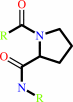 peptidylproline (omega=0)
|
|
|
|
|
|
|
|
|
|
|
|
|
Molecule diagrams generated from .mol files obtained from the
KEGG ftp site
|
|
|
|
|
|
|
|
|
|
|
|
|
|
 |
|
|
|
|
|
|
| |
|
|
| |
|
DOI no:
|
Structure
14:185-195
(2006)
|
|
PubMed id:
|
|
|
|
|
|
| |
|
The Crystal Structure of Aspergillus fumigatus Cyclophilin Reveals 3D Domain Swapping of a Central Element.
|
|
A.Limacher,
D.P.Kloer,
S.Flückiger,
G.Folkers,
R.Crameri,
L.Scapozza.
|
|
|
|
|
| |
ABSTRACT
|
|
|
|
| |
|
|
The crystal structure of Aspergillus fumigatus cyclophilin (Asp f 11) was solved
by the multiwavelength anomalous dispersion method and was refined to a
resolution of 1.85 A with R and R(free) values of 18.9% and 21.4%, respectively.
Many cyclophilin structures have been solved to date, all showing the same
monomeric conformation. In contrast, the structure of A. fumigatus cyclophilin
reveals dimerization by 3D domain swapping and represents one of the first
proteins with a swapped central domain. The domain-swapped element consists of
two beta strands and a subsequent loop carrying a conserved tryptophan. The
tryptophan binds into the active site, inactivating cis-trans isomerization.
This might be a means of biological regulation. The two hinge loops leave the
protein prone to misfolding. In this context, alternative forms of 3D domain
swapping that can lead to N- or C-terminally swapped dimers, oligomers, and
aggregates are discussed.
|
|
|
|
|
|
| |
Selected figure(s)
|
|
|
|
| |
|
|

|
|
Figure 3.
Figure 3. W Loop Bound to Active Site and Second Hinge Loop
(A) Electron density of the second hinge loop and parts of
the adjacent W loop (aa 124-129). The experimental map is
contoured at 1s using solvent-flattened experimental phases
calculated without NCS averaging. H bonds within and between the
hinges of both chains are indicated by yellow, dashed lines.
Residues of chain A and B are colored in violet and green,
respectively.
(B) Hydrophobic binding of the W loop into
its own active site. Trp124 and Leu125 of chain A sit into the
hydrophobic pocket of subunit A, making hydrophobic interactions
with surrounding residues of both chains. In subunit B, Val121
and Trp124 of chain B sit into its active site. Position and
conformation of some distinctive residues of human CyPA (2CPL)
are shown for comparison. Two independent monomers of CyPA were
superimposed on either subunit of Asp f 11 (see Figure 1C). Side
chains of CyPA superposed on subunit A and B are colored in
orange and yellow, respectively.
|
|
|
|
|
|
| |
The above figure is
reprinted
by permission from Cell Press:
Structure
(2006,
14,
185-195)
copyright 2006.
|
|
| |
Figure was
selected
by an automated process.
|
|
|
|
|
|
|
|
|
|
|
|
|
|
|
|
 |
 |
 |
|
Literature references that cite this PDB file's key reference
|
|
|
| |
PubMed id
|
|
Reference
|
|
|
|
|
|
J.Stie,
and
D.Fox
(2008).
Calcineurin regulation in fungi and beyond.
|
| |
Eukaryot Cell,
7,
177-186.
|
|
|
|
|
|
|
V.Thai,
P.Renesto,
C.A.Fowler,
D.J.Brown,
T.Davis,
W.Gu,
D.D.Pollock,
D.Kern,
D.Raoult,
and
E.Z.Eisenmesser
(2008).
Structural, biochemical, and in vivo characterization of the first virally encoded cyclophilin from the Mimivirus.
|
| |
J Mol Biol,
378,
71-86.
|
|
|
PDB code:
|
|
|
|
|
|
|
|
Y.Hirano,
M.M.Hossain,
K.Takeda,
H.Tokuda,
and
K.Miki
(2007).
Structural studies of the Cpx pathway activator NlpE on the outer membrane of Escherichia coli.
|
| |
Structure,
15,
963-976.
|
|
|
PDB codes:
|
|
|
|
|
|
|
The most recent references are shown first.
Citation data come partly from CiteXplore and partly
from an automated harvesting procedure. Note that this is likely to be
only a partial list as not all journals are covered by
either method. However, we are continually building up the citation data
so more and more references will be included with time.
Where a reference describes a PDB structure, the PDB
code is
shown on the right.
|
|


 Links
Links


