 |
PDBsum entry 2bck

|
|
|
|
|
|

|

|

|

|
|

|
|

|
|

|
|

|
|

|
|

|
|
|
 |

|

|
|
|
|
|
|
|
|
|
|
|
|
|
|
|
|
|
|
|
|
|
|
|
|
|
|
|
|
|
|
|
|
|
|
|
Immune system
|
PDB id
|
|
|
|
2bck
|
|
|
|
|
|
|
|
|
|
|
|
|
|
|

|

|

|
|
|
|
|
|
|
|
 |
Contents |
 |
|
|
|
|
|
|
|
|
|
|
|
|
* Residue conservation analysis
|
|
|
|
|
|
PDB id:
|
|
|
|
| Name: |
|
Immune system
|
|
|
Title:
|
|
Crystal structure of hla-a 2402 Complexed with a telomerase peptide
|
|
Structure:
|
|
Hla class i histocompatibility antigen, a-24 alpha chain. Chain: a, d. Fragment: residues 1-276. Synonym: mhc class i antigen a 24, Aw-24, a-9, hla-a 2402 Heavy chain, alpha chain. Engineered: yes. Beta-2-microglobulin. Chain: b, e. Fragment: residues 1-99.
|
|
Source:
|
|
Homo sapiens. Human. Organism_taxid: 9606. Expressed in: escherichia coli. Expression_system_taxid: 562. Synthetic: yes. Other_details: the peptide was chemically synthesized. The sequence of the peptide is naturally found in human.
|
|
Biol. unit:
|
|
 Trimer (from
)
Trimer (from
)
|
|
Resolution:
|
|
|
2.80Å
|
R-factor:
|
0.187
|
R-free:
|
0.256
|
|
|
Authors:
|
|
P.J.Rizkallah,B.K.Jakobsen,D.K.Cole,G.F.Gao
|
|
Key ref:
|
|
D.K.Cole
et al.
(2006).
Crystal structure of HLA-A*2402 complexed with a telomerase peptide.
Eur J Immunol,
36,
170-179.
PubMed id:
DOI:
|
|
|
Date:
|
|
|
19-Oct-05
|
Release date:
|
10-Jan-06
|
|
|
|
|
|
|
PROCHECK
|

|
|
|
|
|
Headers
|
|
|
|
References
|
|
|
|
|
|
|
|
|
|
|
|
Enzyme class:
|
|
Chains :
E.C.2.7.7.49
- RNA-directed Dna polymerase.
|
|
|
|
|
|
|
Reaction:
|
|
DNA(n) + a 2'-deoxyribonucleoside 5'-triphosphate = DNA(n+1) + diphosphate
|
|
|
|
|
|
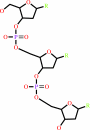 DNA(n)
|
+
|
2'-deoxyribonucleoside 5'-triphosphate
|
=
|
DNA(n+1)
|
+
|
 diphosphate
|
|
|
|
|
|
|
|
|
|
|
|
|
Molecule diagrams generated from .mol files obtained from the
KEGG ftp site
|
|
|
|
|
|
|
|
|
|
|
|
|
|
 |
|
|
|
|
|
|
| |
|
|
| |
|
DOI no:
|
Eur J Immunol
36:170-179
(2006)
|
|
PubMed id:
|
|
|
|
|
|
| |
|
Crystal structure of HLA-A*2402 complexed with a telomerase peptide.
|
|
D.K.Cole,
P.J.Rizkallah,
F.Gao,
N.I.Watson,
J.M.Boulter,
J.I.Bell,
M.Sami,
G.F.Gao,
B.K.Jakobsen.
|
|
|
|
|
| |
ABSTRACT
|
|
|
|
| |
|
|
HLA-A*2402 is the most commonly expressed HLA allele in oriental populations. It
is also widely expressed in the Caucasian population, making it one of, if not
the most abundant HLA I types. In order to study its structure in terms of
overall fold and peptide presentation, a soluble form of this HLA I (alpha1,
alpha2, alpha3 and beta(2)m domains) has been expressed, refolded and
crystallized in complex with a cancer-related telomerase peptide (VYGFVRACL),
and its structure has been solved to 2.8 A resolution. The overall structure of
HLA-A*2402 is virtually identical to other reported peptide-HLA I structures.
However, there are distinct features observable from this structure at the HLA I
peptide binding pockets. The size and depth of pocket B makes it highly suitable
for binding to large aromatic side chains, which explains the high prevalence of
tyrosine at peptide position 2. Also, for HLA binding at peptide position 5,
there is an additional anchor point, which allows the proximal amino acids to
protrude out, providing a prominent feature for TCR interaction. Finally, pocket
F allows the anchor residue at position 9 to be bound unusually deeply within
the HLA structure.
|
|
|
|
|
|
|
|
|
|
|
|
|
|
|
|
|
|
 |
 |
 |
|
Literature references that cite this PDB file's key reference
|
|
|
| |
PubMed id
|
|
Reference
|
|
|
|
|
|
J.Liu,
P.Wu,
F.Gao,
J.Qi,
A.Kawana-Tachikawa,
J.Xie,
C.J.Vavricka,
A.Iwamoto,
T.Li,
and
G.F.Gao
(2010).
Novel immunodominant peptide presentation strategy: a featured HLA-A*2402-restricted cytotoxic T-lymphocyte epitope stabilized by intrachain hydrogen bonds from severe acute respiratory syndrome coronavirus nucleocapsid protein.
|
| |
J Virol,
84,
11849-11857.
|
|
|
PDB code:
|
|
|
|
|
|
|
|
D.Sharma,
K.Bastard,
L.A.Guethlein,
P.J.Norman,
N.Yawata,
M.Yawata,
M.Pando,
H.Thananchai,
T.Dong,
S.Rowland-Jones,
F.M.Brodsky,
and
P.Parham
(2009).
Dimorphic motifs in D0 and D1+D2 domains of killer cell Ig-like receptor 3DL1 combine to form receptors with high, moderate, and no avidity for the complex of a peptide derived from HIV and HLA-A*2402.
|
| |
J Immunol,
183,
4569-4582.
|
|
|
|
|
|
|
E.Miyazaki,
A.Kawana-Tachikawa,
M.Tomizawa,
J.Nunoya,
T.Odawara,
T.Fujii,
Y.Shi,
G.F.Gao,
and
A.Iwamoto
(2009).
Highly restricted T-cell receptor repertoire in the CD8+ T-cell response against an HIV-1 epitope with a stereotypic amino acid substitution.
|
| |
AIDS,
23,
651-660.
|
|
|
|
|
|
|
H.Abdeen,
C.McErlean,
M.E.Moraes,
M.Torres,
S.Campiotto,
S.Galvão,
C.Gouvea,
and
D.Middleton
(2007).
Identification of three novel alleles of HLA-DRB1 and HLA-A in the Brazilian population.
|
| |
Tissue Antigens,
69,
607-610.
|
|
|
|
|
|
The most recent references are shown first.
Citation data come partly from CiteXplore and partly
from an automated harvesting procedure. Note that this is likely to be
only a partial list as not all journals are covered by
either method. However, we are continually building up the citation data
so more and more references will be included with time.
Where a reference describes a PDB structure, the PDB
code is
shown on the right.
|
|
|


 Links
Links


