
|
|
|
|
|
 |
Contents |
 |
|
|
|
|
|
|
|
|
|
|
|
 215 a.a.
|
|
|
|
|
|
|
|
|
|
|
 226 a.a.
|
|
|
|
|
|
|
|
|
|
|
 16 a.a.
|
|
|
|
|
|
|
|
|
* Residue conservation analysis
|
|
|
|
|
|
PDB id:
|
|
|
|
| Name: |
|
Immune system
|
|
|
Title:
|
|
Crystal structure analysis of anti-HIV-1 v3 fab 2219 in complex with ug29 peptide
|
|
Structure:
|
|
Fab 2219, light chain. Chain: l. Fragment: light chain. Fab 2219, heavy chain. Chain: h. Fragment: heavy chain. Ug29 peptide of exterior membrane glycoprotein gp120. Chain: p. Fragment: residues 96-118.
|
|
Source:
|
|
Homo sapiens. Human. Organism_taxid: 9606. Organ: blood. Cell: peripheral blood cells. Synthetic: yes. Other_details: this sequence occurs in human immunodeficiency virus type 1 (isolate mn)
|
|
Biol. unit:
|
|
Trimer (from
)
|
|
Resolution:
|
|
|
2.00Å
|
R-factor:
|
0.206
|
R-free:
|
0.238
|
|
|
Authors:
|
|
R.L.Stanfield,M.K.Gorny,S.Zolla-Pazner,I.A.Wilson
|
|
Key ref:
|
|
R.L.Stanfield
et al.
(2006).
Crystal structures of human immunodeficiency virus type 1 (HIV-1) neutralizing antibody 2219 in complex with three different V3 peptides reveal a new binding mode for HIV-1 cross-reactivity.
J Virol,
80,
6093-6105.
PubMed id:
|
|
|
Date:
|
|
|
15-Sep-05
|
Release date:
|
04-Jul-06
|
|
|
|
|
|
|
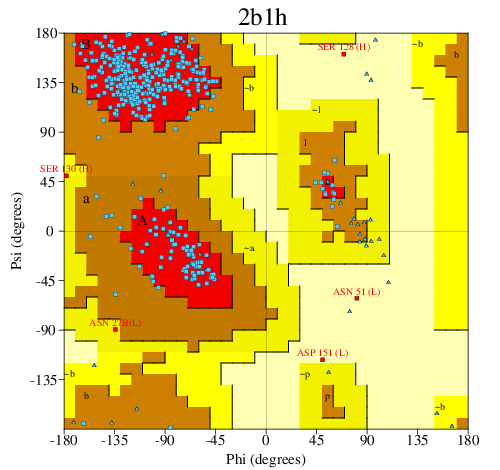
PROCHECK
|
|
|
|
|
|
Headers
|
|
|
|
References
|
|
|
|
|
|

|
|
No UniProt id for this chain
|
|
|
|
|
|
|
|
|
|
|
|
|
|
|
|
|
|
|
|
|
|
|
|
|
 |
|
|
|
|
|
|
| |
|
|
J Virol
80:6093-6105
(2006)
|
|
PubMed id:
|
|
|
|
|
|
| |
|
Crystal structures of human immunodeficiency virus type 1 (HIV-1) neutralizing antibody 2219 in complex with three different V3 peptides reveal a new binding mode for HIV-1 cross-reactivity.
|
|
R.L.Stanfield,
M.K.Gorny,
S.Zolla-Pazner,
I.A.Wilson.
|
|
|
|
|
| |
ABSTRACT
|
|
|
|
| |
|
|
Human monoclonal antibody 2219 is a neutralizing antibody isolated from a human
immunodeficiency virus type 1-infected individual. 2219 was originally selected
for binding to a V3 fusion protein and can neutralize primary isolates from
subtypes B, A, and F. Thus, 2219 represents a cross-reactive, human anti-V3
antibody. Fab 2219 binds to one face of the variable V3 beta-hairpin, primarily
contacting conserved residues on the N-terminal beta-strand of V3, leaving the
V3 crown or tip largely accessible. Three V3/2219 complexes reveal the
antibody-bound conformations for both the N- and C-terminal regions that flank
the V3 crown and illustrate how twisting of the V3 loop alters the relative
dispositions and pairing of the amino acids in the adjacent V3 beta-strands and
how the antibody can accommodate V3 loops with different sequences.
|
|
|
|
|
|
|
|
|
|
|
|
|
|
|
|
|
|
 |
 |
 |
|
Literature references that cite this PDB file's key reference
|
|
|
| |
PubMed id
|
|
Reference
|
|
|
|
|
|
C.E.Hioe,
T.Wrin,
M.S.Seaman,
X.Yu,
B.Wood,
S.Self,
C.Williams,
M.K.Gorny,
and
S.Zolla-Pazner
(2010).
Anti-V3 monoclonal antibodies display broad neutralizing activities against multiple HIV-1 subtypes.
|
| |
PLoS One,
5,
e10254.
|
|
|
|
|
|
|
D.Almond,
T.Kimura,
X.Kong,
J.Swetnam,
S.Zolla-Pazner,
and
T.Cardozo
(2010).
Structural conservation predominates over sequence variability in the crown of HIV type 1's V3 loop.
|
| |
AIDS Res Hum Retroviruses,
26,
717-723.
|
|
|
|
|
|
|
H.C.Kelker,
V.R.Itri,
and
F.T.Valentine
(2010).
A strategy for eliciting antibodies against cryptic, conserved, conformationally dependent epitopes of HIV envelope glycoprotein.
|
| |
PLoS One,
5,
e8555.
|
|
|
|
|
|
|
J.Ambrosioni,
G.Andreani,
C.Acuipil,
R.Barral,
R.Rabinovich,
and
L.Martinez Peralta
(2010).
Comparative reactivity of serum samples from Argentinean HIV-infected patients with V3 peptides from subtype B or BF recombinants.
|
| |
Arch Virol,
155,
2029-2034.
|
|
|
|
|
|
|
J.Swetnam,
E.Shmelkov,
S.Zolla-Pazner,
and
T.Cardozo
(2010).
Comparative magnitude of cross-strain conservation of HIV variable loop neutralization epitopes.
|
| |
PLoS One,
5,
e15994.
|
|
|
|
|
|
|
S.Zolla-Pazner,
and
T.Cardozo
(2010).
Structure-function relationships of HIV-1 envelope sequence-variable regions refocus vaccine design.
|
| |
Nat Rev Immunol,
10,
527-535.
|
|
|
|
|
|
|
X.Jiang,
V.Burke,
M.Totrov,
C.Williams,
T.Cardozo,
M.K.Gorny,
S.Zolla-Pazner,
and
X.P.Kong
(2010).
Conserved structural elements in the V3 crown of HIV-1 gp120.
|
| |
Nat Struct Mol Biol,
17,
955-961.
|
|
|
PDB codes:
|
|
|
|
|
|
|
|
A.Mor,
E.Segal,
B.Mester,
B.Arshava,
O.Rosen,
F.X.Ding,
J.Russo,
A.Dafni,
F.Schvartzman,
T.Scherf,
F.Naider,
and
J.Anglister
(2009).
Mimicking the structure of the V3 epitope bound to HIV-1 neutralizing antibodies.
|
| |
Biochemistry,
48,
3288-3303.
|
|
|
|
|
|
|
K.L.Longenecker,
Q.Ruan,
E.H.Fry,
S.C.Saldana,
S.E.Brophy,
P.L.Richardson,
and
S.Y.Tetin
(2009).
Crystal structure and thermodynamic analysis of diagnostic mAb 106.3 complexed with BNP 5-13 (C10A).
|
| |
Proteins,
76,
536-547.
|
|
|
PDB code:
|
|
|
|
|
|
|
|
M.K.Gorny,
X.H.Wang,
C.Williams,
B.Volsky,
K.Revesz,
B.Witover,
S.Burda,
M.Urbanski,
P.Nyambi,
C.Krachmarov,
A.Pinter,
S.Zolla-Pazner,
and
A.Nadas
(2009).
Preferential use of the VH5-51 gene segment by the human immune response to code for antibodies against the V3 domain of HIV-1.
|
| |
Mol Immunol,
46,
917-926.
|
|
|
|
|
|
|
P.A.Galanakis,
N.G.Kandias,
A.K.Rizos,
D.Morikis,
E.Krambovitis,
and
G.A.Spyroulias
(2009).
NMR evidence of charge-dependent interaction between various PND V3 and CCR5 N-terminal peptides.
|
| |
Biopolymers,
92,
94.
|
|
|
|
|
|
|
R.Berro,
R.W.Sanders,
M.Lu,
P.J.Klasse,
and
J.P.Moore
(2009).
Two HIV-1 variants resistant to small molecule CCR5 inhibitors differ in how they use CCR5 for entry.
|
| |
PLoS Pathog,
5,
e1000548.
|
|
|
|
|
|
|
R.M.Lynch,
T.Shen,
S.Gnanakaran,
and
C.A.Derdeyn
(2009).
Appreciating HIV type 1 diversity: subtype differences in Env.
|
| |
AIDS Res Hum Retroviruses,
25,
237-248.
|
|
|
|
|
|
|
S.Zolla-Pazner,
S.Cohen,
A.Pinter,
C.Krachmarov,
T.Wrin,
S.Wang,
and
S.Lu
(2009).
Cross-clade neutralizing antibodies against HIV-1 induced in rabbits by focusing the immune response on a neutralizing epitope.
|
| |
Virology,
392,
82-93.
|
|
|
|
|
|
|
T.Cardozo,
J.Swetnam,
A.Pinter,
C.Krachmarov,
A.Nadas,
D.Almond,
and
S.Zolla-Pazner
(2009).
Worldwide distribution of HIV type 1 epitopes recognized by human anti-V3 monoclonal antibodies.
|
| |
AIDS Res Hum Retroviruses,
25,
441-450.
|
|
|
|
|
|
|
U.Neogi,
V.Sood,
A.Choudhry,
S.Das,
V.G.Ramachandran,
V.K.Sreedhar,
A.Wanchu,
N.Ghosh,
and
A.C.Banerjea
(2009).
Genetic analysis of HIV-1 Circulating Recombinant Form 02_AG, B and C subtype-specific envelope sequences from Northern India and their predicted co-receptor usage.
|
| |
AIDS Res Ther,
6,
28.
|
|
|
|
|
|
|
V.Burke,
C.Williams,
M.Sukumaran,
S.S.Kim,
H.Li,
X.H.Wang,
M.K.Gorny,
S.Zolla-Pazner,
and
X.P.Kong
(2009).
Structural basis of the cross-reactivity of genetically related human anti-HIV-1 mAbs: implications for design of V3-based immunogens.
|
| |
Structure,
17,
1538-1546.
|
|
|
PDB codes:
|
|
|
|
|
|
|
|
A.K.Dhillon,
R.L.Stanfield,
M.K.Gorny,
C.Williams,
S.Zolla-Pazner,
and
I.A.Wilson
(2008).
Structure determination of an anti-HIV-1 Fab 447-52D-peptide complex from an epitaxially twinned data set.
|
| |
Acta Crystallogr D Biol Crystallogr,
64,
792-802.
|
|
|
PDB code:
|
|
|
|
|
|
|
|
C.H.Bell,
R.Pantophlet,
A.Schiefner,
L.A.Cavacini,
R.L.Stanfield,
D.R.Burton,
and
I.A.Wilson
(2008).
Structure of antibody F425-B4e8 in complex with a V3 peptide reveals a new binding mode for HIV-1 neutralization.
|
| |
J Mol Biol,
375,
969-978.
|
|
|
PDB code:
|
|
|
|
|
|
|
|
J.E.Lee,
A.Kuehne,
D.M.Abelson,
M.L.Fusco,
M.K.Hart,
and
E.O.Saphire
(2008).
Complex of a protective antibody with its Ebola virus GP peptide epitope: unusual features of a V lambda x light chain.
|
| |
J Mol Biol,
375,
202-216.
|
|
|
PDB code:
|
|
|
|
|
|
|
|
M.B.Patel,
N.G.Hoffman,
and
R.Swanstrom
(2008).
Subtype-specific conformational differences within the V3 region of subtype B and subtype C human immunodeficiency virus type 1 Env proteins.
|
| |
J Virol,
82,
903-916.
|
|
|
|
|
|
|
M.L.Visciano,
M.Tuen,
P.D.Chen,
and
C.E.Hioe
(2008).
Antibodies to the CD4-binding site of HIV-1 gp120 suppress gp120-specific CD4 T cell response while enhancing antibody response.
|
| |
Infect Agent Cancer,
3,
11.
|
|
|
|
|
|
|
M.Vaine,
S.Wang,
E.T.Crooks,
P.Jiang,
D.C.Montefiori,
J.Binley,
and
S.Lu
(2008).
Improved induction of antibodies against key neutralizing epitopes by human immunodeficiency virus type 1 gp120 DNA prime-protein boost vaccination compared to gp120 protein-only vaccination.
|
| |
J Virol,
82,
7369-7378.
|
|
|
|
|
|
|
P.Nyambi,
S.Burda,
M.Urbanski,
L.Heyndrickx,
W.Janssens,
G.Vanham,
and
A.Nadas
(2008).
Neutralization patterns and evolution of sequential HIV type 1 envelope sequences in HIV type 1 subtype B-infected drug-naive individuals.
|
| |
AIDS Res Hum Retroviruses,
24,
1507-1519.
|
|
|
|
|
|
|
K.H.Roux,
and
K.A.Taylor
(2007).
AIDS virus envelope spike structure.
|
| |
Curr Opin Struct Biol,
17,
244-252.
|
|
|
|
|
|
|
P.Scheerer,
A.Kramer,
L.Otte,
M.Seifert,
H.Wessner,
C.Scholz,
N.Krauss,
J.Schneider-Mergener,
and
W.Höhne
(2007).
Structure of an anti-cholera toxin antibody Fab in complex with an epitope-derived D-peptide: a case of polyspecific recognition.
|
| |
J Mol Recognit,
20,
263-274.
|
|
|
PDB code:
|
|
|
|
|
|
|
|
R.Pantophlet,
R.O.Aguilar-Sino,
T.Wrin,
L.A.Cavacini,
and
D.R.Burton
(2007).
Analysis of the neutralization breadth of the anti-V3 antibody F425-B4e8 and re-assessment of its epitope fine specificity by scanning mutagenesis.
|
| |
Virology,
364,
441-453.
|
|
|
|
|
|
|
T.Cardozo,
T.Kimura,
S.Philpott,
B.Weiser,
H.Burger,
and
S.Zolla-Pazner
(2007).
Structural basis for coreceptor selectivity by the HIV type 1 V3 loop.
|
| |
AIDS Res Hum Retroviruses,
23,
415-426.
|
|
|
|
|
|
|
Y.T.Duong,
D.C.Meadows,
I.K.Srivastava,
J.Gervay-Hague,
and
T.W.North
(2007).
Direct inactivation of human immunodeficiency virus type 1 by a novel small-molecule entry inhibitor, DCM205.
|
| |
Antimicrob Agents Chemother,
51,
1780-1786.
|
|
|
|
|
|
The most recent references are shown first.
Citation data come partly from CiteXplore and partly
from an automated harvesting procedure. Note that this is likely to be
only a partial list as not all journals are covered by
either method. However, we are continually building up the citation data
so more and more references will be included with time.
Where a reference describes a PDB structure, the PDB
codes are
shown on the right.
|
 |
|


 Links
Links


