 |
PDBsum entry 2b0f

|
|
|
|
|
|

|

|

|

|
|

|
|

|
|

|
|

|
|
|
 |

|

|
|
|
|
|
|
|
|
|
|
|
|
|
|
|
|
|
|
|
|
|
|
|
|
|
|
|
|
|
|
|
|
|
Hydrolase/hydrolase inhibitor
|
PDB id
|
|
|
|
2b0f
|
|
|
|
|
|
|
|
|
|
|
|
|
|
|

|

|

|
|
|
|
|
|
|
|
 |
Contents |
 |
|
|
|
|
|
|
|
|
|
|
* Residue conservation analysis
|
|
|
|
|
|
|
|
|
|
|
Enzyme class 2:
|
|
E.C.2.7.7.48
- RNA-directed Rna polymerase.
|
|
|
|
|
|
|
Reaction:
|
|
RNA(n) + a ribonucleoside 5'-triphosphate = RNA(n+1) + diphosphate
|
|
|
|
|
|
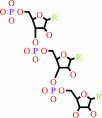 RNA(n)
|
+
|
ribonucleoside 5'-triphosphate
|
=
|
RNA(n+1)
|
+
|
 diphosphate
|
|
|
|
|
|
|
|
|
|
Enzyme class 3:
|
|
E.C.3.4.22.28
- picornain 3C.
|
|
|
|
|
|
|
Reaction:
|
|
Selective cleavage of Gln-|-Gly bond in the poliovirus polyprotein. In other picornavirus reactions Glu may be substituted for Gln, and Ser or Thr for Gly.
|
|
|
|
|
|
Enzyme class 4:
|
|
E.C.3.4.22.29
- picornain 2A.
|
|
|
|
|
|
|
Reaction:
|
|
Selective cleavage of Tyr-|-Gly bond in the picornavirus polyprotein. In other picornavirus reactions Glu may be substituted for Gln, and Ser or Thr for Gly.
|
|
|
|
|
|
Enzyme class 5:
|
|
E.C.3.6.1.15
- nucleoside-triphosphate phosphatase.
|
|
|
|
|
|
|
Reaction:
|
|
a ribonucleoside 5'-triphosphate + H2O = a ribonucleoside 5'-diphosphate + phosphate + H+
|
|
|
|
|
|
ribonucleoside 5'-triphosphate
|
+
|
H2O
|
=
|
ribonucleoside 5'-diphosphate
|
+
|
 phosphate
|
+
|
H(+)
|
|
|
|
|
|
|
|
|
|
|
|
|
Note, where more than one E.C. class is given (as above), each may
correspond to a different protein domain or, in the case of polyprotein
precursors, to a different mature protein.
|
|
|
|
Molecule diagrams generated from .mol files obtained from the
KEGG ftp site
|
|
|
|
|
|
|
|
|
|
|
|
|
|
 |
|
|
|
|
|
|
| |
|
|
| |
|
|
Biochemistry
46:12945-12958
(2007)
|
|
PubMed id:
|
|
|
|
|
|
| |
|
NMR solution structures of the apo and peptide-inhibited human rhinovirus 3C protease (Serotype 14): structural and dynamic comparison.
|
|
T.C.Bjorndahl,
L.C.Andrew,
V.Semenchenko,
D.S.Wishart.
|
|
|
|
|
| |
ABSTRACT
|
|
|
|
| |
|
|
The human rhinovirus (HRV) is a positive sense RNA virus responsible for about
30% of "common colds". It relies on a 182 residue cysteine protease (3C) to
proteolytically process its single gene product. Inhibition of this enzyme in
vitro and in vivo has consistently demonstrated cessation of viral replication.
This suggests that 3C protease inhibitors could serve as good drug candidates.
However, significant proteolytic substrate diversity exists within the 110+
known rhinovirus serotypes. To investigate this variability we used NMR to solve
the structure of the rhinovirus serotype 14 3C protease (subgenus B) covalently
bound to a peptide (acetyl-LEALFQ-ethylpropionate) inhibitor. The
inhibitor-bound structure was determined to an overall rmsd of 0.82 A (backbone
atoms) and 1.49 A (all heavy atoms). Comparison with the X-ray structure of the
serotype 2 HRV 3C protease from subgenus A (51% sequence identity) bound to the
inhibitor ruprintrivir allowed the identification of conserved intermolecular
interactions involved in proximal substrate binding as well as subgenus
differences that might account for the variability observed in SAR studies. To
better characterize the 3C protease and investigate the structural and dynamic
differences between the apo and bound states we also solved the solution
structure of the apo form. The apo structure has an overall rmsd of 1.07 +/-
0.17 A over backbone atoms, which is greater by 0.25 A than what is seen for the
inhibited enzyme (2B0F.pdb). This increase is localized to the enzyme's
C-terminal beta-barrel domain, which is responsible for recognizing and binding
proteolytic substrates. Amide hydrogen exchange dynamics revealed dramatic
differences between the two enzyme states. Furthermore, a number of residues
exhibited exchange-broadened amide NMR signals in the apo state compared to the
inhibited state. The majority of these residues are associated with proteolytic
substrate interaction.
|
|
|
|
|
|
|
|
|
|
|
|
|
|
|
|
|
|
 |
 |
 |
|
Literature references that cite this PDB file's key reference
|
|
|
| |
PubMed id
|
|
Reference
|
|
|
|
|
|
N.Lewis-Rogers,
M.L.Bendall,
and
K.A.Crandall
(2009).
Phylogenetic relationships and molecular adaptation dynamics of human rhinoviruses.
|
| |
Mol Biol Evol,
26,
969-981.
|
|
|
|
|
|
|
H.J.Lee,
Y.J.Yoon,
d.o. .S.Jang,
C.Kim,
H.J.Cha,
B.H.Hong,
K.Y.Choi,
and
H.C.Lee
(2008).
15N NMR relaxation studies of Y14F mutant of ketosteroid isomerase: the influence of mutation on backbone mobility.
|
| |
J Biochem,
144,
159-166.
|
|
|
|
|
|
The most recent references are shown first.
Citation data come partly from CiteXplore and partly
from an automated harvesting procedure. Note that this is likely to be
only a partial list as not all journals are covered by
either method. However, we are continually building up the citation data
so more and more references will be included with time.
|
|


 Links
Links


