|
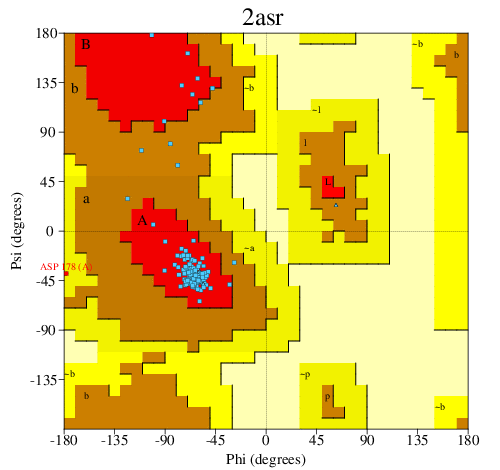
PDBsum entry 2asr

|
|
|
|
|
 |
Contents |
 |
|
|
|
|
|
|
|
|
|
|
|
|
* Residue conservation analysis
|
|
|
|
|
|
|
|
|
|
|
|
|
|
|
 |
|
|
|
|
|
|
| |
|
DOI no:
|
Acta Crystallogr D Biol Crystallogr
51:145-154
(1995)
|
|
PubMed id:
|
|
|
|
|
|
| |
|
The three-dimensional structure of the aspartate receptor from Escherichia coli.
|
|
J.U.Bowie,
A.A.Pakula,
M.I.Simon.
|
|
|
|
|
| |
ABSTRACT
|
|
|
|
| |
|
|
The crystal structure of the periplasmic domain of the aspartate receptor from
Escherichia coli has been solved and refined to an R-factor of 0.203 at 2.3 A,
resolution. The dimeric protein is largely helical, with four helices from each
monomer forming a four-helix bundle. The dimer interface is constructed from
four helices, two from each subunit, also packed together in a four-helix bundle
arrangement. A sulfate ion occupies the aspartate-binding site. All hydrogen
bonds made to aspartate are substituted by direct or water-mediated hydrogen
bonds to the sulfate. Comparison of the Escherichia coli aspartate-receptor
structure with that of Salmonella typhimurium [Milburn, Prive, Milligan, Scott,
Yeh, Jancarik, Koshland & Kim (1991). Science, 254, 1342-1347; Scott,
Milligan, Milburn, Prive, Yeh, Koshland & Kim (1993). J. Mol. Biol. 232,
555-573] reveals strong conservation in the structure of the monomer, but more
divergence in the orientation of the subunits with respect to one another.
Mutations that render the Escherichia coli receptor incapable of responding to
maltose are either located in spatially conserved sites or in regions of the
structures that have high temperature factors and are therefore likely to be
quite flexible. The inability of the receptor from Salmonella typhimurium to
respond to maltose may, therefore, be because of differences in amino acids
located on the binding surface rather than structural differences.
|
|
|
|
|
|
| |
Selected figure(s)
|
|
|
|
| |
|
|

|
|

|
|
Figure 4.
Fig. 4. The AR-Ec dimer structure. (a) A ribbon drawing showing
the sulfate bound in the aspartate-binding pocket in a ball-and-stick
representation. (b) A stereoview of the Ca trace. The figure was
produced using the program
MOLSCRIPT
(Kraulis, 1991).
|
|
Figure 7.
Fig. 7. Location of mal- mutations. The structure of AR-Ec (light grey)
is shown superimposed on the structure of AR-St-apo (dark grey).
Position of the mal- mutations are indicated on the AR-Ec structure
by black balls
at their Ca positions. The figure was produced using
the program
MOLSCRIPT
(Kraulis, 1991)
|
|
|
|
|
|
| |
The above figures are
reprinted
by permission from the IUCr:
Acta Crystallogr D Biol Crystallogr
(1995,
51,
145-154)
copyright 1995.
|
|
| |
Figures were
selected
by an automated process.
|
|
|
|
|
|
|
|
|
|
|
|
|
|
|
|
 |
 |
 |
|
Literature references that cite this PDB file's key reference
|
|
|
| |
PubMed id
|
|
Reference
|
|
|
|
|
|
P.D.Scheu,
O.B.Kim,
C.Griesinger,
and
G.Unden
(2010).
Sensing by the membrane-bound sensor kinase DcuS: exogenous versus endogenous sensing of C(4)-dicarboxylates in bacteria.
|
| |
Future Microbiol,
5,
1383-1402.
|
|
|
|
|
|
|
S.M.Ward,
A.F.Bormans,
and
M.D.Manson
(2006).
Mutationally altered signal output in the Nart (NarX-Tar) hybrid chemoreceptor.
|
| |
J Bacteriol,
188,
3944-3951.
|
|
|
|
|
|
|
W.C.Lai,
M.L.Peach,
T.P.Lybrand,
and
G.L.Hazelbauer
(2006).
Diagnostic cross-linking of paired cysteine pairs demonstrates homologous structures for two chemoreceptor domains with low sequence identity.
|
| |
Protein Sci,
15,
94.
|
|
|
|
|
|
|
S.E.Winston,
R.Mehan,
and
J.J.Falke
(2005).
Evidence that the adaptation region of the aspartate receptor is a dynamic four-helix bundle: cysteine and disulfide scanning studies.
|
| |
Biochemistry,
44,
12655-12666.
|
|
|
|
|
|
|
S.M.Ward,
A.Delgado,
R.P.Gunsalus,
and
M.D.Manson
(2002).
A NarX-Tar chimera mediates repellent chemotaxis to nitrate and nitrite.
|
| |
Mol Microbiol,
44,
709-719.
|
|
|
|
|
|
|
B.D.Beel,
and
G.L.Hazelbauer
(2001).
Substitutions in the periplasmic domain of low-abundance chemoreceptor trg that induce or reduce transmembrane signaling: kinase activation and context effects.
|
| |
J Bacteriol,
183,
671-679.
|
|
|
|
|
|
|
B.D.Beel,
and
G.L.Hazelbauer
(2001).
Signalling substitutions in the periplasmic domain of chemoreceptor Trg induce or reduce helical sliding in the transmembrane domain.
|
| |
Mol Microbiol,
40,
824-834.
|
|
|
|
|
|
|
Y.Zhang,
P.J.Gardina,
A.S.Kuebler,
H.S.Kang,
J.A.Christopher,
and
M.D.Manson
(1999).
Model of maltose-binding protein/chemoreceptor complex supports intrasubunit signaling mechanism.
|
| |
Proc Natl Acad Sci U S A,
96,
939-944.
|
|
|
|
|
|
|
P.J.Gardina,
A.F.Bormans,
and
M.D.Manson
(1998).
A mechanism for simultaneous sensing of aspartate and maltose by the Tar chemoreceptor of Escherichia coli.
|
| |
Mol Microbiol,
29,
1147-1154.
|
|
|
|
|
|
|
A.G.Hughson,
G.F.Lee,
and
G.L.Hazelbauer
(1997).
Analysis of protein structure in intact cells: crosslinking in vivo between introduced cysteines in the transmembrane domain of a bacterial chemoreceptor.
|
| |
Protein Sci,
6,
315-322.
|
|
|
|
|
|
|
C.Chothia,
T.Hubbard,
S.Brenner,
H.Barns,
and
A.Murzin
(1997).
Protein folds in the all-beta and all-alpha classes.
|
| |
Annu Rev Biophys Biomol Struct,
26,
597-627.
|
|
|
|
|
|
|
J.J.Falke,
R.B.Bass,
S.L.Butler,
S.A.Chervitz,
and
M.A.Danielson
(1997).
The two-component signaling pathway of bacterial chemotaxis: a molecular view of signal transduction by receptors, kinases, and adaptation enzymes.
|
| |
Annu Rev Cell Dev Biol,
13,
457-512.
|
|
|
|
|
|
|
A.G.Hughson,
and
G.L.Hazelbauer
(1996).
Detecting the conformational change of transmembrane signaling in a bacterial chemoreceptor by measuring effects on disulfide cross-linking in vivo.
|
| |
Proc Natl Acad Sci U S A,
93,
11546-11551.
|
|
|
|
|
|
|
J.W.Baumgartner,
and
G.L.Hazelbauer
(1996).
Mutational analysis of a transmembrane segment in a bacterial chemoreceptor.
|
| |
J Bacteriol,
178,
4651-4660.
|
|
|
|
|
|
The most recent references are shown first.
Citation data come partly from CiteXplore and partly
from an automated harvesting procedure. Note that this is likely to be
only a partial list as not all journals are covered by
either method. However, we are continually building up the citation data
so more and more references will be included with time.
|
|


 Links
Links