 |
PDBsum entry 2vv6

|
|
|
|
|
|

|

|

|

|
|

|
|

|
|

|
|

|
|

|
|

|
|
|
 |

|

|
|
|
|
|
|
|
|
|
|
|
|
|
|
|
|
|
|
|
|
|
|
|
|
|
|
|
|
|
|
|
|
|
|
|
Signaling protein, transferase
|
PDB id
|
|
|
|
2vv6
|
|
|
|
|
|
|
|
|
|
|
|
|
|
|

|

|

|
|
|
|
|
|
|
|
 |
Contents |
 |
|
|
|
|
|
|
|
|
|
|
|
|
|
|
* Residue conservation analysis
|
|
|
|
|
|
|
|
|
|
|
Enzyme class:
|
|
E.C.2.7.13.3
- histidine kinase.
|
|
|
|
|
|
|
Reaction:
|
|
ATP + protein L-histidine = ADP + protein N-phospho-L-histidine
|
|
|
|
|
|
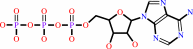 ATP
ATP
|
+
|
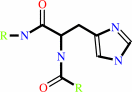 protein L-histidine
|
=
|
 ADP
ADP
|
+
|
protein N-phospho-L-histidine
|
|
|
|
|
|
|
|
|
|
|
|
|
Molecule diagrams generated from .mol files obtained from the
KEGG ftp site
|
|
|
|
|
|
|
|
|
|
|
|
|
|
 |
|
|
|
|
|
|
| |
|
|
| |
|
|
Biochemistry
47:12078-12086
(2008)
|
|
PubMed id:
|
|
|
|
|
|
| |
|
Changes in quaternary structure in the signaling mechanisms of PAS domains.
|
|
R.A.Ayers,
K.Moffat.
|
|
|
|
|
| |
ABSTRACT
|
|
|
|
| |
|
|
FixL from Bradyrhizobium japonicum is a PAS sensor protein in which two PAS
domains covalently linked to a histidine kinase domain are responsible for
regulating nitrogen fixation in an oxygen-dependent manner. The more C-terminal
PAS domain, denoted bjFixLH, contains a heme cofactor that binds diatomic
molecules such as carbon monoxide and oxygen and regulates the activity of the
FixL histidine kinase as part of a two-component signaling system. We present
the structures of ferric, deoxy, and carbon monoxide-bound bjFixLH in a new
space group ( P1) and at resolutions (1.5-1.8 A) higher than the resolutions of
those previously obtained. Interestingly, bjFixLH can form two different dimers
(in P1 and R32 crystal forms) in the same crystallization solution, where the
monomers in one dimer are rotated approximately 175 degrees relative to the
second. This suggests that PAS monomers are plastic and that two quite distinct
quaternary structures are closely similar in free energy. We use screw rotation
analysis to carry out a quantitative pairwise comparison of PAS quaternary
structures, which identifies five different relative orientations adopted by
isolated PAS monomers. We conclude that PAS monomer arrangement is
context-dependent and could differ depending on whether the PAS domains are
isolated or are part of a full-length protein. Structurally homologous residues
comprise a conserved dimer interface. Using network analysis, we find that the
architecture of the PAS dimer interface is continuous rather than modular; the
network of residues comprising the interface is strongly connected. A continuous
dimer interface is consistent with the low dimer-monomer dissociation
equilibrium constant. Finally, we quantitate quaternary structural changes
induced by carbon monoxide binding to a bjFixLH dimer, in which monomers rotate
by up to approximately 2 degrees relative to each other. We relate these changes
to those in other dimeric PAS domains and discuss the role of quaternary
structural changes in the signaling mechanisms of PAS sensor proteins.
|
|
|
|
|
|
|
|
|
|
|
|
|
|
|
|
|
|
 |
 |
 |
|
Literature references that cite this PDB file's key reference
|
|
|
| |
PubMed id
|
|
Reference
|
|
|
|
|
|
J.D.Satterlee
(2011).
Origins of aging mass loss in recombinant N-terminus and C-terminus deletion mutants of the heme-PAS biosensor domain BjFixLH(140-270).
|
| |
J Inorg Biochem,
105,
609-615.
|
|
|
|
|
|
|
J.Perry,
K.Koteva,
and
G.Wright
(2011).
Receptor domains of two-component signal transduction systems.
|
| |
Mol Biosyst,
7,
1388-1398.
|
|
|
|
|
|
|
J.Cheung,
and
W.A.Hendrickson
(2010).
Sensor domains of two-component regulatory systems.
|
| |
Curr Opin Microbiol,
13,
116-123.
|
|
|
|
|
|
|
L.J.Smith,
A.Kahraman,
and
J.M.Thornton
(2010).
Heme proteins--diversity in structural characteristics, function, and folding.
|
| |
Proteins,
78,
2349-2368.
|
|
|
|
|
|
|
P.Slavny,
R.Little,
P.Salinas,
T.A.Clarke,
and
R.Dixon
(2010).
Quaternary structure changes in a second Per-Arnt-Sim domain mediate intramolecular redox signal relay in the NifL regulatory protein.
|
| |
Mol Microbiol,
75,
61-75.
|
|
|
|
|
|
|
A.Möglich,
R.A.Ayers,
and
K.Moffat
(2009).
Structure and signaling mechanism of Per-ARNT-Sim domains.
|
| |
Structure,
17,
1282-1294.
|
|
|
|
|
|
|
C.Lechauve,
L.Bouzhir-Sima,
T.Yamashita,
M.C.Marden,
M.H.Vos,
U.Liebl,
and
L.Kiger
(2009).
Heme ligand binding properties and intradimer interactions in the full-length sensor protein dos from Escherichia coli and its isolated heme domain.
|
| |
J Biol Chem,
284,
36146-36159.
|
|
|
|
|
|
|
J.S.Lamb,
B.D.Zoltowski,
S.A.Pabit,
L.Li,
B.R.Crane,
and
L.Pollack
(2009).
Illuminating solution responses of a LOV domain protein with photocoupled small-angle X-ray scattering.
|
| |
J Mol Biol,
393,
909-919.
|
|
|
PDB code:
|
|
|
|
|
|
|
The most recent references are shown first.
Citation data come partly from CiteXplore and partly
from an automated harvesting procedure. Note that this is likely to be
only a partial list as not all journals are covered by
either method. However, we are continually building up the citation data
so more and more references will be included with time.
Where a reference describes a PDB structure, the PDB
code is
shown on the right.
|
|


 Links
Links


