 |
PDBsum entry 2vh5

|
|
|
|
|
|

|

|

|

|
|

|
|

|
|

|
|

|
|

|
|
|
 |

|

|
|
|
|
|
|
|
|
|
|
|
|
|
|
|
|
|
|
|
|
|
|
|
|
|
|
|
|
|
|
|
|
|
|
Immune system
|
PDB id
|
|
|
|
2vh5
|
|
|
|
|
|
|
|
|
|
|
|
|
|
|

|

|

|
|
|
|
|
|
|
|
 |
Contents |
 |
|
|
|
|
|
|
|
|
|
|
|
 114 a.a.
|
|
|
|
|
|
|
|
|
|
|
 104 a.a.
|
|
|
|
|
|
|
|
|
|
|
 166 a.a.
|
|
|
|
|
|
|
|
|
|
|
|
|
* Residue conservation analysis
|
|
|
|
|
|
PDB id:
|
|
|
|
| Name: |
|
Immune system
|
|
|
Title:
|
|
Crystal structure of hras(g12v) - anti-ras fv (disulfide free mutant) complex
|
|
Structure:
|
|
Anti-ras fv heavy chain. Chain: h. Engineered: yes. Anti-ras fv light chain. Chain: l. Engineered: yes. Gtpase hras. Chain: r. Fragment: residues 1-166.
|
|
Source:
|
|
Homo sapiens. Human. Organism_taxid: 9606. Expressed in: escherichia coli bl21(de3). Expression_system_taxid: 469008. Expression_system_variant: c41.
|
|
Resolution:
|
|
|
2.70Å
|
R-factor:
|
0.215
|
R-free:
|
0.291
|
|
|
Authors:
|
|
T.Tanaka,R.L.Williams,T.H.Rabbitts
|
Key ref:

|
|
T.Tanaka
and
T.H.Rabbitts
(2008).
Functional intracellular antibody fragments do not require invariant intra-domain disulfide bonds.
J Mol Biol,
376,
749-757.
PubMed id:
DOI:

|
|
|
Date:
|
|
|
19-Nov-07
|
Release date:
|
22-Jan-08
|
|
|
|
|
|
|
PROCHECK
|

|
|
|
|
|
Headers
|
|
|
|
References
|
|
|
|
|
|

|
|
No UniProt id for this chain
|
|
|
|
|
|
|
|
|
|
|
|
|
|
|
|
|
|
|
|
|
Enzyme class:
|
|
Chain R:
E.C.3.6.5.2
- small monomeric GTPase.
|
|
|
|
|
|
|
Reaction:
|
|
GTP + H2O = GDP + phosphate + H+
|
|
|
|
|
|
GTP
Bound ligand (Het Group name = )
corresponds exactly
|
+
|
H2O
|
=
|
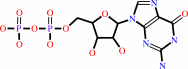 GDP
GDP
|
+
|
 phosphate
|
+
|
H(+)
|
|
|
|
|
|
|
|
|
|
|
|
|
Molecule diagrams generated from .mol files obtained from the
KEGG ftp site
|
|
|
|
|
|
|
|
|
|
|
|
|
|
 |
|
|
|
|
|
|
| |
|
|
| |
|
DOI no:
|
J Mol Biol
376:749-757
(2008)
|
|
PubMed id:
|
|
|
|
|
|
| |
|
Functional intracellular antibody fragments do not require invariant intra-domain disulfide bonds.
|
|
T.Tanaka,
T.H.Rabbitts.
|
|
|
|
|
| |
ABSTRACT
|
|
|
|
| |
|
|
Intracellular antibody fragments that interfere with molecular interactions
inside cells are valuable in investigation of interactomes and in therapeutics,
but their application demands that they function in the reducing cellular
milieu. We show here a 2.7-A crystal structure of intracellular antibody folds
based on scaffolds developed from intracellular antibody capture technology, and
we reveal that there is no structural or functional difference with or without
the intra-domain disulfide bond of the variable domain of heavy chain or the
variable domain of light chain. The data indicate that, in the reducing in vivo
environment, the absence of the intra-domain disulfide bond is not an impediment
to correction of antibody folding or to interaction with antigen. Thus, the
structural constraints for in-cell function are intrinsic to variable
single-domain framework sequences, providing a generic scaffold for isolation of
functional intracellular antibody single domains.
|
|
|
|
|
|
| |
Selected figure(s)
|
|
|
|
| |
|
|

|
|

|
|
Figure 3.
Fig. 3. Structural comparison of native and disulfide-free
RAS–anti-RAS Fv complex. (a) Representation of HRAS bound by
disulfide-free Fv. HRAS(G12V) (green) is shown as a molecular
surface model. The switch I and switch II regions of RAS are
shown in cyan and magenta, respectively, and guanidine
triphosphate (GTP) is shown in orange. The Fv [comprising VH
(blue) and VL (red)] is shown as a ribbon representation, with
the CDRs of VH and VL in blue and pink, respectively. The
positions 23 and 104 where cysteines were substituted by
alanine and valine in VH, or by valine and alanine in VL, are in
yellow. (b) Superimposition of anti-RAS Fv native form^2 and
disulfide-free Fv with alanine–valine substitutions in VH
[VH#6(AV)] and with valine–alanine substitutions in VL(VA).
The structure is shown as a stereo view of the Cα trace VH and
VL of the native forms shown in cyan and pink and of the
disulfide-free forms shown in blue and red, respectively. (c and
d) 2F[o] − F[c] electron density maps (contoured at 0.5σ)
around the disulfide bond regions of VH (c) and VL (d): native
form (left) and disulfide-free mutant (right). The distance of
Cα atom between the residues of cysteines or their
substitutions is shown as a dotted line in yellow.
|
|
Figure 4.
Fig. 4. Electron density maps of VH and VL CDRs. Views of VH
and VL CDR structures with a 2F[o] − F[c] electron density
map. The map is contoured at 0.5σ. Left panels show the native
anti-RAS VH (a–c) and VL (d–f) single domains. Right panels
show the disulfide-free form. (a) VHCDR1; (b) VHCDR2; (c)
VHCDR3; (d) VLCDR1; (e) VLCDR2; (f) VLCDR3.
|
|
|
|
|
|
| |
The above figures are
reprinted
by permission from Elsevier:
J Mol Biol
(2008,
376,
749-757)
copyright 2008.
|
|
| |
Figures were
selected
by an automated process.
|
|
|
|
|
|
|
|
|
|
|
|
|
|
|
|
 |
 |
 |
|
Literature references that cite this PDB file's key reference
|
|
|
| |
PubMed id
|
|
Reference
|
|
|
|
|
|
D.Pérez-Martínez,
T.Tanaka,
and
T.H.Rabbitts
(2010).
Intracellular antibodies and cancer: new technologies offer therapeutic opportunities.
|
| |
Bioessays,
32,
589-598.
|
|
|
|
|
|
|
T.Tanaka,
and
T.H.Rabbitts
(2010).
Protocol for the selection of single-domain antibody fragments by third generation intracellular antibody capture.
|
| |
Nat Protoc,
5,
67-92.
|
|
|
|
|
|
|
M.J.Seo,
K.J.Jeong,
C.E.Leysath,
A.D.Ellington,
B.L.Iverson,
and
G.Georgiou
(2009).
Engineering antibody fragments to fold in the absence of disulfide bonds.
|
| |
Protein Sci,
18,
259-267.
|
|
|
|
|
|
|
A.Cardinale,
and
S.Biocca
(2008).
The potential of intracellular antibodies for therapeutic targeting of protein-misfolding diseases.
|
| |
Trends Mol Med,
14,
373-380.
|
|
|
|
|
|
The most recent references are shown first.
Citation data come partly from CiteXplore and partly
from an automated harvesting procedure. Note that this is likely to be
only a partial list as not all journals are covered by
either method. However, we are continually building up the citation data
so more and more references will be included with time.
|
|
| |


 Links
Links


