 |
PDBsum entry 2pi5

|
|
|
|
|
|

|

|

|

|
|

|
|

|
|

|
|

|
|

|
|
|
 |

|

|
|
|
|
|
|
|
|
|
|
|
|
|
|
|
|
|
|
|
|
|
|
|
|
|
|
|
|
|
|
|
|
|
|
Transferase/DNA
|
PDB id
|
|
|
|
2pi5
|
|
|
|
|
|
|
|
|
|
|
|
|
|
|

|

|

|
|
|
|
|
|
|
|
 |
Contents |
 |
|
|
|
|
|
|
|
|
|
|
* Residue conservation analysis
|
|
|
|
|
|
|
|
|
|
|
Enzyme class:
|
|
E.C.2.7.7.6
- DNA-directed Rna polymerase.
|
|
|
|
|
|
|
Reaction:
|
|
RNA(n) + a ribonucleoside 5'-triphosphate = RNA(n+1) + diphosphate
|
|
|
|
|
|
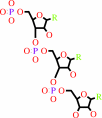 RNA(n)
|
+
|
ribonucleoside 5'-triphosphate
|
=
|
RNA(n+1)
|
+
|
 diphosphate
|
|
|
|
|
|
|
|
|
|
|
|
|
Molecule diagrams generated from .mol files obtained from the
KEGG ftp site
|
|
|
|
|
|
|
|
|
|
|
|
|
|
 |
|
|
|
|
|
|
| |
|
|
| |
|
DOI no:
|
J Mol Biol
370:256-268
(2007)
|
|
PubMed id:
|
|
|
|
|
|
| |
|
Mechanism for de novo RNA synthesis and initiating nucleotide specificity by t7 RNA polymerase.
|
|
W.P.Kennedy,
J.R.Momand,
Y.W.Yin.
|
|
|
|
|
| |
ABSTRACT
|
|
|
|
| |
|
|
DNA-directed RNA polymerases are capable of initiating synthesis of RNA without
primers, the first catalytic stage of initiation is referred to as de novo RNA
synthesis. De novo synthesis is a unique phase in the transcription cycle where
the RNA polymerase binds two nucleotides rather than a nascent RNA polymer and a
single nucleotide. For bacteriophage T7 RNA polymerase, transcription begins
with a marked preference for GTP at the +1 and +2 positions. We determined the
crystal structures of T7 RNA polymerase complexes captured during the de novo
RNA synthesis. The DNA substrates in the structures in the complexes contain a
common Phi10 duplex promoter followed by a unique five base single-stranded
extension of template DNA whose sequences varied at positions +1 and +2, thereby
allowing for different pairs of initiating nucleotides GTP, ATP, CTP or UTP to
bind. The structures show that the initiating nucleotides bind RNA polymerase in
locations distinct from those described previously for elongation complexes.
Selection bias in favor of GTP as an initiating nucleotide is accomplished by
shape complementarity, extensive protein side-chain and strong base-stacking
interactions for the guanine moiety in the enzyme active site. Consequently, an
initiating GTP provides the largest stabilization force for the open promoter
conformation.
|
|
|
|
|
|
| |
Selected figure(s)
|
|
|
|
| |
|
|

|
|

|
|
Figure 1.
Figure 1. Configuration of the active site of T7 RNAP before
and after NTP binding. (a) The pre-insertion conformation that
is incompetent for NTP binding. The templating residue n is in a
flipped-out position; the NTP-binding site (N-site) is occluded
by Y639 and the O-helix is inward, away from the NTP site. (b)
The post insertion conformation induced by NTP binding. The
conformational changes move Y639 away from the N-site,
repositions the templating residue n, and rotates the O-helix
towards the active site.
|
|
Figure 4.
Figure 4. Guanine-specific interactions between the
initiating GTP nucleotides and the active site residues of the
polymerase. (a) Interaction of the first G:C base-pair between
GTP (gold) and the + 1 cytosine on the template (blue) with
RNAP. (b) Interaction of the second G:C base-pair between GTP
(gold) and the + 2 cytosine (blue) on the template with the
RNAP.
|
|
|
|
|
|
| |
The above figures are
reprinted
by permission from Elsevier:
J Mol Biol
(2007,
370,
256-268)
copyright 2007.
|
|
| |
Figures were
selected
by an automated process.
|
|
|
|
|
|
|
|
|
|
|
|
|
|
|
|
 |
 |
 |
|
Literature references that cite this PDB file's key reference
|
|
|
| |
PubMed id
|
|
Reference
|
|
|
|
|
|
M.L.Gleghorn,
E.K.Davydova,
R.Basu,
L.B.Rothman-Denes,
and
K.S.Murakami
(2011).
X-ray crystal structures elucidate the nucleotidyl transfer reaction of transcript initiation using two nucleotides.
|
| |
Proc Natl Acad Sci U S A,
108,
3566-3571.
|
|
|
PDB codes:
|
|
|
|
|
|
|
|
J.M.Fusté,
S.Wanrooij,
E.Jemt,
C.E.Granycome,
T.J.Cluett,
Y.Shi,
N.Atanassova,
I.J.Holt,
C.M.Gustafsson,
and
M.Falkenberg
(2010).
Mitochondrial RNA polymerase is needed for activation of the origin of light-strand DNA replication.
|
| |
Mol Cell,
37,
67-78.
|
|
|
|
|
|
|
S.Paratkar,
and
S.S.Patel
(2010).
Mitochondrial transcription factor Mtf1 traps the unwound non-template strand to facilitate open complex formation.
|
| |
J Biol Chem,
285,
3949-3956.
|
|
|
|
|
|
|
E.K.Davydova,
I.Kaganman,
K.M.Kazmierczak,
and
L.B.Rothman-Denes
(2009).
Identification of bacteriophage n4 virion RNA polymerase-nucleic Acid interactions in transcription complexes.
|
| |
J Biol Chem,
284,
1962-1970.
|
|
|
|
|
|
|
J.N.Pitt,
and
A.R.Ferré-D'Amaré
(2009).
Structure-guided engineering of the regioselectivity of RNA ligase ribozymes.
|
| |
J Am Chem Soc,
131,
3532-3540.
|
|
|
PDB codes:
|
|
|
|
|
|
|
The most recent references are shown first.
Citation data come partly from CiteXplore and partly
from an automated harvesting procedure. Note that this is likely to be
only a partial list as not all journals are covered by
either method. However, we are continually building up the citation data
so more and more references will be included with time.
Where a reference describes a PDB structure, the PDB
codes are
shown on the right.
|
|


 Links
Links


