
|
|
|
|
|
 |
Contents |
 |
|
|
|
|
|
|
|
|
|
|
|
|
|
|
* Residue conservation analysis
|
|
|
|
|
|
|
|
|
|
Enzyme class:
|
|
Chains A, B:
E.C.2.7.7.52
- Rna uridylyltransferase.
|
|
|
|
|
|
|
Reaction:
|
|
RNA(n) + UTP = RNA(n)-3'-uridine ribonucleotide + diphosphate
|
|
|
|
|
|
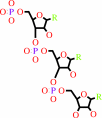 RNA(n)
|
+
|
UTP
Bound ligand (Het Group name = )
matches with 96.55% similarity
|
=
|
RNA(n)-3'-uridine ribonucleotide
|
+
|
 diphosphate
|
|
|
|
|
|
|
|
|
|
|
|
|
Molecule diagrams generated from .mol files obtained from the
KEGG ftp site
|
|
|
|
|
|
|
|
|
|
|
|
|
|
 |
|
|
|
|
|
|
| |
|
|
| |
|
DOI no:
|
J Mol Biol
366:882-899
(2007)
|
|
PubMed id:
|
|
|
|
|
|
| |
|
UTP-bound and Apo Structures of a Minimal RNA Uridylyltransferase.
|
|
J.Stagno,
I.Aphasizheva,
A.Rosengarth,
H.Luecke,
R.Aphasizhev.
|
|
|
|
|
| |
ABSTRACT
|
|
|
|
| |
|
|
3'-Uridylylation of RNA is emerging as a phylogenetically widespread phenomenon
involved in processing events as diverse as uridine insertion/deletion RNA
editing in mitochondria of trypanosomes and small nuclear RNA (snRNA) maturation
in humans. This reaction is catalyzed by terminal uridylyltransferases
(TUTases), which are template-independent RNA nucleotidyltransferases that
specifically recognize UTP and belong to a large enzyme superfamily typified by
DNA polymerase beta. Multiple TUTases, recently identified in trypanosomes, as
well as a U6 snRNA-specific TUTase enzyme in humans, are highly divergent at the
protein sequence level. However, they all possess conserved catalytic and UTP
recognition domains, often accompanied by various auxiliary modules present at
the termini or between conserved domains. Here we report identification,
structural and biochemical analyses of a novel trypanosomal TUTase, TbTUT4,
which represents a minimal catalytically active RNA uridylyltransferase. The
TbTUT4 consists of only two domains that define the catalytic center at the
bottom of the nucleoside triphosphate and RNA substrate binding cleft. The 2.0 A
crystal structure reveals two significantly different conformations of this
TUTase: one molecule is in a relatively open apo conformation, whereas the other
displays a more compact TUTase-UTP complex. A single nucleoside triphosphate is
bound in the active site by a complex network of interactions between amino acid
residues, a magnesium ion and highly ordered water molecules with the UTP's
base, ribose and phosphate moieties. The structure-guided mutagenesis and
cross-linking studies define the amino acids essential for catalysis, uracil
base recognition, ribose binding and phosphate coordination by
uridylyltransferases. In addition, the cluster of positively charged residues
involved in RNA binding is identified. We also report a 2.4 A crystal structure
of TbTUT4 with the bound 2' deoxyribonucleoside, which provides the structural
basis of the enzyme's preference toward ribonucleotides.
|
|
|
|
|
|
| |
Selected figure(s)
|
|
|
|
| |
|
|

|
|

|
|
Figure 4.
Figure 4. Structural superposition of (a) TbRET2 (teal; PDB
code 2B51) with TbTUT4 (red) with the middle domain, which is
only present in TbRET2, on the left. (b) Superposition of ScPAP
(gray; PDB code 1FA0) with TbTUT4 (red), with an additional
domain at the C terminus, which is only present in ScPAP, on the
upper right. UTP/Mg^2+ are included for TbTUT4 for visual
reference. The Figure was generated using PyMOL
[http://www.pymol.org]. Figure 4. Structural superposition of
(a) TbRET2 (teal; PDB code 2B51) with TbTUT4 (red) with the
middle domain, which is only present in TbRET2, on the left. (b)
Superposition of ScPAP (gray; PDB code 1FA0) with TbTUT4 (red),
with an additional domain at the C terminus, which is only
present in ScPAP, on the upper right. UTP/Mg^2+ are included for
TbTUT4 for visual reference. The Figure was generated using
PyMOL [http://www.pymol.org].
|
|
Figure 6.
Figure 6. Key protein–UTP contacts in the UTP binding site.
(a) UTP observed in molecule A shown with electron density from
a composite annealed omit map contoured at 1.0σ. (b)
Superposition of the active sites of TbRET2 (teal) and TbTUT4
(red). Residue labels are for TbTUT4. (c) Comparison of UTP
binding via active site residues and their respective hydrogen
bond networks for TbTUT4 and TbRET2. Selected water molecules
(cyan spheres) were included to illustrate their significance in
coordinating the uracil base while others were left out to
improve clarity. The metal cations are shown as spheres: for
TbTUT4 a Mg^2+ (magenta sphere), and for TbRET2 a Mn^2+ (black
sphere). The Figurewas generated using PyMOL
[http://www.pymol.org]. Figure 6. Key protein–UTP contacts
in the UTP binding site. (a) UTP observed in molecule A shown
with electron density from a composite annealed omit map
contoured at 1.0σ. (b) Superposition of the active sites of
TbRET2 (teal) and TbTUT4 (red). Residue labels are for TbTUT4.
(c) Comparison of UTP binding via active site residues and their
respective hydrogen bond networks for TbTUT4 and TbRET2.
Selected water molecules (cyan spheres) were included to
illustrate their significance in coordinating the uracil base
while others were left out to improve clarity. The metal cations
are shown as spheres: for TbTUT4 a Mg^2+ (magenta sphere), and
for TbRET2 a Mn^2+ (black sphere). The Figurewas generated using
PyMOL [http://www.pymol.org].
|
|
|
|
|
|
| |
The above figures are
reprinted
from an Open Access publication published by Elsevier:
J Mol Biol
(2007,
366,
882-899)
copyright 2007.
|
|
| |
Figures were
selected
by an automated process.
|
|
|
|
|
|
|
|
|
|
|
|
|
|
|
|
 |
 |
 |
|
Literature references that cite this PDB file's key reference
|
|
|
| |
PubMed id
|
|
Reference
|
|
|
|
|
|
L.A.Yates,
S.Fleurdépine,
O.S.Rissland,
L.De Colibus,
K.Harlos,
C.J.Norbury,
and
R.J.Gilbert
(2012).
Structural basis for the activity of a cytoplasmic RNA terminal uridylyl transferase.
|
| |
Nat Struct Mol Biol,
19,
782-787.
|
|
|
PDB codes:
|
|
|
|
|
|
|
|
Y.Bai,
S.K.Srivastava,
J.H.Chang,
J.L.Manley,
and
L.Tong
(2011).
Structural basis for dimerization and activity of human PAPD1, a noncanonical poly(A) polymerase.
|
| |
Mol Cell,
41,
311-320.
|
|
|
PDB code:
|
|
|
|
|
|
|
|
S.Hamill,
S.L.Wolin,
and
K.M.Reinisch
(2010).
Structure and function of the polymerase core of TRAMP, a RNA surveillance complex.
|
| |
Proc Natl Acad Sci U S A,
107,
15045-15050.
|
|
|
PDB code:
|
|
|
|
|
|
|
|
I.Aphasizheva,
G.E.Ringpis,
J.Weng,
P.D.Gershon,
R.H.Lathrop,
and
R.Aphasizhev
(2009).
Novel TUTase associates with an editosome-like complex in mitochondria of Trypanosoma brucei.
|
| |
RNA,
15,
1322-1337.
|
|
|
|
|
|
|
K.Kuchta,
L.Knizewski,
L.S.Wyrwicz,
L.Rychlewski,
and
K.Ginalski
(2009).
Comprehensive classification of nucleotidyltransferase fold proteins: identification of novel families and their representatives in human.
|
| |
Nucleic Acids Res,
37,
7701-7714.
|
|
|
|
|
|
|
R.D.Etheridge,
D.M.Clemens,
P.D.Gershon,
and
R.Aphasizhev
(2009).
Identification and characterization of nuclear non-canonical poly(A) polymerases from Trypanosoma brucei.
|
| |
Mol Biochem Parasitol,
164,
66-73.
|
|
|
|
|
|
|
G.Martin,
S.Doublié,
and
W.Keller
(2008).
Determinants of substrate specificity in RNA-dependent nucleotidyl transferases.
|
| |
Biochim Biophys Acta,
1779,
206-216.
|
|
|
|
|
|
|
R.Aphasizhev,
and
I.Aphasizheva
(2008).
Terminal RNA uridylyltransferases of trypanosomes.
|
| |
Biochim Biophys Acta,
1779,
270-280.
|
|
|
|
|
|
|
R.D.Etheridge,
I.Aphasizheva,
P.D.Gershon,
and
R.Aphasizhev
(2008).
3' adenylation determines mRNA abundance and monitors completion of RNA editing in T. brucei mitochondria.
|
| |
EMBO J,
27,
1596-1608.
|
|
|
|
|
|
|
S.Kramer,
R.Queiroz,
L.Ellis,
H.Webb,
J.D.Hoheisel,
C.Clayton,
and
M.Carrington
(2008).
Heat shock causes a decrease in polysomes and the appearance of stress granules in trypanosomes independently of eIF2(alpha) phosphorylation at Thr169.
|
| |
J Cell Sci,
121,
3002-3014.
|
|
|
|
|
|
|
C.Y.Kao,
and
L.K.Read
(2007).
Targeted depletion of a mitochondrial nucleotidyltransferase suggests the presence of multiple enzymes that polymerize mRNA 3' tails in Trypanosoma brucei mitochondria.
|
| |
Mol Biochem Parasitol,
154,
158-169.
|
|
|
|
|
|
|
G.Martin,
and
W.Keller
(2007).
RNA-specific ribonucleotidyl transferases.
|
| |
RNA,
13,
1834-1849.
|
|
|
|
|
|
|
J.Stagno,
I.Aphasizheva,
R.Aphasizhev,
and
H.Luecke
(2007).
Dual role of the RNA substrate in selectivity and catalysis by terminal uridylyl transferases.
|
| |
Proc Natl Acad Sci U S A,
104,
14634-14639.
|
|
|
PDB codes:
|
|
|
|
|
|
|
|
P.B.Balbo,
and
A.Bohm
(2007).
Mechanism of poly(A) polymerase: structure of the enzyme-MgATP-RNA ternary complex and kinetic analysis.
|
| |
Structure,
15,
1117-1131.
|
|
|
PDB code:
|
|
|
|
|
|
|
The most recent references are shown first.
Citation data come partly from CiteXplore and partly
from an automated harvesting procedure. Note that this is likely to be
only a partial list as not all journals are covered by
either method. However, we are continually building up the citation data
so more and more references will be included with time.
Where a reference describes a PDB structure, the PDB
codes are
shown on the right.
|
 |


 Links
Links


