 |
PDBsum entry 2fzh

|
|
|
|
|
|

|

|

|

|
|

|
|

|
|

|
|

|
|
|
 |

|

|
|
|
|
|
|
|
|
|
|
|
|
|
|
|
|
|
|
|
|
|
|
|
|
|
|
|
|
|
|
|
|
|
Oxidoreductase
|
PDB id
|
|
|
|
2fzh
|
|
|
|
|
|
|
|
|
|
|
|
|
|
|

|

|

|
|
|
|
|
|
|
|
 |
Contents |
 |
|
|
|
|
|
|
|
|
|
|
|
|
* Residue conservation analysis
|
|
|
|
|
|
|
|
|
|
|
Enzyme class:
|
|
E.C.1.5.1.3
- dihydrofolate reductase.
|
|
|
|
|
|
|
Pathway:
|
|
Folate Coenzymes
|
|
|
|
|
|
Reaction:
|
|
(6S)-5,6,7,8-tetrahydrofolate + NADP+ = 7,8-dihydrofolate + NADPH + H+
|
|
|
|
|
|
(6S)-5,6,7,8-tetrahydrofolate
|
+
|
NADP(+)
Bound ligand (Het Group name = )
corresponds exactly
|
=
|
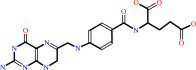 7,8-dihydrofolate
|
+
|
 NADPH
NADPH
|
+
|
H(+)
|
|
|
|
|
|
|
|
|
|
|
|
|
Molecule diagrams generated from .mol files obtained from the
KEGG ftp site
|
|
|
|
|
|
|
|
|
|
|
|
|
|
 |
|
|
|
|
|
|
| |
|
|
| |
|
DOI no:
|
Proteins
65:959-969
(2006)
|
|
PubMed id:
|
|
|
|
|
|
| |
|
New insights into DHFR interactions: analysis of Pneumocystis carinii and mouse DHFR complexes with NADPH and two highly potent 5-(omega-carboxy(alkyloxy) trimethoprim derivatives reveals conformational correlations with activity and novel parallel ring stacking interactions.
|
|
V.Cody,
J.Pace,
K.Chisum,
A.Rosowsky.
|
|
|
|
|
| |
ABSTRACT
|
|
|
|
| |
|
|
Structural data are reported for two highly potent antifolates,
2,4-diamino-5-[3',4'-dimethoxy-5'-(5-carboxy-1-pentynyl)]benzylpyrimidine
(PY1011), with 5000-fold selectivity for Pneumocystis carinii dihydrofolate
reductase (pcDHFR), relative to rat liver DHFR, and
2,4-diamino-5-[2-methoxy-5-(4-carboxybutyloxy)benzyl]pyrimidine (PY957), that
has 80-fold selectivity for pcDHFR. Crystal structures are reported for NADPH
ternary complexes with PY957 and pcDHFR, refined to 2.2 A resolution; with
PY1011 and pcDHFR, refined to 2.0 A resolution; and with PY1011 and mouse DHFR
(mDHFR), refined to 2.2 A resolution. These results reveal that the carboxylate
of the omega-carboxyalkyloxy side chain of these inhibitors form ionic
interactions with the conserved Arg in the substrate binding pocket of DHFR.
These data suggest that the enhanced inhibitory activity of PY1011 compared with
PY957 is, in part, due to the favorable contacts with Phe69 of pcDHFR by the
methylene carbons of the inhibitor side chain that are oriented by the triple
bond of the 1-pentynyl side chain. These contacts are not present in the PY957
pcDHFR complex, or in the PY1011 mDHFR complex. In the structure of mDHFR the
site of Phe69 in pcDHFR is occupied by Asn64. These data also revealed a
preference for an unusual parallel ring stacking interaction between Tyr35 of
the active site helix and Phe199 of the C-terminal beta sheet in pcDHFR and by
Tyr33 and Phe179 in mDHFR that is independent of bound ligand. A unique
His174-His187 parallel ring stacking interaction was also observed only in the
structure of pcDHFR. These ring stacking interactions are rarely found in any
other protein families and may serve to enhance protein stability.
|
|
|
|
|
|
| |
Selected figure(s)
|
|
|
|
| |
|
|

|
|

|
|
Figure 6.
Figure 6. (a) Conserved intermolecular contacts involving Arg75
of pcDHFR and inhibitor PY957. Residues Thr40, Ser41, and Lys73
make a series of hydrogen bond contacts to the N functions of
Arg75. The carboxylate of PY957 also makes contact with the
NH[2] of Arg-75, and through a water molecule, makes hydrogen
bond contacts to the backbone carbonyl of Phe 69. (b) Similar
intermolecular contacts with the conserved Arg70 of mDHFR and
PY1011 are shown. Note that the conformation of Lys68 is such
that its terminal NH2 goup can occupy the water position
observed in the pcDHFR structures. Figure generated with
DeepView.[41] (c) Stereoview of hydrogen bond contacts for
PY1011 carboxylate side chain with pcDHFR NADPH PY1011 ternary
complex.
|
|
Figure 8.
Figure 8. Superposition of pcDHFR PY1011 NADPH ternary complex
(yellow/red) highlighting the stacking interactions of
Tyr35/Phe199 and His174/His187 on mDHFR-PY1011 NADPH ternary
complex (green) showing the differences in the loop conformation
near the His stacking site.
|
|
|
|
|
|
| |
The above figures are
reprinted
by permission from John Wiley & Sons, Inc.:
Proteins
(2006,
65,
959-969)
copyright 2006.
|
|
| |
Figures were
selected
by the author.
|
|
|
|
|
|
|
|
|
|
|
|
|
|
|
|
 |
 |
 |
|
Literature references that cite this PDB file's key reference
|
|
|
| |
PubMed id
|
|
Reference
|
|
|
|
|
|
C.R.Bourne,
E.W.Barrow,
R.A.Bunce,
P.C.Bourne,
K.D.Berlin,
and
W.W.Barrow
(2010).
Inhibition of antibiotic-resistant Staphylococcus aureus by the broad-spectrum dihydrofolate reductase inhibitor RAB1.
|
| |
Antimicrob Agents Chemother,
54,
3825-3833.
|
|
|
PDB codes:
|
|
|
|
|
|
|
|
C.R.Bourne,
R.A.Bunce,
P.C.Bourne,
K.D.Berlin,
E.W.Barrow,
and
W.W.Barrow
(2009).
Crystal structure of Bacillus anthracis dihydrofolate reductase with the dihydrophthalazine-based trimethoprim derivative RAB1 provides a structural explanation of potency and selectivity.
|
| |
Antimicrob Agents Chemother,
53,
3065-3073.
|
|
|
PDB codes:
|
|
|
|
|
|
|
|
J.Liu,
D.B.Bolstad,
E.S.Bolstad,
D.L.Wright,
and
A.C.Anderson
(2009).
Towards new antifolates targeting eukaryotic opportunistic infections.
|
| |
Eukaryot Cell,
8,
483-486.
|
|
|
|
|
|
|
J.P.Volpato,
B.J.Yachnin,
J.Blanchet,
V.Guerrero,
L.Poulin,
E.Fossati,
A.M.Berghuis,
and
J.N.Pelletier
(2009).
Multiple conformers in active site of human dihydrofolate reductase F31R/Q35E double mutant suggest structural basis for methotrexate resistance.
|
| |
J Biol Chem,
284,
20079-20089.
|
|
|
PDB code:
|
|
|
|
|
|
|
|
L.E.Pedró Rosa,
D.R.Reddy,
S.F.Queener,
and
L.W.Miller
(2009).
Selective antifolates for chemically labeling proteins in mammalian cells.
|
| |
Chembiochem,
10,
1462-1464.
|
|
|
|
|
|
|
V.Cody,
J.Pace,
and
A.Rosowsky
(2008).
Structural analysis of a holoenzyme complex of mouse dihydrofolate reductase with NADPH and a ternary complex with the potent and selective inhibitor 2,4-diamino-6-(2'-hydroxydibenz[b,f]azepin-5-yl)methylpteridine.
|
| |
Acta Crystallogr D Biol Crystallogr,
64,
977-984.
|
|
|
PDB codes:
|
|
|
|
|
|
|
The most recent references are shown first.
Citation data come partly from CiteXplore and partly
from an automated harvesting procedure. Note that this is likely to be
only a partial list as not all journals are covered by
either method. However, we are continually building up the citation data
so more and more references will be included with time.
Where a reference describes a PDB structure, the PDB
codes are
shown on the right.
|
|


 Links
Links


