 |
PDBsum entry 2d0s

|
|
|
|
|
|

|

|

|

|
|

|
|

|
|

|
|

|
|
|
 |

|

|
|
|
|
|
|
|
|
|
|
|
|
|
|
|
|
|
|
|
|
|
|
|
|
|
|
|
|
|
|
|
|
|
Electron transport
|
PDB id
|
|
|
|
2d0s
|
|
|
|
|
|
|
|
|
|
|
|
|
|
|

|

|

|
|
|
|
|
|
|
|
 |
Contents |
 |
|
|
|
|
|
|
|
|
|
|
|
|
* Residue conservation analysis
|
|
|
|
|
|
PDB id:
|
|
|
|
| Name: |
|
Electron transport
|
|
|
Title:
|
|
Crystal structure of the cytochrome c552 from moderate thermophilic bacterium, hydrogenophilus thermoluteolus
|
|
Structure:
|
|
CytochromE C. Chain: a. Fragment: residues 1-79. Synonym: cytochrome c552. Engineered: yes
|
|
Source:
|
|
Hydrogenophilus thermoluteolus. Organism_taxid: 297. Expressed in: escherichia coli. Expression_system_taxid: 562.
|
|
Resolution:
|
|
|
2.20Å
|
R-factor:
|
0.184
|
R-free:
|
0.218
|
|
|
Authors:
|
|
S.Nakamura,S.I.Ichiki,H.Takashima,S.Uchiyama,J.Hasegawa,Y.Kobayashi, Y.Sambongi,T.Ohkubo
|
Key ref:

|
|
S.Nakamura
et al.
(2006).
Structure of cytochrome c552 from a moderate thermophilic bacterium, Hydrogenophilus thermoluteolus: comparative study on the thermostability of cytochrome c.
Biochemistry,
45,
6115-6123.
PubMed id:
DOI:
|
|
|
Date:
|
|
|
08-Aug-05
|
Release date:
|
23-May-06
|
|
|
|
|
|
|
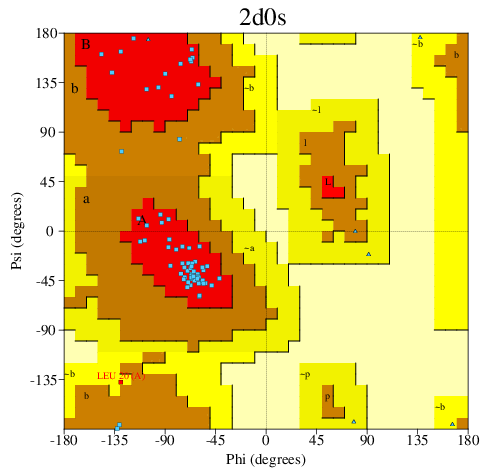
PROCHECK
|
|
|
|
|
|
Headers
|
|
|
|
References
|
|
|
|
|
|

|
|
Q76IQ6
(Q76IQ6_HYDTE) -
Cytochrome c from Hydrogenophilus thermoluteolus
|
|
|
|
Seq:
Struc:
|
|
|
|
102 a.a.
79 a.a.
|
|

|

|
|
|
|
|
|
|
|
|
|
|
|
Key: |
 |
PfamA domain |
|
|
 |
Secondary structure |
|
 |
CATH domain |
|
|
|
|
|
|
|
|
|
|
|
|
|
|
|
|
|
 |
|
|
|
|
|
|
| |
|
DOI no:
|
Biochemistry
45:6115-6123
(2006)
|
|
PubMed id:
|
|
|
|
|
|
| |
|
Structure of cytochrome c552 from a moderate thermophilic bacterium, Hydrogenophilus thermoluteolus: comparative study on the thermostability of cytochrome c.
|
|
S.Nakamura,
S.Ichiki,
H.Takashima,
S.Uchiyama,
J.Hasegawa,
Y.Kobayashi,
Y.Sambongi,
T.Ohkubo.
|
|
|
|
|
| |
ABSTRACT
|
|
|
|
| |
|
|
We have studied the structure-thermostability relationship using cytochromes c
from mesophilic and thermophilic bacteria; Pseudomonas aeruginosa (PAc(551))
growing at 37 degrees C and Hydrogenobacter thermophilus (HTc(552)) at 72
degrees C and showed that only five residues primarily differentiate their
stabilities. For a more comprehensive study, we found Hydrogenophilus
thermoluteolus (Pseudomonas hydrogenothermophila) growing at 52 degrees C and
showed the moderate stability of the cytochrome c from this bacterium
(PHc(552)). To explore the stabilization mechanisms, the crystal structure of
PHc(552) was determined by X-ray analysis. The solution structure of HTc(552)
elucidated previously by NMR was refined using distributed computational
implementation. Furthermore, the recently reported crystal structure of HTc(552)
has become available [Travaglini-Allocatelli, C. et al. (2005) J. Biol. Chem.
280, 25729-25734]. When the structures of these three cytochromes c were
combined, this revealed that the five residues, corresponding to those mentioned
above, determine the difference of stabilities among them as well. These facts
suggested the stabilization mechanisms as follows: (1) improved van der Waals
interactions by packing optimization at the N-terminal helix, (2) attractive
electrostatic interactions with the heme propionate group, and (3) favorable van
der Waals interaction with the heme. This comparative study, by supplementing
the structural information of PHc(552) with its complementary feature,
demonstrates that just a small number of amino acid residues determine the
overall molecular stability by means of additivity of the effects of their
substitutions. It is interesting that, in naturally occurring proteins, these
adaptation strategies are accommodated by these bacteria to survive in the wide
range of thermal conditions.
|
|
|
|
|
|
|
|
|
|
|
|
|
|
|
|
|
|
 |
 |
 |
|
Literature references that cite this PDB file's key reference
|
|
|
| |
PubMed id
|
|
Reference
|
|
|
|
|
|
K.Oda,
R.Kodama,
T.Yoshidome,
M.Yamanaka,
Y.Sambongi,
and
M.Kinoshita
(2011).
Effects of heme on the thermal stability of mesophilic and thermophilic cytochromes c: comparison between experimental and theoretical results.
|
| |
J Chem Phys,
134,
025101.
|
|
|
|
|
|
|
M.Obuchi,
K.Kawahara,
D.Motooka,
S.Nakamura,
M.Yamanaka,
T.Takeda,
S.Uchiyama,
Y.Kobayashi,
T.Ohkubo,
and
Y.Sambongi
(2009).
Hyperstability and crystal structure of cytochrome c(555) from hyperthermophilic Aquifex aeolicus.
|
| |
Acta Crystallogr D Biol Crystallogr,
65,
804-813.
|
|
|
PDB code:
|
|
|
|
|
|
|
|
T.Takeda,
T.Sonoyama,
S.J.Takayama,
H.Mita,
Y.Yamamoto,
and
Y.Sambongi
(2009).
Correlation between the stability and redox potential of three homologous cytochromes c from two thermophiles and one mesophile.
|
| |
Biosci Biotechnol Biochem,
73,
366-371.
|
|
|
|
|
|
|
Y.Kobayashi,
T.Sonoyama,
T.Takeda,
and
Y.Sambongi
(2009).
Effects of cysteine introduction into three homologous cytochromes C.
|
| |
Biosci Biotechnol Biochem,
73,
1227-1229.
|
|
|
|
|
|
|
S.Hakamada,
T.Sonoyama,
S.Ichiki,
S.Nakamura,
S.Uchiyama,
Y.Kobayashi,
and
Y.Sambongi
(2008).
Stabilization mechanism of cytochrome c552 from a moderately thermophilic bacterium, Hydrogenophilus thermoluteolus.
|
| |
Biosci Biotechnol Biochem,
72,
2103-2109.
|
|
|
|
|
|
|
R.A.Goldstein
(2007).
Amino-acid interactions in psychrophiles, mesophiles, thermophiles, and hyperthermophiles: insights from the quasi-chemical approximation.
|
| |
Protein Sci,
16,
1887-1895.
|
|
|
|
|
|
The most recent references are shown first.
Citation data come partly from CiteXplore and partly
from an automated harvesting procedure. Note that this is likely to be
only a partial list as not all journals are covered by
either method. However, we are continually building up the citation data
so more and more references will be included with time.
Where a reference describes a PDB structure, the PDB
code is
shown on the right.
|
|


 Links
Links


