 |
PDBsum entry 2bu7

|
|
|
|
|
 |
Contents |
 |
|
|
|
|
|
|
|
|
|
|
|
|
* Residue conservation analysis
|
|
|
|
|
|
PDB id:
|
|
|
|
| Name: |
|
Transferase
|
|
|
Title:
|
|
Crystal structures of human pyruvate dehydrogenase kinase 2 containing physiological and synthetic ligands
|
|
Structure:
|
|
Pyruvate dehydrogenase kinase isoenzyme 2. Chain: a. Synonym: pyruvate dehydrogenase kinase isoform 2. Engineered: yes
|
|
Source:
|
|
Homo sapiens. Human. Organism_taxid: 9606. Expressed in: trichoplusia ni. Expression_system_taxid: 7111. Expression_system_cell_line: high five.
|
|
Biol. unit:
|
|
 Dimer (from PDB file)
|
|
Resolution:
|
|
|
2.40Å
|
R-factor:
|
0.211
|
R-free:
|
0.241
|
|
|
Authors:
|
|
T.R.Knoechel,A.D.Tucker,C.M.Robinson,C.Phillips,W.Taylor,P.J.Bungay, S.A.Kasten,T.E.Roche,D.G.Brown
|
Key ref:

|
|
T.R.Knoechel
et al.
(2006).
Regulatory roles of the N-terminal domain based on crystal structures of human pyruvate dehydrogenase kinase 2 containing physiological and synthetic ligands.
Biochemistry,
45,
402-415.
PubMed id:
DOI:
|
|
|
Date:
|
|
|
08-Jun-05
|
Release date:
|
02-Feb-06
|
|
|
|
|
|
|
PROCHECK
|

|
|
|
|
|
Headers
|
|
|
|
References
|
|
|
|
|
|

|
|
Q15119
(PDK2_HUMAN) -
[Pyruvate dehydrogenase (acetyl-transferring)] kinase isozyme 2, mitochondrial from Homo sapiens
|
|
|
|
Seq:
Struc:
|
|
|
|
407 a.a.
359 a.a.*
|
|

|

|

|
|
|
|
|
|
|
|
|
|
|
Key: |
 |
PfamA domain |
|
|
 |
Secondary structure |
|
 |
CATH domain |
|
|
*
PDB and UniProt seqs differ
at 2 residue positions (black
crosses)
|
|
|
|
|
|
|
|
|
|
|
|
|
Enzyme class:
|
|
E.C.2.7.11.2
- [pyruvate dehydrogenase (acetyl-transferring)] kinase.
|
|
|
|
|
|
|
Reaction:
|
|
L-seryl-[pyruvate dehydrogenase E1 alpha subunit] + ATP = O-phospho-L- seryl-[pyruvate dehydrogenase E1 alpha subunit] + ADP + H+
|
|
|
|
|
|
L-seryl-[pyruvate dehydrogenase E1 alpha subunit]
|
+
|
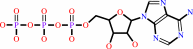 ATP
ATP
|
=
|
O-phospho-L- seryl-[pyruvate dehydrogenase E1 alpha subunit]
|
+
|
 ADP
ADP
|
+
|
H(+)
|
|
|
|
|
|
|
|
|
|
|
|
|
Molecule diagrams generated from .mol files obtained from the
KEGG ftp site
|
|
|
|
|
|
|
|
|
|
|
|
|
|
 |
|
|
|
|
|
|
| |
|
|
| |
|
DOI no:
|
Biochemistry
45:402-415
(2006)
|
|
PubMed id:
|
|
|
|
|
|
| |
|
Regulatory roles of the N-terminal domain based on crystal structures of human pyruvate dehydrogenase kinase 2 containing physiological and synthetic ligands.
|
|
T.R.Knoechel,
A.D.Tucker,
C.M.Robinson,
C.Phillips,
W.Taylor,
P.J.Bungay,
S.A.Kasten,
T.E.Roche,
D.G.Brown.
|
|
|
|
|
| |
ABSTRACT
|
|
|
|
| |
|
|
Pyruvate dehydrogenase kinase (PDHK) regulates the activity of the pyruvate
dehydrogenase multienzyme complex. PDHK inhibition provides a route for
therapeutic intervention in diabetes and cardiovascular disorders. We report
crystal structures of human PDHK isozyme 2 complexed with physiological and
synthetic ligands. Several of the PDHK2 structures disclosed have C-terminal
cross arms that span a large trough region between the N-terminal regulatory (R)
domains of the PDHK2 dimers. The structures containing bound ATP and ADP
demonstrate variation in the conformation of the active site lid, residues
316-321, which enclose the nucleotide beta and gamma phosphates at the active
site in the C-terminal catalytic domain. We have identified three novel ligand
binding sites located in the R domain of PDHK2. Dichloroacetate (DCA) binds at
the pyruvate binding site in the center of the R domain, which together with
ADP, induces significant changes at the active site. Nov3r and AZ12 inhibitors
bind at the lipoamide binding site that is located at one end of the R domain.
Pfz3 (an allosteric inhibitor) binds in an extended site at the other end of the
R domain. We conclude that the N-terminal domain of PDHK has a key regulatory
function and propose that the different inhibitor classes act by discrete
mechanisms. The structures we describe provide insights that can be used for
structure-based design of PDHK inhibitors.
|
|
|
|
|
|
|
|
|
|
|
|
|
|
|
|
|
|
 |
 |
 |
|
Literature references that cite this PDB file's key reference
|
|
|
| |
PubMed id
|
|
Reference
|
|
|
|
|
|
I.Papandreou,
T.Goliasova,
and
N.C.Denko
(2011).
Anticancer drugs that target metabolism: Is dichloroacetate the new paradigm?
|
| |
Int J Cancer,
128,
1001-1008.
|
|
|
|
|
|
|
J.Li,
M.Kato,
and
D.T.Chuang
(2009).
Pivotal role of the C-terminal DW-motif in mediating inhibition of pyruvate dehydrogenase kinase 2 by dichloroacetate.
|
| |
J Biol Chem,
284,
34458-34467.
|
|
|
|
|
|
|
A.Klyuyeva,
A.Tuganova,
and
K.M.Popov
(2008).
Allosteric coupling in pyruvate dehydrogenase kinase 2.
|
| |
Biochemistry,
47,
8358-8366.
|
|
|
|
|
|
|
R.M.Wynn,
M.Kato,
J.L.Chuang,
S.C.Tso,
J.Li,
and
D.T.Chuang
(2008).
Pyruvate dehydrogenase kinase-4 structures reveal a metastable open conformation fostering robust core-free basal activity.
|
| |
J Biol Chem,
283,
25305-25315.
|
|
|
PDB codes:
|
|
|
|
|
|
|
|
T.Green,
A.Grigorian,
A.Klyuyeva,
A.Tuganova,
M.Luo,
and
K.M.Popov
(2008).
Structural and functional insights into the molecular mechanisms responsible for the regulation of pyruvate dehydrogenase kinase 2.
|
| |
J Biol Chem,
283,
15789-15798.
|
|
|
PDB codes:
|
|
|
|
|
|
|
|
A.Klyuyeva,
A.Tuganova,
and
K.M.Popov
(2007).
Amino acid residues responsible for the recognition of dichloroacetate by pyruvate dehydrogenase kinase 2.
|
| |
FEBS Lett,
581,
2988-2992.
|
|
|
|
|
|
|
A.Tuganova,
A.Klyuyeva,
and
K.M.Popov
(2007).
Recognition of the inner lipoyl-bearing domain of dihydrolipoyl transacetylase and of the blood glucose-lowering compound AZD7545 by pyruvate dehydrogenase kinase 2.
|
| |
Biochemistry,
46,
8592-8602.
|
|
|
|
|
|
|
M.Kato,
J.Li,
J.L.Chuang,
and
D.T.Chuang
(2007).
Distinct structural mechanisms for inhibition of pyruvate dehydrogenase kinase isoforms by AZD7545, dichloroacetate, and radicicol.
|
| |
Structure,
15,
992.
|
|
|
PDB codes:
|
|
|
|
|
|
|
|
S.Bonnet,
S.L.Archer,
J.Allalunis-Turner,
A.Haromy,
C.Beaulieu,
R.Thompson,
C.T.Lee,
G.D.Lopaschuk,
L.Puttagunta,
S.Bonnet,
G.Harry,
K.Hashimoto,
C.J.Porter,
M.A.Andrade,
B.Thebaud,
and
E.D.Michelakis
(2007).
A mitochondria-K+ channel axis is suppressed in cancer and its normalization promotes apoptosis and inhibits cancer growth.
|
| |
Cancer Cell,
11,
37-51.
|
|
|
|
|
|
|
Y.Devedjiev,
C.N.Steussy,
and
D.G.Vassylyev
(2007).
Crystal structure of an asymmetric complex of pyruvate dehydrogenase kinase 3 with lipoyl domain 2 and its biological implications.
|
| |
J Mol Biol,
370,
407-416.
|
|
|
PDB code:
|
|
|
|
|
|
|
|
S.C.Tso,
M.Kato,
J.L.Chuang,
and
D.T.Chuang
(2006).
Structural determinants for cross-talk between pyruvate dehydrogenase kinase 3 and lipoyl domain 2 of the human pyruvate dehydrogenase complex.
|
| |
J Biol Chem,
281,
27197-27204.
|
|
|
|
|
|
|
Y.Hiromasa,
L.Hu,
and
T.E.Roche
(2006).
Ligand-induced effects on pyruvate dehydrogenase kinase isoform 2.
|
| |
J Biol Chem,
281,
12568-12579.
|
|
|
|
|
|
The most recent references are shown first.
Citation data come partly from CiteXplore and partly
from an automated harvesting procedure. Note that this is likely to be
only a partial list as not all journals are covered by
either method. However, we are continually building up the citation data
so more and more references will be included with time.
Where a reference describes a PDB structure, the PDB
codes are
shown on the right.
|
|


 Links
Links


