 |
PDBsum entry 1xwh

|
|
|
|
|
|

|

|

|

|
|

|
|

|
|

|
|

|
|
|
 |

|

|
|
|
|
|
|
|
|
|
|
|
|
|
|
|
|
|
|
|
|
|
|
|
|
|
|
|
|
|
|
|
|
|
Transcription
|
PDB id
|
|
|
|
1xwh
|
|
|
|
|
|
|
|
|
|
|
|
|
|
|

|

|

|
|
|
|
|
|
|
|
 |
Contents |
 |
|
|
|
|
|
|
|
|
|
|
* Residue conservation analysis
|
|
|
|
|
|
PDB id:
|
|
|
|
| Name: |
|
Transcription
|
|
|
Title:
|
|
Nmr structure of the first phd finger of autoimmune regulator protein (aire1): insights into apeced
|
|
Structure:
|
|
Autoimmune regulator. Chain: a. Fragment: first phddomain. Synonym: autoimmune polyendocrinopathy candidiasis ectodermal dystrophy protein, apeced protein. Engineered: yes
|
|
Source:
|
|
Homo sapiens. Human. Organism_taxid: 9606. Gene: aire1. Expressed in: escherichia coli bl21(de3). Expression_system_taxid: 469008.
|
|
NMR struc:
|
|
20 models
|
|
|
Authors:
|
|
M.J.Bottomley,G.Stier,J.Krasotkina,G.Legube,B.Simon,A.Akhtar, M.Sattler,G.Musco
|
Key ref:

|
|
M.J.Bottomley
et al.
(2005).
NMR structure of the first PHD finger of autoimmune regulator protein (AIRE1). Insights into autoimmune polyendocrinopathy-candidiasis-ectodermal dystrophy (APECED) disease.
J Biol Chem,
280,
11505-11512.
PubMed id:
DOI:

|
|
|
Date:
|
|
|
01-Nov-04
|
Release date:
|
25-Jan-05
|
|
|
|
|
|
|
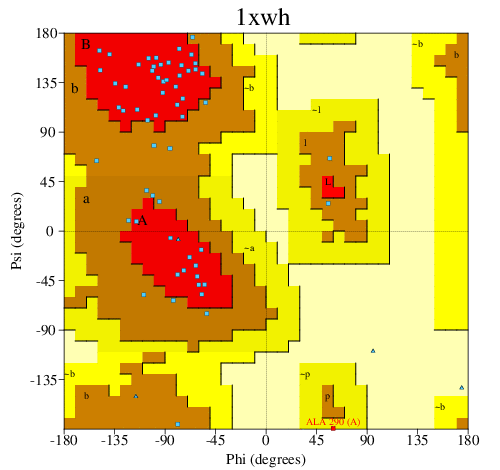
PROCHECK
|
|
|
|
|
|
Headers
|
|
|
|
References
|
|
|
|
|
|

|
|
O43918
(AIRE_HUMAN) -
Autoimmune regulator from Homo sapiens
|
|
|
|
Seq:
Struc:
|
|
|
|
545 a.a.
66 a.a.*
|
|

|

|
|
|
|
|
|
|
|
|
|
|
|
Key: |
 |
PfamA domain |
|
|
 |
Secondary structure |
|
 |
CATH domain |
|
|
*
PDB and UniProt seqs differ
at 4 residue positions (black
crosses)
|
|
|
|
|
|
|
|
|
|
|
|
|
|
|
|
|
 |
|
|
|
|
|
|
| |
|
DOI no:
|
J Biol Chem
280:11505-11512
(2005)
|
|
PubMed id:
|
|
|
|
|
|
| |
|
NMR structure of the first PHD finger of autoimmune regulator protein (AIRE1). Insights into autoimmune polyendocrinopathy-candidiasis-ectodermal dystrophy (APECED) disease.
|
|
M.J.Bottomley,
G.Stier,
D.Pennacchini,
G.Legube,
B.Simon,
A.Akhtar,
M.Sattler,
G.Musco.
|
|
|
|
|
| |
ABSTRACT
|
|
|
|
| |
|
|
Mutations in the autoimmune regulator protein AIRE1 cause a monogenic autosomal
recessively inherited disease: autoimmune
polyendocrinopathy-candidiasis-ectodermal dystrophy (APECED). AIRE1 is a
multidomain protein that harbors two plant homeodomain (PHD)-type zinc fingers.
The first PHD finger of AIRE1 is a mutational hot spot, to which several
pathological point mutations have been mapped. Using heteronuclear NMR
spectroscopy, we determined the solution structure of the first PHD finger of
AIRE1 (AIRE1-PHD1), and characterized the peptide backbone mobility of the
domain. We performed a conformational analysis of pathological AIRE1-PHD1
mutants that allowed us to rationalize the structural impact of APECED-causing
mutations and to identify an interaction site with putative protein ligands of
the AIRE1-PHD1 domain. The structure unequivocally exhibits the canonical PHD
finger fold, with a highly conserved tryptophan buried inside the structure. The
PHD finger is stabilized by two zinc ions coordinated in an interleaved
(cross-brace) scheme. This zinc coordination resembles RING finger domains,
which can function as E3 ligases in the ubiquitination pathway. Based on this
fold similarity, it has been suggested that PHD fingers might also function as
E3 ligases, although this hypothesis is controversial. At variance to a previous
report, we could not find any evidence that AIRE1-PHD1 has an intrinsic E3
ubiquitin ligase activity, nor detect any direct interaction between AIRE1-PHD1
and its putative cognate E2. Consistently, we show that the AIRE1-PHD1 structure
is clearly distinct from the RING finger fold. Our results point to a function
of the AIRE1-PHD1 domain in protein-protein interactions, which is impaired in
some APECED mutations.
|
|
|
|
|
|
| |
Selected figure(s)
|
|
|
|
| |
|
|

|
|

|
|
Figure 1.
FIG. 1. The three-dimensional structure of the AIRE1-PHD1
domain. A, multiple sequence alignment of PHD and RING finger
domains. Zinc-binding residues and the conserved Trp are marked
with asterisks (*). Sites of APECED-causing mutations are marked
with a red plus (+). Secondary structure elements of AIRE1-PHD1
are shown above the alignment. B, stereo-view representation of
the backbone atoms (N, C  , C') for residues
295-344 of an NMR ensemble of 20 structures. Secondary structure
elements are in blue, the loops and random coil in gray, the
variable loop L3 in yellow, the zinc ions in pink, and the
commonly conserved Trp residue side chain in cyan. C, ribbon
representation of AIRE1-PHD1 (same orientation as B, showing the
side chains (cyan) and atoms (sulfur in yellow, nitrogen in
green) of the zinc-coordinating residues, plus the conserved
Trp335 (cyan). , C') for residues
295-344 of an NMR ensemble of 20 structures. Secondary structure
elements are in blue, the loops and random coil in gray, the
variable loop L3 in yellow, the zinc ions in pink, and the
commonly conserved Trp residue side chain in cyan. C, ribbon
representation of AIRE1-PHD1 (same orientation as B, showing the
side chains (cyan) and atoms (sulfur in yellow, nitrogen in
green) of the zinc-coordinating residues, plus the conserved
Trp335 (cyan).
|
|
Figure 5.
FIG. 5. Location and structural effects of APECED causing
mutations. 1H-1D spectra (amide region) of pathological mutants
of AIRE1-PHD1 and of wild-type AIRE1-PHD1 and AIRE1-PHD2. A,
mutant C311Y; B, AIRE1-PHD1 wild type upon addition of 20 mM
EDTA; C, mutant P326Q; D, mutant P326L; asterisks indicate the
presence of additional conformers, possibly coming from a
cis-trans isomerization of P325; E, mutant V301M; F, wild-type
AIRE1 PHD1, and G, wild-type AIRE1-PHD2; H, ribbon
representation of the AIRE1-PHD1 structure (blue) and mapping of
pathological point mutations by showing their side chains in
red; the zinc-binding residues are in cyan, the cis-proline
Pro325 in yellow, and the zinc ions in pink. I, space-filled
representation of AIRE1-PHD1, with pathological mutation sites
in red, Pro325 in yellow and zinc ions in pink. Val301 and
Pro326 are partially exposed to the surface.
|
|
|
|
|
|
| |
The above figures are
reprinted
by permission from the ASBMB:
J Biol Chem
(2005,
280,
11505-11512)
copyright 2005.
|
|
| |
Figures were
selected
by the author.
|
|
|
|
|
|
|
|
|
|
|
|
|
|
|
|
 |
 |
 |
|
Literature references that cite this PDB file's key reference
|
|
|
| |
PubMed id
|
|
Reference
|
|
|
|
|
|
A.H.Aguissa-Touré,
R.P.Wong,
and
G.Li
(2011).
The ING family tumor suppressors: from structure to function.
|
| |
Cell Mol Life Sci,
68,
45-54.
|
|
|
|
|
|
|
S.A.Eldershaw,
D.M.Sansom,
and
P.Narendran
(2011).
Expression and function of the autoimmune regulator (Aire) gene in non-thymic tissue.
|
| |
Clin Exp Immunol,
163,
296-308.
|
|
|
|
|
|
|
K.L.Yap,
and
M.M.Zhou
(2010).
Keeping it in the family: diverse histone recognition by conserved structural folds.
|
| |
Crit Rev Biochem Mol Biol,
45,
488-505.
|
|
|
|
|
|
|
A.H.Coles,
and
S.N.Jones
(2009).
The ING gene family in the regulation of cell growth and tumorigenesis.
|
| |
J Cell Physiol,
218,
45-57.
|
|
|
|
|
|
|
D.Mathis,
and
C.Benoist
(2009).
Aire.
|
| |
Annu Rev Immunol,
27,
287-312.
|
|
|
|
|
|
|
F.Chignola,
M.Gaetani,
A.Rebane,
T.Org,
L.Mollica,
C.Zucchelli,
A.Spitaleri,
V.Mannella,
P.Peterson,
and
G.Musco
(2009).
The solution structure of the first PHD finger of autoimmune regulator in complex with non-modified histone H3 tail reveals the antagonistic role of H3R2 methylation.
|
| |
Nucleic Acids Res,
37,
2951-2961.
|
|
|
PDB code:
|
|
|
|
|
|
|
|
V.G.Bhoj,
and
Z.J.Chen
(2009).
Ubiquitylation in innate and adaptive immunity.
|
| |
Nature,
458,
430-437.
|
|
|
|
|
|
|
W.Wei,
J.Huang,
Y.J.Hao,
H.F.Zou,
H.W.Wang,
J.Y.Zhao,
X.Y.Liu,
W.K.Zhang,
B.Ma,
J.S.Zhang,
and
S.Y.Chen
(2009).
Soybean GmPHD-type transcription regulators improve stress tolerance in transgenic Arabidopsis plants.
|
| |
PLoS One,
4,
e7209.
|
|
|
|
|
|
|
A.S.Bøe Wolff,
B.Oftedal,
S.Johansson,
O.Bruland,
K.Løvås,
A.Meager,
C.Pedersen,
E.S.Husebye,
and
P.M.Knappskog
(2008).
AIRE variations in Addison's disease and autoimmune polyendocrine syndromes (APS): partial gene deletions contribute to APS I.
|
| |
Genes Immun,
9,
130-136.
|
|
|
|
|
|
|
A.S.Koh,
A.J.Kuo,
S.Y.Park,
P.Cheung,
J.Abramson,
D.Bua,
D.Carney,
S.E.Shoelson,
O.Gozani,
R.E.Kingston,
C.Benoist,
and
D.Mathis
(2008).
Aire employs a histone-binding module to mediate immunological tolerance, linking chromatin regulation with organ-specific autoimmunity.
|
| |
Proc Natl Acad Sci U S A,
105,
15878-15883.
|
|
|
|
|
|
|
G.Musco,
and
P.Peterson
(2008).
PHD finger of autoimmune regulator: An epigenetic link between the histone modifications and tissue-specific antigen expression in thymus.
|
| |
Epigenetics,
3,
310-314.
|
|
|
|
|
|
|
I.Liiv,
A.Rebane,
T.Org,
M.Saare,
J.Maslovskaja,
K.Kisand,
E.Juronen,
L.Valmu,
M.J.Bottomley,
N.Kalkkinen,
and
P.Peterson
(2008).
DNA-PK contributes to the phosphorylation of AIRE: Importance in transcriptional activity.
|
| |
Biochim Biophys Acta,
1783,
74-83.
|
|
|
|
|
|
|
L.A.Baker,
C.D.Allis,
and
G.G.Wang
(2008).
PHD fingers in human diseases: disorders arising from misinterpreting epigenetic marks.
|
| |
Mutat Res,
647,
3.
|
|
|
|
|
|
|
M.Saltis,
M.F.Criscitiello,
Y.Ohta,
M.Keefe,
N.S.Trede,
R.Goitsuka,
and
M.F.Flajnik
(2008).
Evolutionarily conserved and divergent regions of the autoimmune regulator (Aire) gene: a comparative analysis.
|
| |
Immunogenetics,
60,
105-114.
|
|
|
|
|
|
|
P.Peterson,
T.Org,
and
A.Rebane
(2008).
Transcriptional regulation by AIRE: molecular mechanisms of central tolerance.
|
| |
Nat Rev Immunol,
8,
948-957.
|
|
|
|
|
|
|
A.E.Lin,
and
T.W.Mak
(2007).
The role of E3 ligases in autoimmunity and the regulation of autoreactive T cells.
|
| |
Curr Opin Immunol,
19,
665-673.
|
|
|
|
|
|
|
D.Mathis,
and
C.Benoist
(2007).
A decade of AIRE.
|
| |
Nat Rev Immunol,
7,
645-650.
|
|
|
|
|
|
|
I.Gavanescu,
B.Kessler,
H.Ploegh,
C.Benoist,
and
D.Mathis
(2007).
Loss of Aire-dependent thymic expression of a peripheral tissue antigen renders it a target of autoimmunity.
|
| |
Proc Natl Acad Sci U S A,
104,
4583-4587.
|
|
|
|
|
|
|
J.J.DeVoss,
and
M.S.Anderson
(2007).
Lessons on immune tolerance from the monogenic disease APS1.
|
| |
Curr Opin Genet Dev,
17,
193-200.
|
|
|
|
|
|
|
J.M.Schartner,
C.G.Fathman,
and
C.M.Seroogy
(2007).
Preservation of self: an overview of E3 ubiquitin ligases and T cell tolerance.
|
| |
Semin Immunol,
19,
188-196.
|
|
|
|
|
|
|
M.H.Cheng,
A.K.Shum,
and
M.S.Anderson
(2007).
What's new in the Aire?
|
| |
Trends Immunol,
28,
321-327.
|
|
|
|
|
|
|
M.Karbowski,
A.Neutzner,
and
R.J.Youle
(2007).
The mitochondrial E3 ubiquitin ligase MARCH5 is required for Drp1 dependent mitochondrial division.
|
| |
J Cell Biol,
178,
71-84.
|
|
|
|
|
|
|
B.Kyewski,
and
L.Klein
(2006).
A central role for central tolerance.
|
| |
Annu Rev Immunol,
24,
571-606.
|
|
|
|
|
|
|
B.Stolarski,
E.Pronicka,
L.Korniszewski,
A.Pollak,
G.Kostrzewa,
E.Rowińska,
P.Włodarski,
A.Skórka,
M.Gremida,
P.Krajewski,
and
R.Ploski
(2006).
Molecular background of polyendocrinopathy-candidiasis-ectodermal dystrophy syndrome in a Polish population: novel AIRE mutations and an estimate of disease prevalence.
|
| |
Clin Genet,
70,
348-354.
|
|
|
|
|
|
|
C.Ramsey,
S.Hässler,
P.Marits,
O.Kämpe,
C.D.Surh,
L.Peltonen,
and
O.Winqvist
(2006).
Increased antigen presenting cell-mediated T cell activation in mice and patients without the autoimmune regulator.
|
| |
Eur J Immunol,
36,
305-317.
|
|
|
|
|
|
|
H.Li,
S.Ilin,
W.Wang,
E.M.Duncan,
J.Wysocka,
C.D.Allis,
and
D.J.Patel
(2006).
Molecular basis for site-specific read-out of histone H3K4me3 by the BPTF PHD finger of NURF.
|
| |
Nature,
442,
91-95.
|
|
|
PDB codes:
|
|
|
|
|
|
|
|
M.Bienz
(2006).
The PHD finger, a nuclear protein-interaction domain.
|
| |
Trends Biochem Sci,
31,
35-40.
|
|
|
|
|
|
|
K.A.Hogquist,
T.A.Baldwin,
and
S.C.Jameson
(2005).
Central tolerance: learning self-control in the thymus.
|
| |
Nat Rev Immunol,
5,
772-782.
|
|
|
|
|
|
|
M.S.Anderson,
E.S.Venanzi,
Z.Chen,
S.P.Berzins,
C.Benoist,
and
D.Mathis
(2005).
The cellular mechanism of Aire control of T cell tolerance.
|
| |
Immunity,
23,
227-239.
|
|
|
|
|
|
|
P.J.Lehner,
S.Hoer,
R.Dodd,
and
L.M.Duncan
(2005).
Downregulation of cell surface receptors by the K3 family of viral and cellular ubiquitin E3 ligases.
|
| |
Immunol Rev,
207,
112-125.
|
|
|
|
|
|
|
P.Peterson,
and
L.Peltonen
(2005).
Autoimmune polyendocrinopathy syndrome type 1 (APS1) and AIRE gene: new views on molecular basis of autoimmunity.
|
| |
J Autoimmun,
25,
49-55.
|
|
|
|
|
|
|
T.Ilmarinen,
P.Eskelin,
M.Halonen,
T.Rüppell,
R.Kilpikari,
G.D.Torres,
H.Kangas,
and
I.Ulmanen
(2005).
Functional analysis of SAND mutations in AIRE supports dominant inheritance of the G228W mutation.
|
| |
Hum Mutat,
26,
322-331.
|
|
|
|
|
|
|
X.Shi,
and
O.Gozani
(2005).
The fellowships of the INGs.
|
| |
J Cell Biochem,
96,
1127-1136.
|
|
|
|
|
|
|
Y.C.Liu,
J.Penninger,
and
M.Karin
(2005).
Immunity by ubiquitylation: a reversible process of modification.
|
| |
Nat Rev Immunol,
5,
941-952.
|
|
|
|
|
|
The most recent references are shown first.
Citation data come partly from CiteXplore and partly
from an automated harvesting procedure. Note that this is likely to be
only a partial list as not all journals are covered by
either method. However, we are continually building up the citation data
so more and more references will be included with time.
Where a reference describes a PDB structure, the PDB
code is
shown on the right.
|
|


 Links
Links


