 |
PDBsum entry 1xvq

|
|
|
|
|
|

|

|

|

|
|

|
|

|
|

|
|

|
|

|
|
|
 |

|

|
|
|
|
|
|
|
|
|
|
|
|
|
|
|
|
|
|
|
|
|
|
|
|
|
|
|
|
|
|
|
|
|
|
Oxidoreductase
|
PDB id
|
|
|
|
1xvq
|
|
|
|
|
|
|
|
|
|
|
|
|
|
|

|

|

|
|
|
|
|
|
|
|
 |
Contents |
 |
|
|
|
|
|
|
|
|
|
|
|
|
|
|
* Residue conservation analysis
|
|
|
|
|
|
PDB id:
|
|
|
|
| Name: |
|
Oxidoreductase
|
|
|
Title:
|
|
Crystal structure of thiol peroxidase from mycobacterium tuberculosis
|
|
Structure:
|
|
Thiol peroxidase. Chain: a. Engineered: yes
|
|
Source:
|
|
Mycobacterium tuberculosis. Organism_taxid: 1773. Gene: tpx. Expressed in: escherichia coli bl21(de3). Expression_system_taxid: 469008.
|
|
Biol. unit:
|
|
 Dimer (from
)
Dimer (from
)
|
|
Resolution:
|
|
|
1.75Å
|
R-factor:
|
0.203
|
R-free:
|
0.225
|
|
|
Authors:
|
|
B.S.Rho,J.D.Pedelacq,L.W.Hung,J.M.Holton,D.Vigil,S.I.Kim,M.S.Park, T.C.Terwilliger,Tb Structural Genomics Consortium (Tbsgc)
|
Key ref:

|
|
B.S.Rho
et al.
(2006).
Functional and structural characterization of a thiol peroxidase from Mycobacterium tuberculosis.
J Mol Biol,
361,
850-863.
PubMed id:
DOI:

|
|
|
Date:
|
|
|
28-Oct-04
|
Release date:
|
07-Dec-04
|
|
|
|
|
|
|
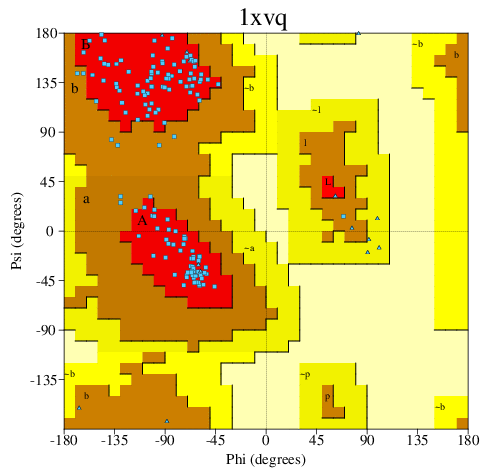
PROCHECK
|
|
|
|
|
|
Headers
|
|
|
|
References
|
|
|
|
|
|

|
|
P9WG35
(TPX_MYCTU) -
Thiol peroxidase from Mycobacterium tuberculosis (strain ATCC 25618 / H37Rv)
|
|
|
|
Seq:
Struc:
|
|
|
|
165 a.a.
160 a.a.*
|
|

|

|
|
|
|
|
|
|
|
|
|
|
|
Key: |
 |
PfamA domain |
|
|
 |
Secondary structure |
|
 |
CATH domain |
|
|
*
PDB and UniProt seqs differ
at 1 residue position (black
cross)
|
|
|
|
|
|
|
|
|
|
|
|
|
Enzyme class:
|
|
E.C.1.11.1.24
- thioredoxin-dependent peroxiredoxin.
|
|
|
|
|
|
|
Reaction:
|
|
a hydroperoxide + [thioredoxin]-dithiol = an alcohol + [thioredoxin]- disulfide + H2O
|
|
|
|
|
|
 hydroperoxide
|
+
|
[thioredoxin]-dithiol
|
=
|
 alcohol
|
+
|
[thioredoxin]- disulfide
|
+
|
H2O
|
|
|
|
|
|
|
|
|
|
|
|
|
Molecule diagrams generated from .mol files obtained from the
KEGG ftp site
|
|
|
|
|
|
|
|
|
|
|
|
|
|
 |
|
|
|
|
|
|
| |
|
|
| |
|
DOI no:
|
J Mol Biol
361:850-863
(2006)
|
|
PubMed id:
|
|
|
|
|
|
| |
|
Functional and structural characterization of a thiol peroxidase from Mycobacterium tuberculosis.
|
|
B.S.Rho,
L.W.Hung,
J.M.Holton,
D.Vigil,
S.I.Kim,
M.S.Park,
T.C.Terwilliger,
J.D.Pédelacq.
|
|
|
|
|
| |
ABSTRACT
|
|
|
|
| |
|
|
A thiol peroxidase (Tpx) from Mycobacterium tuberculosis was functionally
analyzed. The enzyme shows NADPH-linked peroxidase activity using a
thioredoxin-thioredoxin reductase system as electron donor, and anti-oxidant
activity in a thiol-dependent metal-catalyzed oxidation system. It reduces H2O2,
t-butyl hydroperoxide, and cumene hydroperoxide, and is inhibited by sulfhydryl
reagents. Mutational studies revealed that the peroxidatic (Cys60) and resolving
(Cys93) cysteine residues are critical amino acids for catalytic activity. The
X-ray structure determined to a resolution of 1.75 A shows a thioredoxin fold
similar to that of other peroxiredoxin family members. Superposition with
structural homologues in oxidized and reduced forms indicates that the M.
tuberculosis Tpx is a member of the atypical two-Cys peroxiredoxin family. In
addition, the short distance that separates the Calpha atoms of Cys60 and Cys93
and the location of these cysteine residues in unstructured regions may indicate
that the M. tuberculosis enzyme is oxidized, though the side-chain of Cys60 is
poorly visible. It is solely in the reduced Streptococcus pneumoniae Tpx
structure that both residues are part of two distinct helical segments. The M.
tuberculosis Tpx is dimeric both in solution and in the crystal structure. Amino
acid residues from both monomers delineate the active site pocket.
|
|
|
|
|
|
| |
Selected figure(s)
|
|
|
|
| |
|
|

|
|

|
|
Figure 5.
Figure 5. The three-dimensional Mtb Tpx structure. (a)
Stereo view of the 2F[o]−F[c] simulated-annealing omit map
contoured at 0.75 σ level (blue) in the Cys60 and Cys93 region
(yellow). The Cα trace of the reduced S. pneumoniae thiol
peroxidase is shown in grey. Omitted residues correspond
to Cys60, Cys80 and Cys93. (b) Stereo view of the Mtb Tpx
structure. β-Strands are in green, α-helices in dark red, and
3[10] helix in cyan. Cys60, Cys80, and Cys93 are shown in
ball-and-stick representation.
|
|
Figure 7.
Figure 7. Quaternary structure of the Mtb Tpx. (a) Dimer
interface with residues making hydrogen bond contacts shown in
ball-and-stick representation. (b) Overall shape and interface
of dimer−dimer interactions. A rectangle indicates a close
view of dimer−dimer interfaces. Dimers are shown in yellow
(molecules A and B) and red (molecules C and D). Residues making
close contacts interactions are shown with ball-and-stick
representations. Hydrogen bonds are indicated by dotted lines.
|
|
|
|
|
|
| |
The above figures are
reprinted
by permission from Elsevier:
J Mol Biol
(2006,
361,
850-863)
copyright 2006.
|
|
| |
Figures were
selected
by an automated process.
|
|
|
|
|
|
|
|
|
|
|
|
|
|
|
|
 |
 |
 |
|
Literature references that cite this PDB file's key reference
|
|
|
| |
PubMed id
|
|
Reference
|
|
|
|
|
|
H.T.Nguyen,
K.H.Nam,
Y.Saleem,
and
K.S.Kim
(2010).
Characterization of Helicobacter pylori adhesin thiol peroxidase (HP0390) purified from Escherichia coli.
|
| |
J Biosci,
35,
241-248.
|
|
|
|
|
|
|
S.A.Horst,
T.Jaeger,
L.A.Denkel,
S.F.Rouf,
M.Rhen,
and
F.C.Bange
(2010).
Thiol peroxidase protects Salmonella enterica from hydrogen peroxide stress in vitro and facilitates intracellular growth.
|
| |
J Bacteriol,
192,
2929-2932.
|
|
|
|
|
|
|
C.X.Machado,
P.M.Pinto,
A.Zaha,
and
H.B.Ferreira
(2009).
A peroxiredoxin from Mycoplasma hyopneumoniae with a possible role in H2O2 detoxification.
|
| |
Microbiology,
155,
3411-3419.
|
|
|
|
|
|
|
J.M.Atack,
and
D.J.Kelly
(2009).
Oxidative stress in Campylobacter jejuni: responses, resistance and regulation.
|
| |
Future Microbiol,
4,
677-690.
|
|
|
|
|
|
|
M.Cong,
D.Ni,
L.Song,
L.Wang,
J.Zhao,
L.Qiu,
and
L.Li
(2009).
Molecular cloning, characterization and mRNA expression of peroxiredoxin in Zhikong scallop Chlamys farreri.
|
| |
Mol Biol Rep,
36,
1451-1459.
|
|
|
|
|
|
|
Y.Hu,
and
A.R.Coates
(2009).
Acute and persistent Mycobacterium tuberculosis infections depend on the thiol peroxidase TpX.
|
| |
PLoS ONE,
4,
e5150.
|
|
|
|
|
|
|
D.Limauro,
E.Pedone,
I.Galdi,
and
S.Bartolucci
(2008).
Peroxiredoxins as cellular guardians in Sulfolobus solfataricus: characterization of Bcp1, Bcp3 and Bcp4.
|
| |
FEBS J,
275,
2067-2077.
|
|
|
|
|
|
|
J.M.Atack,
P.Harvey,
M.A.Jones,
and
D.J.Kelly
(2008).
The Campylobacter jejuni thiol peroxidases Tpx and Bcp both contribute to aerotolerance and peroxide-mediated stress resistance but have distinct substrate specificities.
|
| |
J Bacteriol,
190,
5279-5290.
|
|
|
|
|
|
|
S.La Carbona,
N.Sauvageot,
J.C.Giard,
A.Benachour,
B.Posteraro,
Y.Auffray,
M.Sanguinetti,
and
A.Hartke
(2007).
Comparative study of the physiological roles of three peroxidases (NADH peroxidase, Alkyl hydroperoxide reductase and Thiol peroxidase) in oxidative stress response, survival inside macrophages and virulence of Enterococcus faecalis.
|
| |
Mol Microbiol,
66,
1148-1163.
|
|
|
|
|
|
The most recent references are shown first.
Citation data come partly from CiteXplore and partly
from an automated harvesting procedure. Note that this is likely to be
only a partial list as not all journals are covered by
either method. However, we are continually building up the citation data
so more and more references will be included with time.
|
|


 Links
Links


