 |
PDBsum entry 1xpm

|
|
|
|
|
 |
Contents |
 |
|
|
|
|
|
|
|
|
|
|
|
|
* Residue conservation analysis
|
|
|
|
|
|
PDB id:
|
|
|
|
| Name: |
|
Transferase
|
|
|
Title:
|
|
Crystal structure of staphylococcus aureus hmg-coa synthase with hmg- coa and acetoacetyl-coa and acetylated cysteine
|
|
Structure:
|
|
3-hydroxy-3-methylglutaryl coa synthase. Chain: a, b, c, d. Engineered: yes
|
|
Source:
|
|
Staphylococcus aureus subsp. Aureus. Organism_taxid: 46170. Strain: subsp. Aureus. Gene: mvas. Expressed in: escherichia coli bl21(de3). Expression_system_taxid: 469008.
|
|
Biol. unit:
|
|
 Dimer (from
)
Dimer (from
)
|
|
Resolution:
|
|
|
1.60Å
|
R-factor:
|
0.210
|
R-free:
|
0.226
|
|
|
Authors:
|
|
M.J.Theisen,I.Misra,D.Saadat,N.Campobasso,H.M.Miziorko,D.H.T.Harrison
|
Key ref:

|
|
M.J.Theisen
et al.
(2004).
3-hydroxy-3-methylglutaryl-CoA synthase intermediate complex observed in "real-time".
Proc Natl Acad Sci U S A,
101,
16442-16447.
PubMed id:
DOI:

|
|
|
Date:
|
|
|
08-Oct-04
|
Release date:
|
02-Nov-04
|
|
|
|
|
|
|
PROCHECK
|

|
|
|
|
|
Headers
|
|
|
|
References
|
|
|
|
|
|

|
|
A0A0H3K1U2
(A0A0H3K1U2_STAAW) -
3-hydroxy-3-methylglutaryl CoA synthase from Staphylococcus aureus (strain MW2)
|
|
|
|
Seq:
Struc:
|
|
|
|
388 a.a.
390 a.a.*
|
|

|

|

|
|
|
|
|
|
|
|
|
|
|
Key: |
 |
PfamA domain |
|
|
 |
Secondary structure |
|
 |
CATH domain |
|
|
*
PDB and UniProt seqs differ
at 2 residue positions (black
crosses)
|
|
|
|
|
|
|
|
|
|
|
|
|
Enzyme class:
|
|
E.C.2.3.3.10
- hydroxymethylglutaryl-CoA synthase.
|
|
|
|
|
|
|
Pathway:
|
|
Mevalonate Biosynthesis
|
|
|
|
|
|
Reaction:
|
|
acetoacetyl-CoA + acetyl-CoA + H2O = (3S)-3-hydroxy-3-methylglutaryl-CoA + CoA + H+
|
|
|
|
|
|
acetoacetyl-CoA
Bound ligand (Het Group name = )
matches with 93.10% similarity
|
+
|
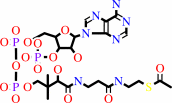 acetyl-CoA
|
+
|
H2O
|
=
|
(3S)-3-hydroxy-3-methylglutaryl-CoA
|
+
|
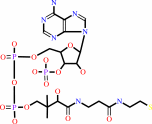 CoA
CoA
|
+
|
H(+)
|
|
|
|
|
|
|
|
|
|
|
|
|
Molecule diagrams generated from .mol files obtained from the
KEGG ftp site
|
|
|
|
|
|
|
|
|
|
|
|
|
|
 |
|
|
|
|
|
|
| |
|
|
| |
|
DOI no:
|
Proc Natl Acad Sci U S A
101:16442-16447
(2004)
|
|
PubMed id:
|
|
|
|
|
|
| |
|
3-hydroxy-3-methylglutaryl-CoA synthase intermediate complex observed in "real-time".
|
|
M.J.Theisen,
I.Misra,
D.Saadat,
N.Campobasso,
H.M.Miziorko,
D.H.Harrison.
|
|
|
|
|
| |
ABSTRACT
|
|
|
|
| |
|
|
The formation of carbon-carbon bonds via an acyl-enzyme intermediate plays a
central role in fatty acid, polyketide, and isoprenoid biosynthesis. Uniquely
among condensing enzymes, 3-hydroxy-3-methylglutaryl (HMG)-CoA synthase (HMGS)
catalyzes the formation of a carbon-carbon bond by activating the methyl group
of an acetylated cysteine. This reaction is essential in Gram-positive bacteria,
and represents the first committed step in human cholesterol biosynthesis.
Reaction kinetics, isotope exchange, and mass spectroscopy suggest surprisingly
that HMGS is able to catalyze the "backwards" reaction in solution,
where HMG-CoA is cleaved to form acetoacetyl-CoA (AcAc-CoA) and acetate. Here,
we trap a complex of acetylated HMGS from Staphylococcus aureus and bound
acetoacetyl-CoA by cryo-cooling enzyme crystals at three different times during
the course of its back-reaction with its physiological product (HMG-CoA). This
nonphysiological "backwards" reaction is used to understand the
details of the physiological reaction with regards to individual residues
involved in catalysis and substrate/product binding. The structures suggest that
an active-site glutamic acid (Glu-79) acts as a general base both in the
condensation between acetoacetyl-CoA and the acetylated enzyme, and the
hydrolytic release of HMG-CoA from the enzyme. The ability to trap this
enzyme-intermediate complex may suggest a role for protein dynamics and the
interplay between protomers during the normal course of catalysis.
|
|
|
|
|
|
| |
Selected figure(s)
|
|
|
|
| |
|
|

|
|

|
|
Figure 3.
Fig. 3. Schematic representation of the contacts in the
active site with AcAc-CoA (A) and the acetylcysteine and HMG-CoA
(B). The wide dashed lines indicate close contacts that violate
van der Waals distance constraints, and the narrow dashed lines
indicate potential hydrogen bonds. The average distances are
given in angstroms (10^-10 m) based on either 11 or 7
structures, and the numbers in parentheses are the standard
deviations of the distance multiplied by 100.
|
|
Figure 4.
Fig. 4. Models of the AcAc-CoA-acetylated enzyme complex
(A) and the HMG-CoA enzyme complex (B). The atoms are colored
according to their CPK atom type, and the bonds are shown in
either white (for protein) or gold (for the acetyl moiety and
the CoA molecules). Yellow-and-red dashed bonds tie reacting
atoms together.
|
|
|
|
| |
Figures were
selected
by an automated process.
|
|
|
|
|
|
|
|
|
|
|
|
|
|
|
|
 |
 |
 |
|
Literature references that cite this PDB file's key reference
|
|
|
| |
PubMed id
|
|
Reference
|
|
|
|
|
|
T.J.Buchholz,
C.M.Rath,
N.B.Lopanik,
N.P.Gardner,
K.Håkansson,
and
D.H.Sherman
(2010).
Polyketide β-branching in bryostatin biosynthesis: identification of surrogate acetyl-ACP donors for BryR, an HMG-ACP synthase.
|
| |
Chem Biol,
17,
1092-1100.
|
|
|
|
|
|
|
A.M.Haapalainen,
G.Meriläinen,
and
R.K.Wierenga
(2006).
The thiolase superfamily: condensing enzymes with diverse reaction specificities.
|
| |
Trends Biochem Sci,
31,
64-71.
|
|
|
|
|
|
|
F.Pojer,
J.L.Ferrer,
S.B.Richard,
D.A.Nagegowda,
M.L.Chye,
T.J.Bach,
and
J.P.Noel
(2006).
Structural basis for the design of potent and species-specific inhibitors of 3-hydroxy-3-methylglutaryl CoA synthases.
|
| |
Proc Natl Acad Sci U S A,
103,
11491-11496.
|
|
|
PDB codes:
|
|
|
|
|
|
|
|
D.Bourgeois,
and
A.Royant
(2005).
Advances in kinetic protein crystallography.
|
| |
Curr Opin Struct Biol,
15,
538-547.
|
|
|
|
|
|
|
B.J.Bahnson
(2004).
An atomic-resolution mechanism of 3-hydroxy-3-methylglutaryl-CoA synthase.
|
| |
Proc Natl Acad Sci U S A,
101,
16399-16400.
|
|
|
|
|
|
The most recent references are shown first.
Citation data come partly from CiteXplore and partly
from an automated harvesting procedure. Note that this is likely to be
only a partial list as not all journals are covered by
either method. However, we are continually building up the citation data
so more and more references will be included with time.
Where a reference describes a PDB structure, the PDB
codes are
shown on the right.
|
|


 Links
Links


