
|
|
|
|
|
 |
Contents |
 |
|
|
|
|
|
|
|
|
|
|
* Residue conservation analysis
|
|
|
|
|
|
|
|
|
|
Enzyme class 1:
|
|
Chain A:
E.C.?
|
|
|
|
|
|
|
Enzyme class 2:
|
|
Chain B:
E.C.2.7.11.22
- cyclin-dependent kinase.
|
|
|
|
|
|
|
Reaction:
|
|
|
1.
|
L-seryl-[protein] + ATP = O-phospho-L-seryl-[protein] + ADP + H+
|
|
2.
|
L-threonyl-[protein] + ATP = O-phospho-L-threonyl-[protein] + ADP + H+
|
|
|
|
|
|
|
L-seryl-[protein]
|
+
|
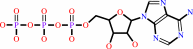 ATP
ATP
|
=
|
O-phospho-L-seryl-[protein]
|
+
|
 ADP
ADP
|
+
|
H(+)
|
|
|
|
|
|
|
L-threonyl-[protein]
|
+
|
ATP
|
=
|
O-phospho-L-threonyl-[protein]
|
+
|
ADP
|
+
|
H(+)
|
|
|
|
|
|
|
|
|
|
|
|
|
Note, where more than one E.C. class is given (as above), each may
correspond to a different protein domain or, in the case of polyprotein
precursors, to a different mature protein.
|
|
|
|
Molecule diagrams generated from .mol files obtained from the
KEGG ftp site
|
|
|
|
|
|
|
|
|
|
|
|
|
|
 |
|
|
|
|
|
|
| |
|
|
| |
|
DOI no:
|
J Med Chem
48:737-743
(2005)
|
|
PubMed id:
|
|
|
|
|
|
| |
|
Crystal structure of a human cyclin-dependent kinase 6 complex with a flavonol inhibitor, fisetin.
|
|
H.Lu,
D.J.Chang,
B.Baratte,
L.Meijer,
U.Schulze-Gahmen.
|
|
|
|
|
| |
ABSTRACT
|
|
|
|
| |
|
|
Cyclin-dependent kinases (CDKs) play a central role in cell cycle control,
apoptosis, transcription, and neuronal functions. They are important targets for
the design of drugs with antimitotic or antineurodegenerative effects. CDK4 and
CDK6 form a subfamily among the CDKs in mammalian cells, as defined by sequence
similarities. Compared to CDK2 and CDK5, structural information on CDK4 and CDK6
is sparse. We describe here the crystal structure of human CDK6 in complex with
a viral cyclin and a flavonol inhibitor, fisetin. Fisetin binds to the active
form of CDK6, forming hydrogen bonds with the side chains of residues in the
binding pocket that undergo large conformational changes during CDK activation
by cyclin binding. The 4-keto group and the 3-hydroxyl group of fisetin are
hydrogen bonded with the backbone in the hinge region between the N-terminal and
C-terminal kinase domain, as has been observed for many CDK inhibitors. However,
CDK2 and HCK kinase in complex with other flavone inhibitors such as quercetin
and flavopiridol showed a different binding mode with the inhibitor rotated by
about 180 degrees. The structural information of the CDK6-fisetin complex is
correlated with the binding affinities of different flavone inhibitors for CDK6.
This complex structure is the first description of an inhibitor complex with a
kinase from the CDK4/6 subfamily and can provide a basis for selecting and
designing inhibitor compounds with higher affinities and specificities.
|
|
|
|
|
|
|
|
|
|
|
|
|
|
|
|
|
|
 |
 |
 |
|
Literature references that cite this PDB file's key reference
|
|
|
| |
PubMed id
|
|
Reference
|
|
|
|
|
|
K.W.Lee,
A.M.Bode,
and
Z.Dong
(2011).
Molecular targets of phytochemicals for cancer prevention.
|
| |
Nat Rev Cancer,
11,
211-218.
|
|
|
|
|
|
|
N.J.Kang,
S.H.Shin,
H.J.Lee,
and
K.W.Lee
(2011).
Polyphenols as small molecular inhibitors of signaling cascades in carcinogenesis.
|
| |
Pharmacol Ther,
130,
310-324.
|
|
|
|
|
|
|
R.Zhang,
L.Chen,
S.Jiralerspong,
A.Snowden,
S.Steinberg,
and
N.Braverman
(2010).
Recovery of PEX1-Gly843Asp peroxisome dysfunction by small-molecule compounds.
|
| |
Proc Natl Acad Sci U S A,
107,
5569-5574.
|
|
|
|
|
|
|
A.L.Salmela,
J.Pouwels,
A.Varis,
A.M.Kukkonen,
P.Toivonen,
P.K.Halonen,
M.Perälä,
O.Kallioniemi,
G.J.Gorbsky,
and
M.J.Kallio
(2009).
Dietary flavonoid fisetin induces a forced exit from mitosis by targeting the mitotic spindle checkpoint.
|
| |
Carcinogenesis,
30,
1032-1040.
|
|
|
|
|
|
|
L.Yuan,
J.S.Seo,
N.S.Kang,
S.Keinan,
S.E.Steele,
G.A.Michelotti,
W.C.Wetsel,
D.N.Beratan,
Y.D.Gong,
T.H.Lee,
and
J.Hong
(2009).
Identification of 3-hydroxy-2-(3-hydroxyphenyl)-4H-1-benzopyran-4-ones as isoform-selective PKC-zeta inhibitors and potential therapeutics for psychostimulant abuse.
|
| |
Mol Biosyst,
5,
927-930.
|
|
|
|
|
|
|
F.Teillet,
A.Boumendjel,
J.Boutonnat,
and
X.Ronot
(2008).
Flavonoids as RTK inhibitors and potential anticancer agents.
|
| |
Med Res Rev,
28,
715-745.
|
|
|
|
|
|
|
J.Ribas,
K.Bettayeb,
Y.Ferandin,
M.Knockaert,
X.Garrofé-Ochoa,
F.Totzke,
C.Schächtele,
J.Mester,
P.Polychronopoulos,
P.Magiatis,
A.L.Skaltsounis,
J.Boix,
and
L.Meijer
(2006).
7-Bromoindirubin-3'-oxime induces caspase-independent cell death.
|
| |
Oncogene,
25,
6304-6318.
|
|
|
|
|
|
|
J.Sridhar,
N.Akula,
and
N.Pattabiraman
(2006).
Selectivity and potency of cyclin-dependent kinase inhibitors.
|
| |
AAPS J,
8,
E204-E221.
|
|
|
|
|
|
|
A.Nicholls,
and
J.A.Grant
(2005).
Molecular shape and electrostatics in the encoding of relevant chemical information.
|
| |
J Comput Aided Mol Des,
19,
661-686.
|
|
|
|
|
|
The most recent references are shown first.
Citation data come partly from CiteXplore and partly
from an automated harvesting procedure. Note that this is likely to be
only a partial list as not all journals are covered by
either method. However, we are continually building up the citation data
so more and more references will be included with time.
|
 |


 Links
Links





