 |
PDBsum entry 1xdb

|
|
|
|
|
|

|

|

|

|
|

|
|

|
|

|
|

|
|

|
|
|
 |

|

|
|
|
|
|
|
|
|
|
|
|
|
|
|
|
|
|
|
|
|
|
|
|
|
|
|
|
|
|
|
|
|
|
|
Oxidoreductase
|
PDB id
|
|
|
|
1xdb
|
|
|
|
|
|
|
|
|
|
|
|
|
|
|

|

|

|
|
|
|
|
|
|
|
 |
Contents |
 |
|
|
|
|
|
|
|
|
|
|
* Residue conservation analysis
|
|
|
|
|
|
|
|
|
|
|
Enzyme class:
|
|
E.C.1.18.6.1
- nitrogenase.
|
|
|
|
|
|
|
Pathway:
|
|
Nitrogenase
|
|
|
|
|
|
Reaction:
|
|
N2 + 8 reduced [2Fe-2S]-[ferredoxin] + 16 ATP + 16 H2O = H2 + 8 oxidized [2Fe-2S]-[ferredoxin] + 2 NH4+ + 16 ADP + 16 phosphate + 6 H+
|
|
|
|
|
|
 N2
N2
|
+
|
8
×
reduced [2Fe-2S]-[ferredoxin]
|
+
|
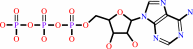 16
×
ATP
16
×
ATP
|
+
|
16
×
H2O
|
=
|
H2
|
+
|
8
×
oxidized [2Fe-2S]-[ferredoxin]
|
+
|
2
×
NH4(+)
|
+
|
 16
×
ADP
16
×
ADP
|
+
|
 16
×
phosphate
16
×
phosphate
|
+
|
6
×
H(+)
|
|
|
|
|
|
|
|
|
|
Cofactor:
|
|
Iron-sulfur; Vanadium cation or Mo cation
|
|
|
|
|
|
 Iron-sulfur
|
Vanadium cation
|
or
|
Mo cation
|
|
|
|
|
|
|
Molecule diagrams generated from .mol files obtained from the
KEGG ftp site
|
|
|
|
|
|
|
|
|
|
|
|
|
|
 |
|
|
|
|
|
|
| |
|
|
| |
|
|
J Biol Inorg Chem
9:1028-1033
(2004)
|
|
PubMed id:
|
|
|
|
|
|
| |
|
Structural and biochemical implications of single amino acid substitutions in the nucleotide-dependent switch regions of the nitrogenase Fe protein from Azotobacter vinelandii.
|
|
S.B.Jang,
M.S.Jeong,
L.C.Seefeldt,
J.W.Peters.
|
|
|
|
|
| |
ABSTRACT
|
|
|
|
| |
|
|
The structures of nitrogenase Fe proteins with defined amino acid substitutions
in the previously implicated nucleotide-dependent signal transduction pathways
termed switch I and switch II have been determined by X-ray diffraction methods.
In the Fe protein of nitrogenase the nucleotide-dependent switch regions are
responsible for communication between the sites responsible for nucleotide
binding and hydrolysis and the [4Fe-4S] cluster of the Fe protein and the
docking interface that interacts with the MoFe protein upon macromolecular
complex formation. In this study the structural characterization of the
Azotobacter vinelandii nitrogenase Fe protein with Asp at position 39
substituted by Asn in MgADP-bound and nucleotide-free states provides an
explanation for the experimental observation that the altered Fe proteins form a
trapped complex subsequent to a single electron transfer event. The structures
reveal that the substitution allows the formation of a hydrogen bond between the
switch I Asn39 and the switch II Asp125. In the structure of the native enzyme
the analogous interaction between the side chains of Asp39 and Asp125 is
precluded due to electrostatic repulsion. These results suggest that the
electrostatic repulsion between Asp39 and Asp125 is important for dissociation
of the Fe protein:MoFe protein complex during catalysis. In a separate study,
the structural characterization of the Fe protein with Asp129 substituted by Glu
provides the structural basis for the observation that the Glu129-substituted
variant in the absence of bound nucleotides has biochemical properties in common
with the native Fe protein with bound MgADP. Interactions of the longer Glu side
chain with the phosphate binding loop (P-loop) results in a similar conformation
of the switch II region as the conformation that results from the binding of the
phosphate of ADP to the P-loop.
|
|
|
|
|
|
|
|
|
|
|
|
|
|
|
|
|
|
 |
 |
 |
|
Literature references that cite this PDB file's key reference
|
|
|
| |
PubMed id
|
|
Reference
|
|
|
|
|
|
E.M.Shepard,
S.E.McGlynn,
A.L.Bueling,
C.S.Grady-Smith,
S.J.George,
M.A.Winslow,
S.P.Cramer,
J.W.Peters,
and
J.B.Broderick
(2010).
Synthesis of the 2Fe subcluster of the [FeFe]-hydrogenase H cluster on the HydF scaffold.
|
| |
Proc Natl Acad Sci U S A,
107,
10448-10453.
|
|
|
|
|
|
|
L.C.Seefeldt,
B.M.Hoffman,
and
D.R.Dean
(2009).
Mechanism of Mo-dependent nitrogenase.
|
| |
Annu Rev Biochem,
78,
701-722.
|
|
|
|
|
|
The most recent references are shown first.
Citation data come partly from CiteXplore and partly
from an automated harvesting procedure. Note that this is likely to be
only a partial list as not all journals are covered by
either method. However, we are continually building up the citation data
so more and more references will be included with time.
|
|


 Links
Links


