 |
PDBsum entry 1vng

|
|
|
|
|
|

|

|

|

|
|

|
|

|
|

|
|

|
|

|
|
|
 |

|

|
|
|
|
|
|
|
|
|
|
|
|
|
|
|
|
|
|
|
|
|
|
|
|
|
|
|
|
|
|
|
|
|
|
Haloperoxidase
|
PDB id
|
|
|
|
1vng
|
|
|
|
|
|
|
|
|
|
|
|
|
|
|

|

|

|
|
|
|
|
|
|
|
 |
Contents |
 |
|
|
|
|
|
|
|
|
|
|
|
|
* Residue conservation analysis
|
|
|
|
|
|
|
|
|
|
|
Enzyme class:
|
|
E.C.1.11.1.10
- chloride peroxidase.
|
|
|
|
|
|
|
Reaction:
|
|
RH + Cl- + H2O2 = RCl + 2 H2O
|
|
|
|
|
|
RH
|
+
|
Cl(-)
|
+
|
 H2O2
H2O2
|
=
|
 RCl
RCl
|
+
|
2
×
H2O
|
|
|
|
|
|
|
|
|
|
Cofactor:
|
|
Heme
|
|
|
|
|
|
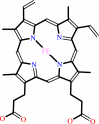 Heme
Heme
|
|
|
|
|
|
|
Molecule diagrams generated from .mol files obtained from the
KEGG ftp site
|
|
|
|
|
|
|
|
|
|
|
|
|
|
 |
|
|
|
|
|
|
| |
|
|
| |
|
|
J Biol Inorg Chem
4:209-219
(1999)
|
|
PubMed id:
|
|
|
|
|
|
| |
|
X-ray crystal structures of active site mutants of the vanadium-containing chloroperoxidase from the fungus Curvularia inaequalis.
|
|
S.Macedo-Ribeiro,
W.Hemrika,
R.Renirie,
R.Wever,
A.Messerschmidt.
|
|
|
|
|
| |
ABSTRACT
|
|
|
|
| |
|
|
The X-ray structures of the chloroperoxidase from Curvularia inaequalis,
heterologously expressed in Saccharomyces cerevisiae, have been determined both
in its apo and in its holo forms at 1.66 and 2.11 A resolution, respectively.
The crystal structures reveal that the overall structure of this enzyme remains
nearly unaltered, particularly at the metal binding site. At the active site of
the apo-chloroperoxidase structure a clearly defined sulfate ion was found,
partially stabilised through electrostatic interactions and hydrogen bonds with
positively charged residues involved in the interactions with the vanadate in
the native protein. The vanadate binding pocket seems to form a very rigid frame
stabilising oxyanion binding. The rigidity of this active site matrix is the
result of a large number of hydrogen bonding interactions involving side chains
and the main chain of residues lining the active site. The structures of single
site mutants to alanine of the catalytic residue His404 and the vanadium protein
ligand His496 have also been analysed. Additionally we determined the structural
effects of mutations to alanine of residue Arg360, directly involved in the
compensation of the negative charge of the vanadate group, and of residue Asp292
involved in forming a salt bridge with Arg490 which also interacts with the
vanadate. The enzymatic chlorinating activity is drastically reduced to
approximately 1% in mutants D292A, H404A and H496A. The structures of the
mutants confirm the view of the active site of this chloroperoxidase as a rigid
matrix providing an oxyanion binding site. No large changes are observed at the
active site for any of the analysed mutants. The empty space left by replacement
of large side chains by alanines is usually occupied by a new solvent molecule
which partially replaces the hydrogen bonding interactions to the vanadate. The
new solvent molecules additionally replace part of the interactions the mutated
side chains were making to other residues lining the active site frame. When
this is not possible, another side chain in the proximity of the mutated residue
moves in order to satisfy the hydrogen bonding potential of the residues located
at the active site frame.
|
|
|
|
|
|
|
|
|
|
|
|
|
|
|
|
|
|
 |
 |
 |
|
Literature references that cite this PDB file's key reference
|
|
|
| |
PubMed id
|
|
Reference
|
|
|
|
|
|
M.R.Maurya,
A.A.Khan,
A.Azam,
S.Ranjan,
N.Mondal,
A.Kumar,
F.Avecilla,
and
J.C.Pessoa
(2010).
Vanadium complexes having [V(IV)O](2+) and [V(V)O(2)](+) cores with binucleating dibasic tetradentate ligands: Synthesis, characterization, catalytic and antiamoebic activities.
|
| |
Dalton Trans,
39,
1345-1360.
|
|
|
|
|
|
|
J.M.Winter,
and
B.S.Moore
(2009).
Exploring the Chemistry and Biology of Vanadium-dependent Haloperoxidases.
|
| |
J Biol Chem,
284,
18577-18581.
|
|
|
|
|
|
|
M.R.Maurya,
S.Agarwal,
M.Abid,
A.Azam,
C.Bader,
M.Ebel,
and
D.Rehder
(2006).
Synthesis, characterisation, reactivity and in vitro antiamoebic activity of hydrazone based oxovanadium(IV), oxovanadium(V) and mu-bis(oxo)bis{oxovanadium(V)} complexes.
|
| |
Dalton Trans,
(),
937-947.
|
|
|
|
|
|
|
M.R.Maurya,
U.Kumar,
and
P.Manikandan
(2006).
Polymer supported vanadium and molybdenum complexes as potential catalysts for the oxidation and oxidative bromination of organic substrates.
|
| |
Dalton Trans,
(),
3561-3575.
|
|
|
|
|
|
|
Z.Hasan,
R.Renirie,
R.Kerkman,
H.J.Ruijssenaars,
A.F.Hartog,
and
R.Wever
(2006).
Laboratory-evolved vanadium chloroperoxidase exhibits 100-fold higher halogenating activity at alkaline pH: catalytic effects from first and second coordination sphere mutations.
|
| |
J Biol Chem,
281,
9738-9744.
|
|
|
|
|
|
|
M.R.Maurya,
S.Agarwal,
C.Bader,
M.Ebel,
and
D.Rehder
(2005).
Synthesis, characterisation and catalytic potential of hydrazonato-vanadium(V) model complexes with [VO]3+ and [VO2]+ cores.
|
| |
Dalton Trans,
(),
537-544.
|
|
|
|
|
|
|
T.Ohshiro,
J.Littlechild,
E.Garcia-Rodriguez,
M.N.Isupov,
Y.Iida,
T.Kobayashi,
and
Y.Izumi
(2004).
Modification of halogen specificity of a vanadium-dependent bromoperoxidase.
|
| |
Protein Sci,
13,
1566-1571.
|
|
|
|
|
|
|
J.Littlechild,
E.Garcia-Rodriguez,
A.Dalby,
and
M.Isupov
(2002).
Structural and functional comparisons between vanadium haloperoxidase and acid phosphatase enzymes.
|
| |
J Mol Recognit,
15,
291-296.
|
|
|
|
|
|
|
R.Renirie,
W.Hemrika,
and
R.Wever
(2000).
Peroxidase and phosphatase activity of active-site mutants of vanadium chloroperoxidase from the fungus Curvularia inaequalis. Implications for the catalytic mechanisms.
|
| |
J Biol Chem,
275,
11650-11657.
|
|
|
|
|
|
|
M.M.Whittaker,
and
J.W.Whittaker
(1999).
Thermally triggered metal binding by recombinant Thermus thermophilus manganese superoxide dismutase, expressed as the apo-enzyme.
|
| |
J Biol Chem,
274,
34751-34757.
|
|
|
|
|
|
|
W.Hemrika,
R.Renirie,
S.Macedo-Ribeiro,
A.Messerschmidt,
and
R.Wever
(1999).
Heterologous expression of the vanadium-containing chloroperoxidase from Curvularia inaequalis in Saccharomyces cerevisiae and site-directed mutagenesis of the active site residues His(496), Lys(353), Arg(360), and Arg(490).
|
| |
J Biol Chem,
274,
23820-23827.
|
|
|
|
|
|
The most recent references are shown first.
Citation data come partly from CiteXplore and partly
from an automated harvesting procedure. Note that this is likely to be
only a partial list as not all journals are covered by
either method. However, we are continually building up the citation data
so more and more references will be included with time.
|
|


 Links
Links


