 |
PDBsum entry 1v83

|
|
|
|
|
 |
Contents |
 |
|
|
|
|
|
|
|
|
|
|
|
|
|
|
* Residue conservation analysis
|
|
|
|
|
|
PDB id:
|
|
|
|
| Name: |
|
Transferase
|
|
|
Title:
|
|
Crystal structure of human glcat-p in complex with udp and mn2+
|
|
Structure:
|
|
Galactosylgalactosylxylosylprotein 3-beta- glucuronosyltransferase 1. Chain: a, b. Fragment: catalytic domain. Synonym: beta-1,3-glucuronyltransferase 1, glucuronosyltransferase-p, glcat-p, udp-glcua:glycoprotein beta- 1,3-glucuronyltransferase. Engineered: yes
|
|
Source:
|
|
Homo sapiens. Human. Organism_taxid: 9606. Expressed in: escherichia coli. Expression_system_taxid: 562.
|
|
Biol. unit:
|
|
Dimer (from
)
|
|
Resolution:
|
|
|
1.90Å
|
R-factor:
|
0.201
|
R-free:
|
0.229
|
|
|
Authors:
|
|
S.Kakuda,T.Shiba,M.Ishiguro,H.Tagawa,S.Oka,Y.Kajihara,T.Kawasaki, S.Wakatsuki,R.Kato
|
Key ref:

|
|
S.Kakuda
et al.
(2004).
Structural basis for acceptor substrate recognition of a human glucuronyltransferase, GlcAT-P, an enzyme critical in the biosynthesis of the carbohydrate epitope HNK-1.
J Biol Chem,
279,
22693-22703.
PubMed id:
DOI:

|
|
|
Date:
|
|
|
27-Dec-03
|
Release date:
|
25-May-04
|
|
|
|
|
|
|
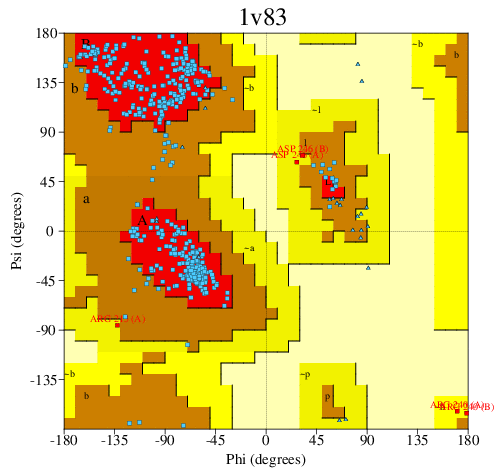
PROCHECK
|
|
|
|
|
|
Headers
|
|
|
|
References
|
|
|
|
|
|

|
|
Q9P2W7
(B3GA1_HUMAN) -
Galactosylgalactosylxylosylprotein 3-beta-glucuronosyltransferase 1 from Homo sapiens
|
|
|
|
Seq:
Struc:
|
|
|
|
334 a.a.
245 a.a.*
|
|

|

|

|
|
|
|
|
|
|
|
|
|
|
Key: |
 |
PfamA domain |
|
|
 |
Secondary structure |
|
 |
CATH domain |
|
|
*
PDB and UniProt seqs differ
at 1 residue position (black
cross)
|
|
|
|
|
|
|
|
|
|
|
|
|
Enzyme class:
|
|
E.C.2.4.1.135
- galactosylgalactosylxylosylprotein 3-beta-glucuronosyltransferase.
|
|
|
|
|
|
|
Pathway:
|
|
Heparan and Chondroitin Biosynthesis
(early stages)
|
|
|
|
|
|
Reaction:
|
|
3-O-(beta-D-galactosyl-(1->3)-beta-D-galactosyl-(1->4)-beta-D-xylosyl)-L- seryl-[protein] + UDP-alpha-D-glucuronate = 3-O-(beta-D-GlcA-(1->3)-beta- D-Gal-(1->3)-beta-D-Gal-(1->4)-beta-D-Xyl)-L-seryl-[protein] + UDP + H+
|
|
|
|
|
|
3-O-(beta-D-galactosyl-(1->3)-beta-D-galactosyl-(1->4)-beta-D-xylosyl)-L- seryl-[protein]
|
+
|
 UDP-alpha-D-glucuronate
|
=
|
3-O-(beta-D-GlcA-(1->3)-beta- D-Gal-(1->3)-beta-D-Gal-(1->4)-beta-D-Xyl)-L-seryl-[protein]
|
+
|
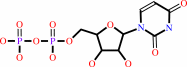 UDP
UDP
|
+
|
H(+)
Bound ligand (Het Group name = )
corresponds exactly
|
|
|
|
|
|
|
|
|
|
Cofactor:
|
|
Mn(2+)
|
|
|
|
|
|
|
|
|
Molecule diagrams generated from .mol files obtained from the
KEGG ftp site
|
|
|
|
|
|
|
|
|
|
|
|
|
|
 |
|
|
|
|
|
|
| |
|
|
| |
|
DOI no:
|
J Biol Chem
279:22693-22703
(2004)
|
|
PubMed id:
|
|
|
|
|
|
| |
|
Structural basis for acceptor substrate recognition of a human glucuronyltransferase, GlcAT-P, an enzyme critical in the biosynthesis of the carbohydrate epitope HNK-1.
|
|
S.Kakuda,
T.Shiba,
M.Ishiguro,
H.Tagawa,
S.Oka,
Y.Kajihara,
T.Kawasaki,
S.Wakatsuki,
R.Kato.
|
|
|
|
|
| |
ABSTRACT
|
|
|
|
| |
|
|
The HNK-1 carbohydrate epitope is found on many neural cell adhesion molecules.
Its structure is characterized by a terminal sulfated glucuronyl acid. The
glucuronyltransferases, GlcAT-P and GlcAT-S, are involved in the biosynthesis of
the HNK-1 epitope, GlcAT-P as the major enzyme. We overexpressed and purified
the recombinant human GlcAT-P from Escherichia coli. Analysis of its enzymatic
activity showed that it catalyzed the transfer reaction for N-acetyllactosamine
(Galbeta1-4GlcNAc) but not lacto-N-biose (Galbeta1-3GlcNAc) as an acceptor
substrate. Subsequently, we determined the first x-ray crystal structures of
human GlcAT-P, in the absence and presence of a donor substrate product UDP,
catalytic Mn(2+), and an acceptor substrate analogue N-acetyllactosamine
(Galbeta1-4GlcNAc) or an asparagine-linked biantennary nonasaccharide. The
asymmetric unit contains two independent molecules. Each molecule is an
alpha/beta protein with two regions that constitute the donor and acceptor
substrate binding sites. The UDP moiety of donor nucleotide sugar is recognized
by conserved amino acid residues including a DXD motif
(Asp(195)-Asp(196)-Asp(197)). Other conserved amino acid residues interact with
the terminal galactose moiety of the acceptor substrate. In addition, Val(320)
and Asn(321), which are located on the C-terminal long loop from a neighboring
molecule, and Phe(245) contribute to the interaction with GlcNAc moiety. These
three residues play a key role in establishing the acceptor substrate
specificity.
|
|
|
|
|
|
| |
Selected figure(s)
|
|
|
|
| |
|
|

|
|

|
|
Figure 3.
FIG. 3. The electron density maps of the substrates and
cofactor. A, the omit F[O]-F[C] electron density map of the UDP
molecule and Mn2+ ion, contoured at 1.6  (gray) and 6.0 (blue),
respectively, superimposed with a ball-and-stick model colored
according to atom types (nitrogen, blue; carbon, black; oxygen,
red; phosphorous, purple; manganese, orange). B, the omit
F[O]-F[C] electron density map of the N-acetyllactosamine,
contoured at 1.6 (gray), superimposed
with a ball-and-stick model. C, the interactions between Mn2+,
UDP, and Asp197 side chain of GlcAT-P. The Mn2+ interactions are
shown in blue dashed lines. (gray) and 6.0 (blue),
respectively, superimposed with a ball-and-stick model colored
according to atom types (nitrogen, blue; carbon, black; oxygen,
red; phosphorous, purple; manganese, orange). B, the omit
F[O]-F[C] electron density map of the N-acetyllactosamine,
contoured at 1.6 (gray), superimposed
with a ball-and-stick model. C, the interactions between Mn2+,
UDP, and Asp197 side chain of GlcAT-P. The Mn2+ interactions are
shown in blue dashed lines.
|
|
Figure 4.
FIG. 4. Comparison of GlcAT-P quaternary complex (UDP,
Mn2+, and N-acetyllactosamine) with GlcAT-I quaternary complex
(UDP, Mn2+, and Gal  1-3Gal). A, dimer
structure of GlcAT-P complex. Each monomer is colored blue and
yellow, respectively. Substrate molecules are shown in
ball-and-stick models. B, dimer structure of GlcAT-I complex is
shown in the same orientation as in A. C, dimer surface of
GlcAT-P complex is colored according to the electrostatic
surface potential (blue, positive; red, negative; scale from -10
to +10 kT/e). D, surface representation of GlcAT-I complex in
dimer is shown in the same orientation as in C. 1-3Gal). A, dimer
structure of GlcAT-P complex. Each monomer is colored blue and
yellow, respectively. Substrate molecules are shown in
ball-and-stick models. B, dimer structure of GlcAT-I complex is
shown in the same orientation as in A. C, dimer surface of
GlcAT-P complex is colored according to the electrostatic
surface potential (blue, positive; red, negative; scale from -10
to +10 kT/e). D, surface representation of GlcAT-I complex in
dimer is shown in the same orientation as in C.
|
|
|
|
|
|
| |
The above figures are
reprinted
by permission from the ASBMB:
J Biol Chem
(2004,
279,
22693-22703)
copyright 2004.
|
|
| |
Figures were
selected
by an automated process.
|
|
|
|
|
|
|
|
|
|
|
|
|
|
|
|
 |
 |
 |
|
Literature references that cite this PDB file's key reference
|
|
|
| |
PubMed id
|
|
Reference
|
|
|
|
|
|
L.Kaminski,
and
J.Eichler
(2010).
Identification of residues important for the activity of Haloferax volcanii AglD, a component of the archaeal N-glycosylation pathway.
|
| |
Archaea,
2010,
315108.
|
|
|
|
|
|
|
D.Anzai,
Y.Tonoyama,
A.Ikeda,
T.Kawasaki,
and
S.Oka
(2009).
Regulated expression of the HNK-1 carbohydrate is essential for medaka (Oryzias latipes) embryogenesis.
|
| |
Glycobiology,
19,
868-878.
|
|
|
|
|
|
|
I.Morita,
Y.Kizuka,
S.Kakuda,
and
S.Oka
(2008).
Expression and function of the HNK-1 carbohydrate.
|
| |
J Biochem,
143,
719-724.
|
|
|
|
|
|
|
L.L.Lairson,
B.Henrissat,
G.J.Davies,
and
S.G.Withers
(2008).
Glycosyltransferases: structures, functions, and mechanisms.
|
| |
Annu Rev Biochem,
77,
521-555.
|
|
|
|
|
|
|
P.K.Qasba,
B.Ramakrishnan,
and
E.Boeggeman
(2008).
Structure and function of beta -1,4-galactosyltransferase.
|
| |
Curr Drug Targets,
9,
292-309.
|
|
|
|
|
|
|
Y.Tone,
L.C.Pedersen,
T.Yamamoto,
T.Izumikawa,
H.Kitagawa,
J.Nishihara,
J.Tamura,
M.Negishi,
and
K.Sugahara
(2008).
2-o-phosphorylation of xylose and 6-o-sulfation of galactose in the protein linkage region of glycosaminoglycans influence the glucuronyltransferase-I activity involved in the linkage region synthesis.
|
| |
J Biol Chem,
283,
16801-16807.
|
|
|
PDB code:
|
|
|
|
|
|
|
|
M.Fondeur-Gelinotte,
V.Lattard,
R.Oriol,
R.Mollicone,
J.C.Jacquinet,
G.Mulliert,
S.Gulberti,
P.Netter,
J.Magdalou,
M.Ouzzine,
and
S.Fournel-Gigleux
(2006).
Phylogenetic and mutational analyses reveal key residues for UDP-glucuronic acid binding and activity of beta1,3-glucuronosyltransferase I (GlcAT-I).
|
| |
Protein Sci,
15,
1667-1678.
|
|
|
|
|
|
|
P.K.Qasba,
B.Ramakrishnan,
and
E.Boeggeman
(2006).
Mutant glycosyltransferases assist in the development of a targeted drug delivery system and contrast agents for MRI.
|
| |
AAPS J,
8,
E190-E195.
|
|
|
|
|
|
|
T.Shiba,
S.Kakuda,
M.Ishiguro,
I.Morita,
S.Oka,
T.Kawasaki,
S.Wakatsuki,
and
R.Kato
(2006).
Crystal structure of GlcAT-S, a human glucuronyltransferase, involved in the biosynthesis of the HNK-1 carbohydrate epitope.
|
| |
Proteins,
65,
499-508.
|
|
|
PDB code:
|
|
|
|
|
|
|
|
P.K.Qasba,
B.Ramakrishnan,
and
E.Boeggeman
(2005).
Substrate-induced conformational changes in glycosyltransferases.
|
| |
Trends Biochem Sci,
30,
53-62.
|
|
|
|
|
|
|
S.Kawano,
K.Hashimoto,
T.Miyama,
S.Goto,
and
M.Kanehisa
(2005).
Prediction of glycan structures from gene expression data based on glycosyltransferase reactions.
|
| |
Bioinformatics,
21,
3976-3982.
|
|
|
|
|
|
The most recent references are shown first.
Citation data come partly from CiteXplore and partly
from an automated harvesting procedure. Note that this is likely to be
only a partial list as not all journals are covered by
either method. However, we are continually building up the citation data
so more and more references will be included with time.
Where a reference describes a PDB structure, the PDB
code is
shown on the right.
|
|


 Links
Links


