 |
PDBsum entry 1v7f
|
|

|
|
PDB id:
|
|
|
|
| Name: |
|
Toxin
|
|
|
Title:
|
|
Solution structure of phrixotoxin 1
|
|
Structure:
|
|
Phrixotoxin 1. Chain: a. Synonym: patx1. Engineered: yes
|
|
Source:
|
|
Synthetic: yes. Paraphysa scrofa. Organism_taxid: 269635. Other_details: chemically synthetized
|
|
NMR struc:
|
|
25 models
|
|
|
Authors:
|
|
B.Chagot,P.Escoubas,E.Villegas,C.Bernard,G.Ferrat,G.Corzo, M.Lazdunski,H.Darbon
|
Key ref:

|
|
B.Chagot
et al.
(2004).
Solution structure of Phrixotoxin 1, a specific peptide inhibitor of Kv4 potassium channels from the venom of the theraphosid spider Phrixotrichus auratus.
Protein Sci,
13,
1197-1208.
PubMed id:
DOI:

|
|
|
Date:
|
|
|
16-Dec-03
|
Release date:
|
23-Nov-04
|
|
|
|
|
|
|
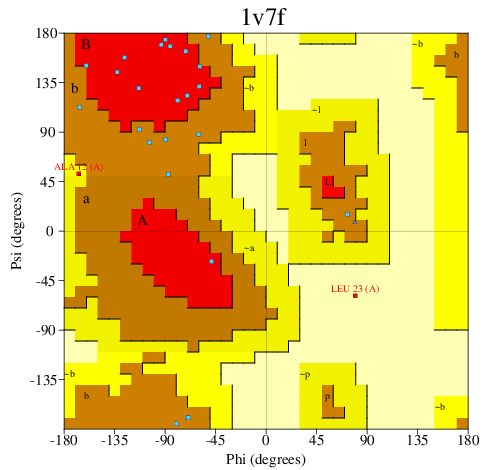
PROCHECK
|
|
|
|
|
|
Headers
|
|
|
|
References
|
|
|
|
|
|

|
|
P61230
(TXP1_PARSR) -
Kappa-theraphotoxin-Ps1a from Paraphysa scrofa
|
|
|
|
Seq:
Struc:
|
|
|
|
29 a.a.
30 a.a.
|
|

|

|
|
|
|
|
|
|
|
|
|
|
|
Key: |
 |
PfamA domain |
|
|
 |
Secondary structure |
|
|
|
|
|
|
|
|
|
|
|
|
|
|
|
|
|
 |
|
|
|
|
|
|
| |
|
DOI no:
|
Protein Sci
13:1197-1208
(2004)
|
|
PubMed id:
|
|
|
|
|
|
| |
|
Solution structure of Phrixotoxin 1, a specific peptide inhibitor of Kv4 potassium channels from the venom of the theraphosid spider Phrixotrichus auratus.
|
|
B.Chagot,
P.Escoubas,
E.Villegas,
C.Bernard,
G.Ferrat,
G.Corzo,
M.Lazdunski,
H.Darbon.
|
|
|
|
|
| |
ABSTRACT
|
|
|
|
| |
|
|
Animal toxins block voltage-dependent potassium channels (Kv) either by
occluding the conduction pore (pore blockers) or by modifying the channel gating
properties (gating modifiers). Gating modifiers of Kv channels bind to four
equivalent extracellular sites near the S3 and S4 segments, close to the voltage
sensor. Phrixotoxins are gating modifiers that bind preferentially to the closed
state of the channel and fold into the Inhibitory Cystine Knot structural motif.
We have solved the solution structure of Phrixotoxin 1, a gating modifier of Kv4
potassium channels. Analysis of the molecular surface and the electrostatic
anisotropy of Phrixotoxin 1 and of other toxins acting on voltage-dependent
potassium channels allowed us to propose a toxin interacting surface that
encompasses both the surface from which the dipole moment emerges and a
neighboring hydrophobic surface rich in aromatic residues.
|
|
|
|
|
|
| |
Selected figure(s)
|
|
|
|
| |
|
|

|
|

|
|
Figure 4.
Figure 4. (A) MOLSCRIPT representation of the structure of
ICK toxins that act against K[V] channels. From left to right:
PaTx1 and HpTx2 (Kv4.2), HaTx1 (Kv2.1),  -PVIIA
(shaker K+). (B) Sequence alignment of PaTx1 with other toxins
acting against K+ channels. PaTx1, PaTx2 (Phrixotoxins 1 and 2)
from Phrixotrichus auratus, HpTx2 (Heteropodatoxin 2) from
Heteropoda venatoria, HaTx1 (Hanatoxin 1) from Grammostola
spatulata, ScTx1 (Stromatoxin 1) from Stromatopelma calceata,
HmTx1 (Heteroscodratoxin 1) from Heteroscodra maculata, PVIIA (
-conotoxin
PVIIA) from Conus purpurascens (see references in text). -PVIIA
(shaker K+). (B) Sequence alignment of PaTx1 with other toxins
acting against K+ channels. PaTx1, PaTx2 (Phrixotoxins 1 and 2)
from Phrixotrichus auratus, HpTx2 (Heteropodatoxin 2) from
Heteropoda venatoria, HaTx1 (Hanatoxin 1) from Grammostola
spatulata, ScTx1 (Stromatoxin 1) from Stromatopelma calceata,
HmTx1 (Heteroscodratoxin 1) from Heteroscodra maculata, PVIIA (
-conotoxin
PVIIA) from Conus purpurascens (see references in text).
|
|
Figure 5.
Figure 5. (A) Orientation of the dipole moment of PaTx1
(top center) emerging through Lys 26. The resulting putative
functional surface of PaTx1 is represented (in the same
orientation) in B, centered around Lys 26 and the hydrophobic
patch (top center). The same procedure was used to generate the
corresponding dipoles of HaTx1 (top left), HpTx2 (top right),
ScTx1 (bottom left), and PaTx2 (bottom right). The residues are
colored green for polar uncharged residues, blue for basic
residues, red for acidic residues, purple for aromatic residues,
and yellow for aromatic residues. (B) Putative functional
surfaces of the toxins represented in CPK (TURBO software), in
the same orientation as in A, centered around basic residues and
the hydrophobic patch. The residues are colored green for polar
uncharged residues, blue for basic residues, red for acidic
residues, purple for aromatic residues, and yellow for aliphatic
residues.
|
|
|
|
|
|
| |
The above figures are
reprinted
by permission from the Protein Society:
Protein Sci
(2004,
13,
1197-1208)
copyright 2004.
|
|
| |
Figures were
selected
by an automated process.
|
|
|
|
|
|
|
|
|
|
|
|
|
|
|
|
 |
 |
 |
|
Literature references that cite this PDB file's key reference
|
|
|
| |
PubMed id
|
|
Reference
|
|
|
|
|
|
G.Schaarschmidt,
F.Wegner,
S.C.Schwarz,
H.Schmidt,
and
J.Schwarz
(2009).
Characterization of voltage-gated potassium channels in human neural progenitor cells.
|
| |
PLoS One,
4,
e6168.
|
|
|
|
|
|
|
P.Hu,
L.Sun,
Z.Q.Zhu,
X.W.Hou,
S.Wang,
S.S.Yu,
H.L.Wang,
P.Zhang,
M.Wang,
L.W.Niu,
M.K.Teng,
and
D.Y.Ruan
(2008).
Crystal structure of Natratoxin, a novel snake secreted phospholipaseA2 neurotoxin from Naja atra venom inhibiting A-type K+ currents.
|
| |
Proteins,
72,
673-683.
|
|
|
PDB code:
|
|
|
|
|
|
|
|
S.Liang
(2008).
Proteome and peptidome profiling of spider venoms.
|
| |
Expert Rev Proteomics,
5,
731-746.
|
|
|
|
|
|
|
K.J.Swartz
(2007).
Tarantula toxins interacting with voltage sensors in potassium channels.
|
| |
Toxicon,
49,
213-230.
|
|
|
|
|
|
|
P.Escoubas
(2006).
Molecular diversification in spider venoms: a web of combinatorial peptide libraries.
|
| |
Mol Divers,
10,
545-554.
|
|
|
|
|
|
|
S.I.Judge,
and
C.T.Bever
(2006).
Potassium channel blockers in multiple sclerosis: neuronal Kv channels and effects of symptomatic treatment.
|
| |
Pharmacol Ther,
111,
224-259.
|
|
|
|
|
|
|
B.Chagot,
P.Escoubas,
S.Diochot,
C.Bernard,
M.Lazdunski,
and
H.Darbon
(2005).
Solution structure of APETx2, a specific peptide inhibitor of ASIC3 proton-gated channels.
|
| |
Protein Sci,
14,
2003-2010.
|
|
|
PDB code:
|
|
|
|
|
|
|
|
B.Chagot,
S.Diochot,
C.Pimentel,
M.Lazdunski,
and
H.Darbon
(2005).
Solution structure of APETx1 from the sea anemone Anthopleura elegantissima: a new fold for an HERG toxin.
|
| |
Proteins,
59,
380-386.
|
|
|
PDB code:
|
|
|
|
|
|
|
|
H.Iida,
T.Jo,
K.Iwasawa,
T.Morita,
H.Hikiji,
T.Takato,
T.Toyo-Oka,
R.Nagai,
and
T.Nakajima
(2005).
Molecular and pharmacological characteristics of transient voltage-dependent K+ currents in cultured human pulmonary arterial smooth muscle cells.
|
| |
Br J Pharmacol,
146,
49-59.
|
|
|
|
|
|
|
S.P.Patel,
and
D.L.Campbell
(2005).
Transient outward potassium current, 'Ito', phenotypes in the mammalian left ventricle: underlying molecular, cellular and biophysical mechanisms.
|
| |
J Physiol,
569,
7.
|
|
|
|
|
|
|
X.Z.Zeng,
Q.Zhu,
and
S.P.Liang
(2005).
Sequence-specific assignment of 1H-NMR resonance and determination of the secondary structure of Jingzhaotoxin-I.
|
| |
Acta Biochim Biophys Sin (Shanghai),
37,
567-572.
|
|
|
|
|
|
The most recent references are shown first.
Citation data come partly from CiteXplore and partly
from an automated harvesting procedure. Note that this is likely to be
only a partial list as not all journals are covered by
either method. However, we are continually building up the citation data
so more and more references will be included with time.
Where a reference describes a PDB structure, the PDB
code is
shown on the right.
|
|


 Links
Links


