
|
|
|
|
|
 |
Contents |
 |
|
|
|
|
|
|
|
|
|
|
|
|
* Residue conservation analysis
|
|
|
|
|
|
PDB id:
|
|
|
|
| Name: |
|
Oxygen storage/transport
|
|
|
Title:
|
|
Crystal structure of bluefin tuna carbonmonoxy-hemoglobin
|
|
Structure:
|
|
Hemoglobin alpha chain. Chain: a, c. Hemoglobin beta chain. Chain: b, d
|
|
Source:
|
|
Thunnus thynnus. Bluefin tuna. Organism_taxid: 8237. Tissue: red cell. Tissue: red cell
|
|
Biol. unit:
|
|
Tetramer (from
)
|
|
Resolution:
|
|
|
2.00Å
|
R-factor:
|
0.207
|
R-free:
|
0.264
|
|
|
Authors:
|
|
T.Yokoyama,K.T.Chong,Y.Miyazaki,T.Nakatsukasa,S.Unzai,G.Miyazaki, H.Morimoto,R.H.T.Jeremy,S.Y.Park
|
Key ref:

|
|
T.Yokoyama
et al.
(2004).
Novel mechanisms of pH sensitivity in tuna hemoglobin: a structural explanation of the root effect.
J Biol Chem,
279,
28632-28640.
PubMed id:
DOI:

|
|
|
Date:
|
|
|
19-Nov-03
|
Release date:
|
06-Jul-04
|
|
|
|
|
|
|
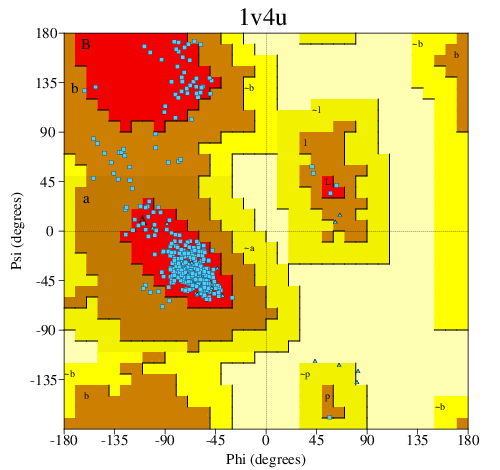
PROCHECK
|
|
|
|
|
|
Headers
|
|
|
|
References
|
|
|
|
|
|
|
|
|
|
|
|
|
|
|
|
 |
|
|
|
|
|
|
| |
|
DOI no:
|
J Biol Chem
279:28632-28640
(2004)
|
|
PubMed id:
|
|
|
|
|
|
| |
|
Novel mechanisms of pH sensitivity in tuna hemoglobin: a structural explanation of the root effect.
|
|
T.Yokoyama,
K.T.Chong,
G.Miyazaki,
H.Morimoto,
D.T.Shih,
S.Unzai,
J.R.Tame,
S.Y.Park.
|
|
|
|
|
| |
ABSTRACT
|
|
|
|
| |
|
|
The crystal structure of hemoglobin has been known for several decades, yet
various features of the molecule remain unexplained or controversial. Several
animal hemoglobins have properties that cannot be readily explained in terms of
their amino acid sequence and known atomic models of hemoglobin. Among these,
fish hemoglobins are well known for their widely varying interactions with
heterotropic effector molecules and pH sensitivity. Some fish hemoglobins are
almost completely insensitive to pH (within physiological limits), whereas
others show extremely low oxygen affinity under acid conditions, a phenomenon
called the Root effect. X-ray crystal structures of Root effect hemoglobins have
not, to date, provided convincing explanations of this effect. Sequence
alignments have signally failed to pinpoint the residues involved, and
site-directed mutagenesis has not yielded a human hemoglobin variant with this
property. We have solved the crystal structure of tuna hemoglobin in the deoxy
form at low and moderate pH and in the presence of carbon monoxide at high pH. A
comparison of these models shows clear evidence for novel mechanisms of
pH-dependent control of ligand affinity.
|
|
|
|
|
|
| |
Selected figure(s)
|
|
|
|
| |
|
|

|
|

|
|
Figure 3.
FIG. 3. Stereo overlay of the  heme pocket of tuna Hb
and HbA. The deoxy form (pH 7.5) (a) and the CO form (b) are
shown. HbA is shown in blue, and the residue numbers of the
human protein are shown in brackets. The atoms and bonds of tuna
Hb are colored by atom type as follows: yellow, carbon; red,
oxygen; blue, nitrogen. heme pocket of tuna Hb
and HbA. The deoxy form (pH 7.5) (a) and the CO form (b) are
shown. HbA is shown in blue, and the residue numbers of the
human protein are shown in brackets. The atoms and bonds of tuna
Hb are colored by atom type as follows: yellow, carbon; red,
oxygen; blue, nitrogen.
|
|
Figure 7.
FIG. 7. The C-terminal histidine of the  chains in the deoxy
form. The position of this residue is almost identical in the
structures at pH 5 and 7.5. Ser-93 hydrogen bonds to Asp-94
through its side chain
hydroxyl group (shown as a red dotted line), but the imidazole
group of His-146 is too far (>3.5
Å) from the Asp for a strong bonding interaction. chains in the deoxy
form. The position of this residue is almost identical in the
structures at pH 5 and 7.5. Ser-93 hydrogen bonds to Asp-94
through its side chain
hydroxyl group (shown as a red dotted line), but the imidazole
group of His-146 is too far (>3.5
Å) from the Asp for a strong bonding interaction.
|
|
|
|
|
|
| |
The above figures are
reprinted
by permission from the ASBMB:
J Biol Chem
(2004,
279,
28632-28640)
copyright 2004.
|
|
| |
Figures were
selected
by an automated process.
|
|
|
|
|
|
|
|
|
|
|
|
|
|
|
|
 |
 |
 |
|
Literature references that cite this PDB file's key reference
|
|
|
| |
PubMed id
|
|
Reference
|
|
|
|
|
|
A.Olianas,
C.Meloni,
I.Messana,
M.T.Sanna,
M.Castagnola,
B.Manconi,
S.Salvadori,
B.Giardina,
and
M.Pellegrini
(2011).
Striped mullet (Mugil cephalus) hemoglobin system: multiplicity and functional properties.
|
| |
J Comp Physiol B,
181,
187-197.
|
|
|
|
|
|
|
L.Boechi,
M.A.Martì,
A.Vergara,
F.Sica,
L.Mazzarella,
D.A.Estrin,
and
A.Merlino
(2011).
Protonation of histidine 55 affects the oxygen access to heme in the alpha chain of the hemoglobin from the Antarctic fish Trematomus bernacchii.
|
| |
IUBMB Life,
63,
175-182.
|
|
|
|
|
|
|
O.F.Wetten,
A.J.Nederbragt,
R.C.Wilson,
K.S.Jakobsen,
R.B.Edvardsen,
and
Ã.˜.Andersen
(2010).
Genomic organization and gene expression of the multiple globins in Atlantic cod: conservation of globin-flanking genes in chordates infers the origin of the vertebrate globin clusters.
|
| |
BMC Evol Biol,
10,
315.
|
|
|
|
|
|
|
T.Kuwada,
T.Hasegawa,
T.Takagi,
I.Sato,
and
F.Shishikura
(2010).
pH-dependent structural changes in haemoglobin component V from the midge larva Propsilocerus akamusi (Orthocladiinae, Diptera).
|
| |
Acta Crystallogr D Biol Crystallogr,
66,
258-267.
|
|
|
PDB codes:
|
|
|
|
|
|
|
|
A.Merlino,
L.Vitagliano,
B.D.Howes,
C.Verde,
G.di Prisco,
G.Smulevich,
F.Sica,
and
A.Vergara
(2009).
Combined crystallographic and spectroscopic analysis of Trematomus bernacchii hemoglobin highlights analogies and differences in the peculiar oxidation pathway of Antarctic fish hemoglobins.
|
| |
Biopolymers,
91,
1117-1125.
|
|
|
PDB code:
|
|
|
|
|
|
|
|
A.Vergara,
M.Franzese,
A.Merlino,
G.Bonomi,
C.Verde,
D.Giordano,
G.di Prisco,
H.C.Lee,
J.Peisach,
and
L.Mazzarella
(2009).
Correlation between hemichrome stability and the root effect in tetrameric hemoglobins.
|
| |
Biophys J,
97,
866-874.
|
|
|
PDB code:
|
|
|
|
|
|
|
|
L.Mazzarella,
A.Vergara,
L.Vitagliano,
A.Merlino,
G.Bonomi,
S.Scala,
C.Verde,
and
G.di Prisco
(2006).
High resolution crystal structure of deoxy hemoglobin from Trematomus bernacchii at different pH values: the role of histidine residues in modulating the strength of the root effect.
|
| |
Proteins,
65,
490-498.
|
|
|
PDB codes:
|
|
|
|
|
|
|
|
L.Mazzarella,
G.Bonomi,
M.C.Lubrano,
A.Merlino,
A.Riccio,
A.Vergara,
L.Vitagliano,
C.Verde,
and
G.di Prisco
(2006).
Minimal structural requirements for root effect: crystal structure of the cathodic hemoglobin isolated from the antarctic fish Trematomus newnesi.
|
| |
Proteins,
62,
316-321.
|
|
|
PDB code:
|
|
|
|
|
|
|
|
D.Pozzi,
G.Amiconi,
A.Arcovito,
M.Girasole,
and
A.C.Castellano
(2005).
Haem conformation of amphibian nytrosylhaemoglobins detected by XANES spectroscopy.
|
| |
Eur Phys J E Soft Matter,
16,
373-379.
|
|
|
|
|
|
|
G.S.Shelness,
and
A.S.Ledford
(2005).
Evolution and mechanism of apolipoprotein B-containing lipoprotein assembly.
|
| |
Curr Opin Lipidol,
16,
325-332.
|
|
|
|
|
|
|
B.Giardina,
D.Mosca,
and
M.C.De Rosa
(2004).
The Bohr effect of haemoglobin in vertebrates: an example of molecular adaptation to different physiological requirements.
|
| |
Acta Physiol Scand,
182,
229-244.
|
|
|
|
|
|
|
C.Bonaventura,
A.L.Crumbliss,
and
R.E.Weber
(2004).
New insights into the proton-dependent oxygen affinity of Root effect haemoglobins.
|
| |
Acta Physiol Scand,
182,
245-258.
|
|
|
|
|
|
The most recent references are shown first.
Citation data come partly from CiteXplore and partly
from an automated harvesting procedure. Note that this is likely to be
only a partial list as not all journals are covered by
either method. However, we are continually building up the citation data
so more and more references will be included with time.
Where a reference describes a PDB structure, the PDB
codes are
shown on the right.
|
 |


 Links
Links


