 |
PDBsum entry 1v07

|
|
|
|
|
|

|

|

|

|
|

|
|

|
|

|
|
|
 |

|

|
|
|
|
|
|
|
|
|
|
|
|
|
|
|
|
|
|
|
|
|
|
|
|
|
|
|
|
|
|
|
|
Oxygen transport
|
PDB id
|
|
|
|
1v07
|
|
|
|
|
|
|
|
|
|
|
|
|
|
|

|

|

|
|
|
|
|
|
|
|
 |
Contents |
 |
|
|
|
|
|
|
|
|
|
|
|
|
* Residue conservation analysis
|
|
|
|
|
|
PDB id:
|
|
|
|
| Name: |
|
Oxygen transport
|
|
|
Title:
|
|
Crystal structure of thre11val mutant of the nerve tissue mini- hemoglobin from the nemertean worm cerebratulus lacteus
|
|
Structure:
|
|
Neural hemoglobin. Chain: a. Synonym: nrhb. Engineered: yes. Mutation: yes
|
|
Source:
|
|
Cerebratulus lacteus. Milky ribbon worm. Organism_taxid: 6221. Expressed in: escherichia coli. Expression_system_taxid: 562.
|
|
Resolution:
|
|
|
1.70Å
|
R-factor:
|
0.170
|
R-free:
|
0.195
|
|
|
Authors:
|
|
A.Pesce,M.Nardini,P.Ascenzi,E.Geuens,S.Dewilde,L.Moens,M.Bolognesi, A.Riggs,A.Hale,P.Deng,G.U.Nienhaus,J.S.Olson,K.Nienhaus
|
Key ref:

|
|
A.Pesce
et al.
(2004).
Thr-E11 regulates O2 affinity in Cerebratulus lacteus mini-hemoglobin.
J Biol Chem,
279,
33662-33672.
PubMed id:
DOI:

|
|
|
Date:
|
|
|
24-Mar-04
|
Release date:
|
03-Jun-04
|
|
|
|
|
|
|
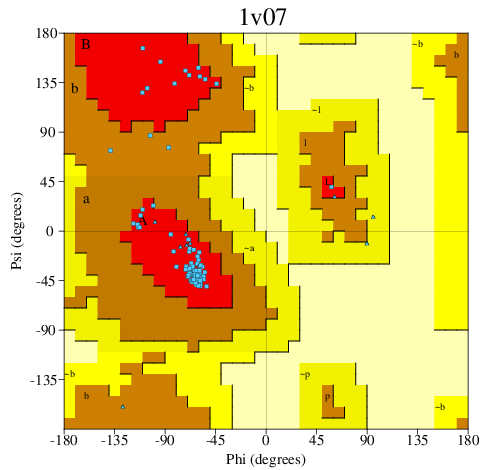
PROCHECK
|
|
|
|
|
|
Headers
|
|
|
|
References
|
|
|
|
|
|

|
|
O76242
(GLBN_CERLA) -
Neural hemoglobin from Cerebratulus lacteus
|
|
|
|
Seq:
Struc:
|
|
|
|
110 a.a.
110 a.a.*
|
|

|

|
|
|
|
|
|
|
|
|
|
|
|
Key: |
 |
PfamA domain |
|
|
 |
Secondary structure |
|
 |
CATH domain |
|
|
*
PDB and UniProt seqs differ
at 1 residue position (black
cross)
|
|
|
|
|
|
|
|
|
|
|
|
|
|
|
|
|
 |
|
|
|
|
|
|
| |
|
DOI no:
|
J Biol Chem
279:33662-33672
(2004)
|
|
PubMed id:
|
|
|
|
|
|
| |
|
Thr-E11 regulates O2 affinity in Cerebratulus lacteus mini-hemoglobin.
|
|
A.Pesce,
M.Nardini,
P.Ascenzi,
E.Geuens,
S.Dewilde,
L.Moens,
M.Bolognesi,
A.F.Riggs,
A.Hale,
P.Deng,
G.U.Nienhaus,
J.S.Olson,
K.Nienhaus.
|
|
|
|
|
| |
ABSTRACT
|
|
|
|
| |
|
|
The mini-hemoglobin from Cerebratulus lacteus (CerHb) belongs to a class of
globins containing the polar Tyr-B10/Gln-E7 amino acid pair that normally causes
low rates of O2 dissociation and ultra-high O2 affinity, which suggest O2
sensing or NO scavenging functions. CerHb, however, has high rates of O2
dissociation (kO2 = 200-600 s(-1)) and moderate O2 affinity (KO2) approximately
1 microm(-1)) as a result of a third polar amino acid in its active site,
Thr-E11. When Thr-E11 is replaced by Val, kO2 decreases 1000-fold and KO2
increases 130-fold at pH 7.0, 20 degrees C. The mutation also shifts the
stretching frequencies of both heme-bound and photodissociated CO, indicating
marked changes of the electrostatic field at the active site. The crystal
structure of Thr-E11 --> Val CerHbO2 at 1.70 A resolution is almost identical to
that of the wild-type protein (root mean square deviation of 0.12 A). The
dramatic functional and spectral effects of the Thr-E11 --> Val mutation are due
exclusively to changes in the hydrogen bonding network in the active site.
Replacing Thr-E11 with Val "frees" the Tyr-B10 hydroxyl group to
rotate toward and donate a strong hydrogen bond to the heme-bound ligand,
causing a selective increase in O2 affinity, a decrease of the rate coefficient
for O2 dissociation, a 40 cm(-1) decrease in nuCO of heme-bound CO, and an
increase in ligand migration toward more remote intermediate sites.
|
|
|
|
|
|
| |
Selected figure(s)
|
|
|
|
| |
|
|

|
|

|
|
Figure 1.
FIG. 1. a, O[2] rebinding to wild-type CerHb, Thr-E11  Val
CerHb, and wild-type sperm whale (sw) Mb at pH 7.0, 20 °C.
The concentration of O[2] was 1,250 µM (buffer
equilibrated with 1 atm pure O[2]). O[2] displacement from
wild-type CerHbO[2], Thr-E11 Val CerHbO[2], and
wild-type sperm whale MbO[2] at pH 7.0, 20 °C is shown on
short (b) and long (c) time scales. Val
CerHb, and wild-type sperm whale (sw) Mb at pH 7.0, 20 °C.
The concentration of O[2] was 1,250 µM (buffer
equilibrated with 1 atm pure O[2]). O[2] displacement from
wild-type CerHbO[2], Thr-E11 Val CerHbO[2], and
wild-type sperm whale MbO[2] at pH 7.0, 20 °C is shown on
short (b) and long (c) time scales.
|
|
Figure 2.
FIG. 2. A stereo view of the CerHb heme distal (upper part
of the figure) and proximal sites (lower part, hosting His-F8).
Short fragments of the B- and E-helices are displayed as cyan
ribbons. The heme is shown in red. The relevant residues are
displayed with light gray bonds, using black labels for the
wild-type CerHb structure. Structural modifications observed in
the Thr-E11 Val CerHb mutant are
highlighted by displaying residues Tyr-B10 and Val E11
in orange. The dashed arrows indicate hydrogen bond donation in
the wild-type protein (blue arrows) and in the Thr-E11 Val
mutant (orange arrow). The O[2] molecule is displayed at the
sixth coordination site of the heme iron as a purple diatomic
species (partly covered by arrows). Lys-E10 is electrostatically
coupled to both heme propionates and contributes to the
shielding of the distal heme pocket.
|
|
|
|
|
|
| |
The above figures are
reprinted
by permission from the ASBMB:
J Biol Chem
(2004,
279,
33662-33672)
copyright 2004.
|
|
| |
Figures were
selected
by an automated process.
|
|
|
|
|
|
|
|
|
|
|
|
|
|
|
|
 |
 |
 |
|
Literature references that cite this PDB file's key reference
|
|
|
| |
PubMed id
|
|
Reference
|
|
|
|
|
|
C.M.Bianchetti,
G.C.Blouin,
E.Bitto,
J.S.Olson,
and
G.N.Phillips
(2010).
The structure and NO binding properties of the nitrophorin-like heme-binding protein from Arabidopsis thaliana gene locus At1g79260.1.
|
| |
Proteins,
78,
917-931.
|
|
|
PDB codes:
|
|
|
|
|
|
|
|
E.Geuens,
D.Hoogewijs,
M.Nardini,
E.Vinck,
A.Pesce,
L.Kiger,
A.Fago,
L.Tilleman,
S.De Henau,
M.C.Marden,
R.E.Weber,
S.Van Doorslaer,
J.Vanfleteren,
L.Moens,
M.Bolognesi,
and
S.Dewilde
(2010).
Globin-like proteins in Caenorhabditis elegans: in vivo localization, ligand binding and structural properties.
|
| |
BMC Biochem,
11,
17.
|
|
|
PDB codes:
|
|
|
|
|
|
|
|
M.D.Salter,
K.Nienhaus,
G.U.Nienhaus,
S.Dewilde,
L.Moens,
A.Pesce,
M.Nardini,
M.Bolognesi,
and
J.S.Olson
(2008).
The apolar channel in Cerebratulus lacteus hemoglobin is the route for O2 entry and exit.
|
| |
J Biol Chem,
283,
35689-35702.
|
|
|
PDB codes:
|
|
|
|
|
|
|
|
S.Dewilde,
A.I.Ioanitescu,
L.Kiger,
K.Gilany,
M.C.Marden,
S.Van Doorslaer,
J.Vercruysse,
A.Pesce,
M.Nardini,
M.Bolognesi,
and
L.Moens
(2008).
The hemoglobins of the trematodes Fasciola hepatica and Paramphistomum epiclitum: a molecular biological, physico-chemical, kinetic, and vaccination study.
|
| |
Protein Sci,
17,
1653-1662.
|
|
|
PDB code:
|
|
|
|
|
|
|
|
M.A.Carrondo,
I.Bento,
P.M.Matias,
and
P.F.Lindley
(2007).
Crystallographic evidence for dioxygen interactions with iron proteins.
|
| |
J Biol Inorg Chem,
12,
429-442.
|
|
|
|
|
|
|
M.A.Martí,
L.Capece,
D.E.Bikiel,
B.Falcone,
and
D.A.Estrin
(2007).
Oxygen affinity controlled by dynamical distal conformations: the soybean leghemoglobin and the Paramecium caudatum hemoglobin cases.
|
| |
Proteins,
68,
480-487.
|
|
|
|
|
|
|
P.Deng,
K.Nienhaus,
P.Palladino,
J.S.Olson,
G.Blouin,
L.Moens,
S.Dewilde,
E.Geuens,
and
G.U.Nienhaus
(2007).
Transient ligand docking sites in Cerebratulus lacteus mini-hemoglobin.
|
| |
Gene,
398,
208-223.
|
|
|
|
|
|
|
C.Hundahl,
A.Fago,
S.Dewilde,
L.Moens,
T.Hankeln,
T.Burmester,
and
R.E.Weber
(2006).
Oxygen binding properties of non-mammalian nerve globins.
|
| |
FEBS J,
273,
1323-1329.
|
|
|
|
|
|
|
M.A.Martí,
D.E.Bikiel,
A.Crespo,
M.Nardini,
M.Bolognesi,
and
D.A.Estrin
(2006).
Two distinct heme distal site states define Cerebratulus lacteus mini-hemoglobin oxygen affinity.
|
| |
Proteins,
62,
641-648.
|
|
|
|
|
|
The most recent references are shown first.
Citation data come partly from CiteXplore and partly
from an automated harvesting procedure. Note that this is likely to be
only a partial list as not all journals are covered by
either method. However, we are continually building up the citation data
so more and more references will be included with time.
Where a reference describes a PDB structure, the PDB
codes are
shown on the right.
|
|


 Links
Links


