
|
|
|
|
|
 |
Contents |
 |
|
|
|
|
|
|
|
|
|
|
|
|
* Residue conservation analysis
|
|
|
|
|
|
PDB id:
|
|
|
|
| Name: |
|
Transferase/inhibitor
|
|
|
Title:
|
|
Cyclin a binding groove inhibitor ace-arg-lys-leu-phe-gly
|
|
Structure:
|
|
Cell division protein kinase 2. Chain: a, c. Synonym: p33 protein kinase, cdk2, cyclin-dependent kinase-2. Engineered: yes. Cyclin a2. Chain: b, d. Fragment: residues 173 - 432. Synonym: cyclin a, ccna2, ccna, ccn1. Engineered: yes.
|
|
Source:
|
|
Homo sapiens. Human. Organism_taxid: 9606. Expressed in: spodoptera frugiperda. Expression_system_taxid: 7108. Expressed in: escherichia coli. Expression_system_taxid: 562. Synthetic: yes. Synthetic construct.
|
|
Biol. unit:
|
|
 Trimer (from PDB file)
|
|
Resolution:
|
|
|
2.60Å
|
R-factor:
|
0.177
|
R-free:
|
0.254
|
|
|
Authors:
|
|
G.Kontopidis,M.Andrews,C.Mcinnes,A.Cowan,H.Powers,L.Innes,A.Plater, G.Griffiths,D.Paterson,D.Zheleva,D.Lane,S.Green,M.Walkinshaw, P.Fischer
|
|
Key ref:
|
|
M.J.Andrews
et al.
(2004).
Design, synthesis, biological activity and structural analysis of cyclic peptide inhibitors targeting the substrate recruitment site of cyclin-dependent kinase complexes.
Org Biomol Chem,
2,
2735-2741.
PubMed id:
|
|
|
Date:
|
|
|
28-Oct-03
|
Release date:
|
31-Oct-03
|
|
|
|
|
|
|
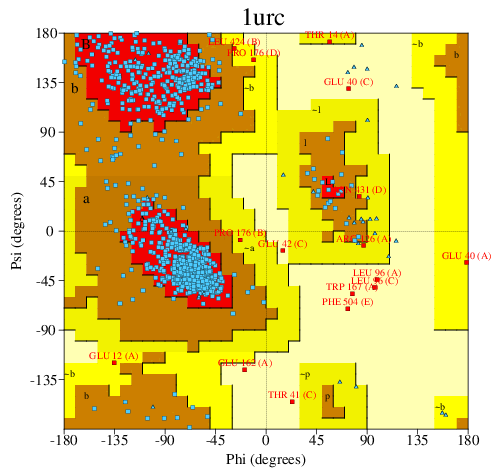
PROCHECK
|
|
|
|
|
|
Headers
|
|
|
|
References
|
|
|
|
|
|
|
|
|
|
|
|
Enzyme class:
|
|
Chains A, C:
E.C.2.7.11.22
- cyclin-dependent kinase.
|
|
|
|
|
|
|
Reaction:
|
|
|
1.
|
L-seryl-[protein] + ATP = O-phospho-L-seryl-[protein] + ADP + H+
|
|
2.
|
L-threonyl-[protein] + ATP = O-phospho-L-threonyl-[protein] + ADP + H+
|
|
|
|
|
|
|
L-seryl-[protein]
|
+
|
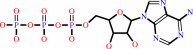 ATP
ATP
|
=
|
O-phospho-L-seryl-[protein]
|
+
|
 ADP
ADP
|
+
|
H(+)
|
|
|
|
|
|
|
L-threonyl-[protein]
|
+
|
ATP
|
=
|
O-phospho-L-threonyl-[protein]
|
+
|
ADP
|
+
|
H(+)
|
|
|
|
|
|
|
|
|
|
|
|
|
Molecule diagrams generated from .mol files obtained from the
KEGG ftp site
|
|
|
|
|
|
|
|
|
|
|
|
|
|
 |
|
|
|
|
|
|
| |
|
|
| |
|
|
Org Biomol Chem
2:2735-2741
(2004)
|
|
PubMed id:
|
|
|
|
|
|
| |
|
Design, synthesis, biological activity and structural analysis of cyclic peptide inhibitors targeting the substrate recruitment site of cyclin-dependent kinase complexes.
|
|
M.J.Andrews,
C.McInnes,
G.Kontopidis,
L.Innes,
A.Cowan,
A.Plater,
P.M.Fischer.
|
|
|
|
|
| |
ABSTRACT
|
|
|
|
| |
|
|
Inhibition of cyclin A- and cyclin E-associated cyclin-dependent kinase-2 (CDK2)
activities is an effective way of selective induction of apoptotic cell death
via the E2F pathway in tumour cells. The cyclin groove recognition motif (CRM)
in the natural CDK-inhibitory (CDKI) tumour suppressor protein p27KIP1 was used
as the basis for the design and synthesis of a series of cyclic peptides whose
biological activity and structural characterisation by NMR and X-ray
crystallography is reported. Whereas linear p27KIP1 sequence peptides were
comparatively ineffective, introduction of side chain-to-tail constraints was
found to be productive. An optimal macrocyclic ring size for the conformational
constraint was determined, mimicking the intramolecular H-bonding system of p27.
Molecular dynamics calculations of various macrocycles suggested a close
correlation between ring flexibility and biological activity. Truncated
inhibitor peptide analogues also confirmed the hypothesis that introduction of a
cyclic conformational constraint is favourable in terms of affinity and potency.
The structural basis for the potency increase in cyclic versus linear peptides
was demonstrated through the determination and interpretation of X-ray crystal
structures of complexes between CDK2/cylin A (CDK2A) and a constrained
pentapeptide.
|
|
|
|
|
|
|
|
|
|
|
|
|
|
|
|
|
|
 |
 |
 |
|
Literature references that cite this PDB file's key reference
|
|
|
| |
PubMed id
|
|
Reference
|
|
|
|
|
|
V.Giménez-Oya,
O.Villacañas,
C.Obiol-Pardo,
M.Antolin-Llovera,
J.Rubio-Martinez,
and
S.Imperial
(2011).
Design of novel ligands of CDP-methylerythritol kinase by mimicking direct protein-protein and solvent-mediated interactions.
|
| |
J Mol Recognit,
24,
71-80.
|
|
|
|
|
|
|
G.Kontopidis,
M.J.Andrews,
C.McInnes,
A.Plater,
L.Innes,
S.Renachowski,
A.Cowan,
and
P.M.Fischer
(2009).
Truncation and optimisation of peptide inhibitors of cyclin-dependent kinase 2-cyclin a through structure-guided design.
|
| |
ChemMedChem,
4,
1120-1128.
|
|
|
PDB codes:
|
|
|
|
|
|
|
|
M.Orzáez,
A.Gortat,
L.Mondragón,
O.Bachs,
and
E.Pérez-Payá
(2009).
ATP-noncompetitive inhibitors of CDK-cyclin complexes.
|
| |
ChemMedChem,
4,
19-24.
|
|
|
|
|
|
|
P.Corsino,
N.Horenstein,
D.Ostrov,
T.Rowe,
M.Law,
A.Barrett,
G.Aslanidi,
W.D.Cress,
and
B.Law
(2009).
A novel class of cyclin-dependent kinase inhibitors identified by molecular docking act through a unique mechanism.
|
| |
J Biol Chem,
284,
29945-29955.
|
|
|
|
|
|
|
L.Bagella,
A.Sun,
T.Tonini,
G.Abbadessa,
G.Cottone,
M.G.Paggi,
A.De Luca,
P.P.Claudio,
and
A.Giordano
(2007).
A small molecule based on the pRb2/p130 spacer domain leads to inhibition of cdk2 activity, cell cycle arrest and tumor growth reduction in vivo.
|
| |
Oncogene,
26,
1829-1839.
|
|
|
|
|
|
|
J.Sridhar,
N.Akula,
and
N.Pattabiraman
(2006).
Selectivity and potency of cyclin-dependent kinase inhibitors.
|
| |
AAPS J,
8,
E204-E221.
|
|
|
|
|
|
|
K.Y.Cheng,
M.E.Noble,
V.Skamnaki,
N.R.Brown,
E.D.Lowe,
L.Kontogiannis,
K.Shen,
P.A.Cole,
G.Siligardi,
and
L.N.Johnson
(2006).
The role of the phospho-CDK2/cyclin A recruitment site in substrate recognition.
|
| |
J Biol Chem,
281,
23167-23179.
|
|
|
PDB codes:
|
|
|
|
|
|
|
|
M.J.Andrews,
G.Kontopidis,
C.McInnes,
A.Plater,
L.Innes,
A.Cowan,
P.Jewsbury,
and
P.M.Fischer
(2006).
REPLACE: a strategy for iterative design of cyclin-binding groove inhibitors.
|
| |
Chembiochem,
7,
1909-1915.
|
|
|
PDB codes:
|
|
|
|
|
|
|
|
N.Canela,
M.Orzáez,
R.Fucho,
F.Mateo,
R.Gutierrez,
A.Pineda-Lucena,
O.Bachs,
and
E.Pérez-Payá
(2006).
Identification of an hexapeptide that binds to a surface pocket in cyclin A and inhibits the catalytic activity of the complex cyclin-dependent kinase 2-cyclin A.
|
| |
J Biol Chem,
281,
35942-35953.
|
|
|
|
|
|
The most recent references are shown first.
Citation data come partly from CiteXplore and partly
from an automated harvesting procedure. Note that this is likely to be
only a partial list as not all journals are covered by
either method. However, we are continually building up the citation data
so more and more references will be included with time.
Where a reference describes a PDB structure, the PDB
codes are
shown on the right.
|
 |


 Links
Links


