 |
PDBsum entry 1upd

|
|
|
|
|
|

|

|

|

|
|

|
|

|
|

|
|

|
|

|
|
|
 |

|

|
|
|
|
|
|
|
|
|
|
|
|
|
|
|
|
|
|
|
|
|
|
|
|
|
|
|
|
|
|
|
|
|
|
Electron transport
|
PDB id
|
|
|
|
1upd
|
|
|
|
|
|
|
|
|
|
|
|
|
|
|

|

|

|
|
|
|
|
|
|
|
 |
Contents |
 |
|
|
|
|
|
|
|
|
|
|
|
|
* Residue conservation analysis
|
|
|
|
|
|
PDB id:
|
|
|
|
| Name: |
|
Electron transport
|
|
|
Title:
|
|
Oxidized structure of cytochrome c3 from desulfovibrio desulfuricans atcc 27774 at ph 7.6
|
|
Structure:
|
|
Cytochrome c3. Chain: a. Synonym: cytc3
|
|
Source:
|
|
Desulfovibrio desulfuricans. Organism_taxid: 876. Atcc: 27774
|
|
Resolution:
|
|
|
1.40Å
|
R-factor:
|
0.147
|
R-free:
|
0.191
|
|
|
Authors:
|
|
I.Bento,P.M.Matias,A.M.Baptista,P.N.Da Costa,W.M.A.M.Van Dongen, L.M.Saraiva,T.R.Schneider,C.M.Soares,M.A.Carrondo
|
Key ref:

|
|
I.Bento
et al.
(2004).
Molecular basis for redox-Bohr and cooperative effects in cytochrome c3 from Desulfovibrio desulfuricans ATCC 27774: crystallographic and modeling studies of oxidized and reduced high-resolution structures at pH 7.6.
Proteins,
54,
135-152.
PubMed id:
DOI:

|
|
|
Date:
|
|
|
29-Sep-03
|
Release date:
|
30-Sep-04
|
|
|
|
|
|
|
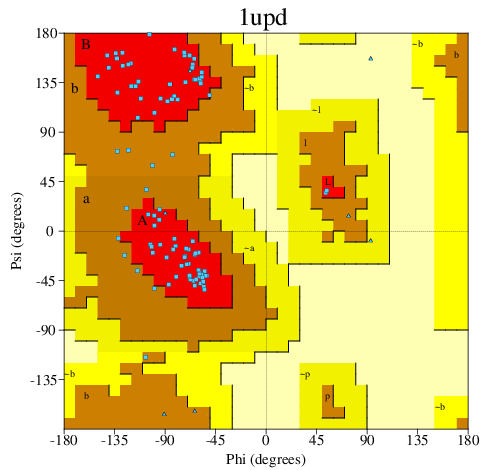
PROCHECK
|
|
|
|
|
|
Headers
|
|
|
|
References
|
|
|
|
|
|

|
|
Q9L915
(Q9L915_DESDE) -
Class III cytochrome C family protein from Desulfovibrio desulfuricans
|
|
|
|
Seq:
Struc:
|
|
|
|
128 a.a.
107 a.a.*
|
|

|

|
|
|
|
|
|
|
|
|
|
|
|
Key: |
 |
PfamA domain |
|
|
 |
Secondary structure |
|
 |
CATH domain |
|
|
*
PDB and UniProt seqs differ
at 1 residue position (black
cross)
|
|
|
|
|
|
|
|
|
|
|
|
|
|
|
|
|
 |
|
|
|
|
|
|
| |
|
DOI no:
|
Proteins
54:135-152
(2004)
|
|
PubMed id:
|
|
|
|
|
|
| |
|
Molecular basis for redox-Bohr and cooperative effects in cytochrome c3 from Desulfovibrio desulfuricans ATCC 27774: crystallographic and modeling studies of oxidized and reduced high-resolution structures at pH 7.6.
|
|
I.Bento,
P.M.Matias,
A.M.Baptista,
P.N.da Costa,
W.M.van Dongen,
L.M.Saraiva,
T.R.Schneider,
C.M.Soares,
M.A.Carrondo.
|
|
|
|
|
| |
ABSTRACT
|
|
|
|
| |
|
|
The tetraheme cytochrome c3 is a small metalloprotein with ca. 13,000 Da found
in sulfate-reducing bacteria, which is believed to act as a partner of
hydrogenase. The three-dimensional structure of the oxidized and reduced forms
of cytochrome c3 from Desulfovibrio desulfuricans ATCC 27774 at pH 7.6 were
determined using high-resolution X-ray crystallography and were compared with
the previously determined oxidized form at pH 4.0. Theoretical calculations were
performed with both structures, using continuum electrostatic calculations and
Monte Carlo sampling of protonation and redox states, in order to understand the
molecular basis of the redox-Bohr and cooperativity effects related to the
coupled transfer of electrons and protons. We were able to identify groups that
showed redox-linked conformational changes. In particular, Glu61, His76, and
propionate D of heme II showed important contributions to the
redox-cooperativity, whereas His76, propionate A of heme I, and propionate D of
heme IV were the key residues for the redox-Bohr effect. Upon reduction, an
important movement of the backbone region surrounding hemes I and II was also
identified, that, together with a few redox-linked conformational changes in
side-chain residues, results in a significant decrease in the solvent
accessibility of hemes I and II.
|
|
|
|
|
|
| |
Selected figure(s)
|
|
|
|
| |
|
|

|
|

|
|
Figure 2.
Figure 2. Stereoviews of heme II and its surroundings. a:
Oxidized form at pH 4.0; b: oxidized form at pH 7.6; c: reduced
form at pH 7.6.
|
|
Figure 5.
Figure 5. Stereoview of heme I. a: Oxidized form at pH 4.0; b:
oxidized form at pH 7.6; c: reduced form at pH 7.6.
|
|
|
|
|
|
| |
The above figures are
reprinted
by permission from John Wiley & Sons, Inc.:
Proteins
(2004,
54,
135-152)
copyright 2004.
|
|
| |
Figures were
selected
by an automated process.
|
|
|
|
|
|
|
|
|
|
|
|
|
|
|
|
 |
 |
 |
|
Literature references that cite this PDB file's key reference
|
|
|
| |
PubMed id
|
|
Reference
|
|
|
|
|
|
I.Bento,
C.S.Silva,
Z.Chen,
L.O.Martins,
P.F.Lindley,
and
C.M.Soares
(2010).
Mechanisms underlying dioxygen reduction in laccases. Structural and modelling studies focusing on proton transfer.
|
| |
BMC Struct Biol,
10,
28.
|
|
|
PDB codes:
|
|
|
|
|
|
|
|
R.O.Louro
(2007).
Proton thrusters: overview of the structural and functional features of soluble tetrahaem cytochromes c3.
|
| |
J Biol Inorg Chem,
12,
1.
|
|
|
|
|
|
|
F.J.Enguita,
E.Pohl,
D.L.Turner,
H.Santos,
and
M.A.Carrondo
(2006).
Structural evidence for a proton transfer pathway coupled with haem reduction of cytochrome c" from Methylophilus methylotrophus.
|
| |
J Biol Inorg Chem,
11,
189-196.
|
|
|
PDB code:
|
|
|
|
|
|
|
|
A.S.Oliveira,
V.H.Teixeira,
A.M.Baptista,
and
C.M.Soares
(2005).
Reorganization and conformational changes in the reduction of tetraheme cytochromes.
|
| |
Biophys J,
89,
3919-3930.
|
|
|
|
|
|
|
L.Rivas,
C.M.Soares,
A.M.Baptista,
J.Simaan,
R.E.Di Paolo,
D.H.Murgida,
and
P.Hildebrandt
(2005).
Electric-field-induced redox potential shifts of tetraheme cytochromes c3 immobilized on self-assembled monolayers: surface-enhanced resonance Raman spectroscopy and simulation studies.
|
| |
Biophys J,
88,
4188-4199.
|
|
|
|
|
|
|
V.H.Teixeira,
A.M.Baptista,
and
C.M.Soares
(2004).
Modeling electron transfer thermodynamics in protein complexes: interaction between two cytochromes c(3).
|
| |
Biophys J,
86,
2773-2785.
|
|
|
|
|
|
The most recent references are shown first.
Citation data come partly from CiteXplore and partly
from an automated harvesting procedure. Note that this is likely to be
only a partial list as not all journals are covered by
either method. However, we are continually building up the citation data
so more and more references will be included with time.
Where a reference describes a PDB structure, the PDB
codes are
shown on the right.
|
|


 Links
Links


