 |
PDBsum entry 1ueb

|
|
|
|
|
|

|

|

|

|
|

|
|

|
|

|
|

|
|
|
 |

|

|
|
|
|
|
|
|
|
|
|
|
|
|
|
|
|
|
|
|
|
|
|
|
|
|
|
|
|
|
|
|
|
|
RNA binding protein
|
PDB id
|
|
|
|
1ueb
|
|
|
|
|
|
|
|
|
|
|
|
|
|
|

|

|

|
|
|
|
|
|
|
|
 |
Contents |
 |
|
|
|
|
|
|
|
|
|
|
* Residue conservation analysis
|
|
|
|
|
|
PDB id:
|
|
|
|
| Name: |
|
RNA binding protein
|
|
|
Title:
|
|
Crystal structure of translation elongation factor p from thermus thermophilus hb8
|
|
Structure:
|
|
Elongation factor p. Chain: a, b. Synonym: ef-p, tt0860. Engineered: yes
|
|
Source:
|
|
Thermus thermophilus. Organism_taxid: 274. Expressed in: escherichia coli bl21(de3). Expression_system_taxid: 469008.
|
|
Resolution:
|
|
|
1.65Å
|
R-factor:
|
0.213
|
R-free:
|
0.241
|
|
|
Authors:
|
|
K.Hanawa-Suetsugu,S.Sekine,H.Sakai,C.Hori-Takemoto,T.Terada, S.Kuramitsu,M.Shirouzu,S.Yokoyama,Riken Structural Genomics/proteomics Initiative (Rsgi)
|
Key ref:

|
|
K.Hanawa-Suetsugu
et al.
(2004).
Crystal structure of elongation factor P from Thermus thermophilus HB8.
Proc Natl Acad Sci U S A,
101,
9595-9600.
PubMed id:
DOI:

|
|
|
Date:
|
|
|
09-May-03
|
Release date:
|
25-May-04
|
|
|
|
|
|
|
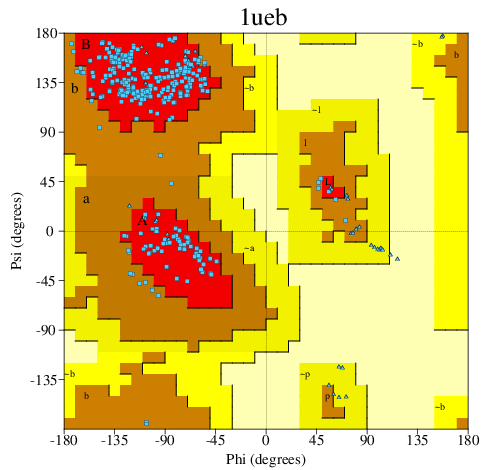
PROCHECK
|
|
|
|
|
|
Headers
|
|
|
|
References
|
|
|
|
|
|

|
|
Q76G20
(EFP_THET8) -
Elongation factor P from Thermus thermophilus (strain ATCC 27634 / DSM 579 / HB8)
|
|
|
|
Seq:
Struc:
|
|
|
|
184 a.a.
184 a.a.
|
|

|

|
|
|
|
|
|
|
|
|
|
|
|
Key: |
 |
PfamA domain |
|
|
 |
Secondary structure |
|
 |
CATH domain |
|
|
|
|
|
|
|
|
|
|
|
|
|
|
|
|
|
 |
|
|
|
|
|
|
| |
|
DOI no:
|
Proc Natl Acad Sci U S A
101:9595-9600
(2004)
|
|
PubMed id:
|
|
|
|
|
|
| |
|
Crystal structure of elongation factor P from Thermus thermophilus HB8.
|
|
K.Hanawa-Suetsugu,
S.Sekine,
H.Sakai,
C.Hori-Takemoto,
T.Terada,
S.Unzai,
J.R.Tame,
S.Kuramitsu,
M.Shirouzu,
S.Yokoyama.
|
|
|
|
|
| |
ABSTRACT
|
|
|
|
| |
|
|
Translation elongation factor P (EF-P) stimulates ribosomal peptidyltransferase
activity. EF-P is conserved in bacteria and is essential for cell viability.
Eukarya and Archaea have an EF-P homologue, eukaryotic initiation factor 5A
(eIF-5A). In the present study, we determined the crystal structure of EF-P from
Thermus thermophilus HB8 at a 1.65-A resolution. EF-P consists of three
beta-barrel domains (I, II, and III), whereas eIF-5A has only two domains (N and
C domains). Domain I of EF-P is topologically the same as the N domain of
eIF-5A. On the other hand, EF-P domains II and III share the same topology as
that of the eIF-5A C domain, indicating that domains II and III arose by
duplication. Intriguingly, the N-terminal half of domain II and the C-terminal
half of domain III of EF-P have sequence homologies to the N- and C-terminal
halves, respectively, of the eIF-5A C domain. The three domains of EF-P are
arranged in an "L" shape, with 65- and 53-A-long arms at an angle of
95 degrees, which is reminiscent of tRNA. Furthermore, most of the EF-P protein
surface is negatively charged. Therefore, EF-P mimics the tRNA shape but uses
domain topologies different from those of the known tRNA-mimicry translation
factors. Domain I of EF-P has a conserved positive charge at its tip, like the
eIF-5A N domain.
|
|
|
|
|
|
| |
Selected figure(s)
|
|
|
|
| |
|
|

|
|

|
|
Figure 3.
Fig. 3. Structure comparison of EF-P with tRNA and
ribosome-binding proteins. (A and B) EF-P from T. thermophilus
(PDB ID code 1UEB [PDB]
). (C) tRNA^Phe from Saccharomyces cerevisiae (PDB ID code 1EVV
[PDB]
). (D) EF-G from T. thermophilus (PDB ID code 1EFG [PDB]
). (E) Ribosome recycling factor from E. coli (PDB code 1EK8 [PDB]
). (F) Release factor 2 from E. coli (PDB ID code 1GQE [PDB]
).
|
|
Figure 5.
Fig. 5. Structure comparison of EF-P and eIF-5A. (A)
Superimposition of the ribbon diagrams of T. thermophilus EF-P
(blue) and M. jannaschii eIF-5A (yellow). (B) Amino acid
residues conserved in EF-Ps and eIF-5As color-coded on the
surface of T. thermophilus EF-P.
|
|
|
|
| |
Figures were
selected
by an automated process.
|
|
|
|
|
|
|
|
|
|
|
|
|
|
|
|
 |
 |
 |
|
Literature references that cite this PDB file's key reference
|
|
|
| |
PubMed id
|
|
Reference
|
|
|
|
|
|
A.Henderson,
and
J.W.Hershey
(2011).
Eukaryotic translation initiation factor (eIF) 5A stimulates protein synthesis in Saccharomyces cerevisiae.
|
| |
Proc Natl Acad Sci U S A,
108,
6415-6419.
|
|
|
|
|
|
|
J.H.Park,
C.A.Dias,
S.B.Lee,
S.R.Valentini,
M.Sokabe,
C.S.Fraser,
and
M.H.Park
(2011).
Production of active recombinant eIF5A: reconstitution in E.coli of eukaryotic hypusine modification of eIF5A by its coexpression with modifying enzymes.
|
| |
Protein Eng Des Sel,
24,
301-309.
|
|
|
|
|
|
|
J.Xu,
B.Zhang,
C.Jiang,
and
F.Ming
(2011).
RceIF5A, encoding an eukaryotic translation initiation factor 5A in Rosa chinensis, can enhance thermotolerance, oxidative and osmotic stress resistance of Arabidopsis thaliana.
|
| |
Plant Mol Biol,
75,
167-178.
|
|
|
|
|
|
|
S.Choi,
and
J.Choe
(2011).
Crystal structure of elongation factor P from Pseudomonas aeruginosa at 1.75 å resolution.
|
| |
Proteins,
79,
1688-1693.
|
|
|
|
|
|
|
M.H.Park,
K.Nishimura,
C.F.Zanelli,
and
S.R.Valentini
(2010).
Functional significance of eIF5A and its hypusine modification in eukaryotes.
|
| |
Amino Acids,
38,
491-500.
|
|
|
|
|
|
|
T.Yanagisawa,
T.Sumida,
R.Ishii,
C.Takemoto,
and
S.Yokoyama
(2010).
A paralog of lysyl-tRNA synthetase aminoacylates a conserved lysine residue in translation elongation factor P.
|
| |
Nat Struct Mol Biol,
17,
1136-1143.
|
|
|
PDB codes:
|
|
|
|
|
|
|
|
W.W.Navarre,
S.B.Zou,
H.Roy,
J.L.Xie,
A.Savchenko,
A.Singer,
E.Edvokimova,
L.R.Prost,
R.Kumar,
M.Ibba,
and
F.C.Fang
(2010).
PoxA, yjeK, and elongation factor P coordinately modulate virulence and drug resistance in Salmonella enterica.
|
| |
Mol Cell,
39,
209-221.
|
|
|
PDB code:
|
|
|
|
|
|
|
|
Y.Matsumoto,
Q.Xu,
S.Miyazaki,
C.Kaito,
C.L.Farr,
H.L.Axelrod,
H.J.Chiu,
H.E.Klock,
M.W.Knuth,
M.D.Miller,
M.A.Elsliger,
A.M.Deacon,
A.Godzik,
S.A.Lesley,
K.Sekimizu,
and
I.A.Wilson
(2010).
Structure of a virulence regulatory factor CvfB reveals a novel winged helix RNA binding module.
|
| |
Structure,
18,
537-547.
|
|
|
PDB code:
|
|
|
|
|
|
|
|
A.Liljas
(2009).
Biochemistry. Leaps in translational elongation.
|
| |
Science,
326,
677-678.
|
|
|
|
|
|
|
G.Blaha,
R.E.Stanley,
and
T.A.Steitz
(2009).
Formation of the first peptide bond: the structure of EF-P bound to the 70S ribosome.
|
| |
Science,
325,
966-970.
|
|
|
PDB codes:
|
|
|
|
|
|
|
|
P.Saini,
D.E.Eyler,
R.Green,
and
T.E.Dever
(2009).
Hypusine-containing protein eIF5A promotes translation elongation.
|
| |
Nature,
459,
118-121.
|
|
|
|
|
|
|
C.A.Dias,
V.S.Cano,
S.M.Rangel,
L.H.Apponi,
M.C.Frigieri,
J.R.Muniz,
W.Garcia,
M.H.Park,
R.C.Garratt,
C.F.Zanelli,
and
S.R.Valentini
(2008).
Structural modeling and mutational analysis of yeast eukaryotic translation initiation factor 5A reveal new critical residues and reinforce its involvement in protein synthesis.
|
| |
FEBS J,
275,
1874-1888.
|
|
|
|
|
|
|
H.Aoki,
J.Xu,
A.Emili,
J.G.Chosay,
A.Golshani,
and
M.C.Ganoza
(2008).
Interactions of elongation factor EF-P with the Escherichia coli ribosome.
|
| |
FEBS J,
275,
671-681.
|
|
|
|
|
|
|
M.Dori-Bachash,
B.Dassa,
S.Pietrokovski,
and
E.Jurkevitch
(2008).
Proteome-based comparative analyses of growth stages reveal new cell cycle-dependent functions in the predatory bacterium Bdellovibrio bacteriovorus.
|
| |
Appl Environ Microbiol,
74,
7152-7162.
|
|
|
|
|
|
|
V.S.Cano,
G.A.Jeon,
H.E.Johansson,
C.A.Henderson,
J.H.Park,
S.R.Valentini,
J.W.Hershey,
and
M.H.Park
(2008).
Mutational analyses of human eIF5A-1--identification of amino acid residues critical for eIF5A activity and hypusine modification.
|
| |
FEBS J,
275,
44-58.
|
|
|
|
|
|
|
C.F.Zanelli,
and
S.R.Valentini
(2007).
Is there a role for eIF5A in translation?
|
| |
Amino Acids,
33,
351-358.
|
|
|
|
|
|
|
E.C.Wolff,
K.R.Kang,
Y.S.Kim,
and
M.H.Park
(2007).
Posttranslational synthesis of hypusine: evolutionary progression and specificity of the hypusine modification.
|
| |
Amino Acids,
33,
341-350.
|
|
|
|
|
|
|
K.R.Kang,
Y.S.Kim,
E.C.Wolff,
and
M.H.Park
(2007).
Specificity of the deoxyhypusine hydroxylase-eukaryotic translation initiation factor (eIF5A) interaction: identification of amino acid residues of the enzyme required for binding of its substrate, deoxyhypusine-containing eIF5A.
|
| |
J Biol Chem,
282,
8300-8308.
|
|
|
|
|
|
|
J.H.Park,
L.Aravind,
E.C.Wolff,
J.Kaevel,
Y.S.Kim,
and
M.H.Park
(2006).
Molecular cloning, expression, and structural prediction of deoxyhypusine hydroxylase: a HEAT-repeat-containing metalloenzyme.
|
| |
Proc Natl Acad Sci U S A,
103,
51-56.
|
|
|
|
|
|
|
M.H.Park
(2006).
The post-translational synthesis of a polyamine-derived amino acid, hypusine, in the eukaryotic translation initiation factor 5A (eIF5A).
|
| |
J Biochem,
139,
161-169.
|
|
|
|
|
|
|
Y.S.Kim,
K.R.Kang,
E.C.Wolff,
J.K.Bell,
P.McPhie,
and
M.H.Park
(2006).
Deoxyhypusine hydroxylase is a Fe(II)-dependent, HEAT-repeat enzyme. Identification of amino acid residues critical for Fe(II) binding and catalysis [corrected].
|
| |
J Biol Chem,
281,
13217-13225.
|
|
|
|
|
|
|
H.Liang,
and
L.F.Landweber
(2005).
Molecular mimicry: quantitative methods to study structural similarity between protein and RNA.
|
| |
RNA,
11,
1167-1172.
|
|
|
|
|
|
The most recent references are shown first.
Citation data come partly from CiteXplore and partly
from an automated harvesting procedure. Note that this is likely to be
only a partial list as not all journals are covered by
either method. However, we are continually building up the citation data
so more and more references will be included with time.
Where a reference describes a PDB structure, the PDB
codes are
shown on the right.
|
|


 Links
Links


