 |
PDBsum entry 1tk3

|
|
|
|
|
 |
Contents |
 |
|
|
|
|
|
|
|
|
|
|
|
|
* Residue conservation analysis
|
|
|
|
|
|
PDB id:
|
|
|
|
| Name: |
|
Hydrolase
|
|
|
Title:
|
|
Crystal structure of human apo dipeptidyl peptidase iv/cd26
|
|
Structure:
|
|
Dipeptidyl peptidase iv. Chain: a, b. Fragment: extracellular domain. Synonym: dpp iv, t-cell activation antigen cd26, tp103, adenosine deaminase complexing protein-2, adabp. Engineered: yes
|
|
Source:
|
|
Homo sapiens. Human. Organism_taxid: 9606. Gene: dpp4, adcp2, cd26. Expressed in: spodoptera frugiperda. Expression_system_taxid: 7108. Expression_system_cell_line: high5.
|
|
Biol. unit:
|
|
Dimer (from
)
|
|
Resolution:
|
|
|
2.00Å
|
R-factor:
|
0.229
|
R-free:
|
0.272
|
|
|
Authors:
|
|
J.R.Bjelke,J.Christensen,S.Branner,N.Wagtmann,C.Olsen,A.B.Kanstrup, H.B.Rasmussen
|
Key ref:

|
|
J.R.Bjelke
et al.
(2004).
Tyrosine 547 constitutes an essential part of the catalytic mechanism of dipeptidyl peptidase IV.
J Biol Chem,
279,
34691-34697.
PubMed id:
DOI:

|
|
|
Date:
|
|
|
08-Jun-04
|
Release date:
|
06-Jul-04
|
|
|
|
|
|
|
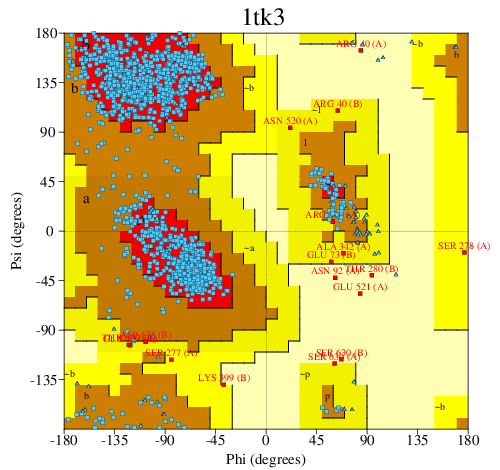
PROCHECK
|
|
|
|
|
|
Headers
|
|
|
|
References
|
|
|
|
|
|

|
|
P27487
(DPP4_HUMAN) -
Dipeptidyl peptidase 4 from Homo sapiens
|
|
|
|
Seq:
Struc:
|
|
|
|
766 a.a.
726 a.a.
|
|

|

|
|
|
|
|
|
|
|
|
|
|
|
Key: |
 |
PfamA domain |
|
|
 |
Secondary structure |
|
 |
CATH domain |
|
|
|
|
|
|
|
|
|
|
|
|
|
Enzyme class:
|
|
E.C.3.4.14.5
- dipeptidyl-peptidase Iv.
|
|
|
|
|
|
|
Reaction:
|
|
Release of an N-terminal dipeptide, Xaa-Xbb-|-Xcc, from a polypeptide, preferentially when Xbb is Pro, provided Xcc is neither Pro nor hydroxyproline.
|
|
|
|
|
|
|
|
|
|
|
|
|
|
|
|
|
|
 |
|
|
|
|
|
|
| |
|
DOI no:
|
J Biol Chem
279:34691-34697
(2004)
|
|
PubMed id:
|
|
|
|
|
|
| |
|
Tyrosine 547 constitutes an essential part of the catalytic mechanism of dipeptidyl peptidase IV.
|
|
J.R.Bjelke,
J.Christensen,
S.Branner,
N.Wagtmann,
C.Olsen,
A.B.Kanstrup,
H.B.Rasmussen.
|
|
|
|
|
| |
ABSTRACT
|
|
|
|
| |
|
|
Human dipeptidyl peptidase IV (DPP-IV) is a ubiquitously expressed type II
transmembrane serine protease. It cleaves the penultimate positioned prolyl
bonds at the N terminus of physiologically important peptides such as the
incretin hormones glucagon-like peptide 1 and glucose-dependent insulinotropic
peptide. In this study, we have characterized different active site mutants. The
Y547F mutant as well as the catalytic triad mutants S630A, D708A, and H740L
showed less than 1% wild type activity. X-ray crystal structure analysis of the
Y547F mutant revealed no overall changes compared with wild type apoDPP-IV,
except the ablation of the hydroxyl group of Tyr(547) and a water molecule
positioned in close proximity to Tyr(547). To elucidate further the reaction
mechanism, we determined the crystal structure of DPP-IV in complex with
diisopropyl fluorophosphate, mimicking the tetrahedral intermediate. The kinetic
and structural findings of the tyrosine residue are discussed in relation to the
catalytic mechanism of DPP-IV and to the inhibitory mechanism of the
2-cyanopyrrolidine class of potent DPP-IV inhibitors, proposing an explanation
for the specificity of this class of inhibitors for the S9b family among serine
proteases.
|
|
|
|
|
|
| |
Selected figure(s)
|
|
|
|
| |
|
|

|
|

|
|
Figure 1.
FIG. 1. The structure of one monomer of DPP-IV in complex
with ValPyr and close-up of the active site. The  -propeller and the -propeller and the  / hydrolase
domains are shown in purple and brown, respectively. Residues in
close proximity of the ValPyr inhibitor are shown with
interatomic distances. See text for details. / hydrolase
domains are shown in purple and brown, respectively. Residues in
close proximity of the ValPyr inhibitor are shown with
interatomic distances. See text for details.
|
|
Figure 4.
FIG. 4. Close-up of active site residues. The initial F[o]
- F[c] electron density maps are overlaid the apoDPP-IV (A),
Y547F mutant (B), and complex DFP·DPP-IV (C, slightly
different view, relative to A and B) contoured at 2  (cyan),
3 (red), 5 (purple,
only contoured in the apo structure), and 8 (blue, only contoured
in the DFP structure). The initial 2F[o] - F[c] electron density
map is overlaid the complex DFP·DPP-IV contoured at 1
(gray). Structural
inspections of the active site of the Y547F mutant reveals a
missing water molecule, clearly seen in the wild type apo
structure (i.e. hydrogen bonds between Tyr547-OH, Ser630-OH, and
Tyr631-NH are indicated). The mutated residue (Phe^547) is
positioned exactly as the tyrosine residue. The water molecule
designated Wat258 and Wat421 in the apo and the Y547F mutant
structure, respectively, is moved 0.5 Å away from the 547
residue and 0.3 Å (2.9 versus 3.2 Å) closer to the
neighboring Tyr666-OH (not shown) in the mutant structure. The
complex between DFP and DPP-IV showed that the organophosphorous
inhibitor was covalently bound to Ser630, mimicking the
tetrahedral intermediate. (cyan),
3 (red), 5 (purple,
only contoured in the apo structure), and 8 (blue, only contoured
in the DFP structure). The initial 2F[o] - F[c] electron density
map is overlaid the complex DFP·DPP-IV contoured at 1
(gray). Structural
inspections of the active site of the Y547F mutant reveals a
missing water molecule, clearly seen in the wild type apo
structure (i.e. hydrogen bonds between Tyr547-OH, Ser630-OH, and
Tyr631-NH are indicated). The mutated residue (Phe^547) is
positioned exactly as the tyrosine residue. The water molecule
designated Wat258 and Wat421 in the apo and the Y547F mutant
structure, respectively, is moved 0.5 Å away from the 547
residue and 0.3 Å (2.9 versus 3.2 Å) closer to the
neighboring Tyr666-OH (not shown) in the mutant structure. The
complex between DFP and DPP-IV showed that the organophosphorous
inhibitor was covalently bound to Ser630, mimicking the
tetrahedral intermediate.
|
|
|
|
|
|
| |
The above figures are
reprinted
by permission from the ASBMB:
J Biol Chem
(2004,
279,
34691-34697)
copyright 2004.
|
|
| |
Figures were
selected
by an automated process.
|
|
|
|
|
|
|
|
|
|
|
|
|
|
|
|
 |
 |
 |
|
Literature references that cite this PDB file's key reference
|
|
|
| |
PubMed id
|
|
Reference
|
|
|
|
|
|
C.Li,
J.Shen,
W.Li,
C.Lu,
G.Liu,
and
Y.Tang
(2011).
Possible ligand release pathway of dipeptidyl peptidase IV investigated by molecular dynamics simulations.
|
| |
Proteins,
79,
1800-1809.
|
|
|
|
|
|
|
M.R.Pitman,
R.I.Menz,
and
C.A.Abbott
(2010).
Hydrophilic residues surrounding the S1 and S2 pockets contribute to dimerisation and catalysis in human dipeptidyl peptidase 8 (DP8).
|
| |
Biol Chem,
391,
959-972.
|
|
|
|
|
|
|
A.G.Sandström,
K.Engström,
J.Nyhlén,
A.Kasrayan,
and
J.E.Bäckvall
(2009).
Directed evolution of Candida antarctica lipase A using an episomaly replicating yeast plasmid.
|
| |
Protein Eng Des Sel,
22,
413-420.
|
|
|
|
|
|
|
K.McNicholas,
T.Chen,
and
C.A.Abbott
(2009).
Dipeptidyl peptidase (DP) 6 and DP10: novel brain proteins implicated in human health and disease.
|
| |
Clin Chem Lab Med,
47,
262-267.
|
|
|
|
|
|
|
I.M.Al-Masri,
M.K.Mohammad,
and
M.O.Taha
(2008).
Discovery of DPP IV inhibitors by pharmacophore modeling and QSAR analysis followed by in silico screening.
|
| |
ChemMedChem,
3,
1763-1779.
|
|
|
|
|
|
|
W.J.Metzler,
J.Yanchunas,
C.Weigelt,
K.Kish,
H.E.Klei,
D.Xie,
Y.Zhang,
M.Corbett,
J.K.Tamura,
B.He,
L.G.Hamann,
M.S.Kirby,
and
J.Marcinkeviciene
(2008).
Involvement of DPP-IV catalytic residues in enzyme-saxagliptin complex formation.
|
| |
Protein Sci,
17,
240-250.
|
|
|
PDB code:
|
|
|
|
|
|
|
|
Y.Nakajima,
K.Ito,
T.Toshima,
T.Egawa,
H.Zheng,
H.Oyama,
Y.F.Wu,
E.Takahashi,
K.Kyono,
and
T.Yoshimoto
(2008).
Dipeptidyl aminopeptidase IV from Stenotrophomonas maltophilia exhibits activity against a substrate containing a 4-hydroxyproline residue.
|
| |
J Bacteriol,
190,
7819-7829.
|
|
|
PDB code:
|
|
|
|
|
|
|
|
C.Oefner,
S.Pierau,
H.Schulz,
and
G.E.Dale
(2007).
Structural studies of a bifunctional inhibitor of neprilysin and DPP-IV.
|
| |
Acta Crystallogr D Biol Crystallogr,
63,
975-981.
|
|
|
PDB code:
|
|
|
|
|
|
|
|
C.Rummey,
and
G.Metz
(2007).
Homology models of dipeptidyl peptidases 8 and 9 with a focus on loop predictions near the active site.
|
| |
Proteins,
66,
160-171.
|
|
|
|
|
|
|
H.Hiramatsu,
K.Kyono,
A.Yamamoto,
K.Saeki,
H.Shima,
S.Sugiyama,
K.Inaka,
and
R.Shimizu
(2007).
Crystal structures of human dipeptidyl peptidase IV in its apo and diprotin B-complexed forms.
|
| |
Acta Biochim Biophys Sin (Shanghai),
39,
335-343.
|
|
|
|
|
|
|
R.R.Pissurlenkar,
M.S.Shaikh,
and
E.C.Coutinho
(2007).
3D-QSAR studies of Dipeptidyl peptidase IV inhibitors using a docking based alignment.
|
| |
J Mol Model,
13,
1047-1071.
|
|
|
|
|
|
|
D.Chen,
A.Kennedy,
J.Y.Wang,
W.Zeng,
Q.Zhao,
M.Pearl,
M.Zhang,
Z.Suo,
J.M.Nesland,
Y.Qiao,
A.K.Ng,
N.Hirashima,
T.Yamane,
Y.Mori,
M.Mitsumata,
G.Ghersi,
and
W.T.Chen
(2006).
Activation of EDTA-resistant gelatinases in malignant human tumors.
|
| |
Cancer Res,
66,
9977-9985.
|
|
|
|
|
|
|
C.J.Chihara,
C.Song,
G.LaMonte,
K.Fetalvero,
K.Hinchman,
H.Phan,
M.Pineda,
K.Robinson,
and
G.P.Schneider
(2005).
Identification and partial characterization of the enzyme of omega: one of five putative DPP IV genes in Drosophila melanogaster.
|
| |
J Insect Sci,
5,
26.
|
|
|
|
|
|
The most recent references are shown first.
Citation data come partly from CiteXplore and partly
from an automated harvesting procedure. Note that this is likely to be
only a partial list as not all journals are covered by
either method. However, we are continually building up the citation data
so more and more references will be included with time.
Where a reference describes a PDB structure, the PDB
code is
shown on the right.
|
|


 Links
Links


