 |
PDBsum entry 1t5a

|
|
|
|
|
 |
Contents |
 |
|
|
|
|
|
|
|
|
|
|
|
|
|
|
* Residue conservation analysis
|
|
|
|
|
|
|
|
|
|
|
Enzyme class:
|
|
E.C.2.7.1.40
- pyruvate kinase.
|
|
|
|
|
|
|
Reaction:
|
|
pyruvate + ATP = phosphoenolpyruvate + ADP + H+
|
|
|
|
|
|
 pyruvate
|
+
|
ATP
Bound ligand (Het Group name = )
matches with 71.43% similarity
|
=
|
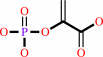 phosphoenolpyruvate
|
+
|
 ADP
ADP
|
+
|
H(+)
Bound ligand (Het Group name = )
matches with 42.86% similarity
|
|
|
|
|
|
|
|
|
|
|
|
|
Molecule diagrams generated from .mol files obtained from the
KEGG ftp site
|
|
|
|
|
|
|
|
|
|
|
|
|
|
 |
|
|
|
|
|
|
| |
|
|
| |
|
DOI no:
|
Biochemistry
44:9417-9429
(2005)
|
|
PubMed id:
|
|
|
|
|
|
| |
|
Structural basis for tumor pyruvate kinase M2 allosteric regulation and catalysis.
|
|
J.D.Dombrauckas,
B.D.Santarsiero,
A.D.Mesecar.
|
|
|
|
|
| |
ABSTRACT
|
|
|
|
| |
|
|
Four isozymes of pyruvate kinase are differentially expressed in human tissue.
Human pyruvate kinase isozyme M2 (hPKM2) is expressed in early fetal tissues and
is progressively replaced by the other three isozymes, M1, R, and L, immediately
after birth. In most cancer cells, hPKM2 is once again expressed to promote
tumor cell proliferation. Because of its almost ubiquitous presence in cancer
cells, hPKM2 has been designated as tumor specific PK-M2, and its presence in
human plasma is currently being used as a molecular marker for the diagnosis of
various cancers. The X-ray structure of human hPKM2 complexed with Mg(2+), K(+),
the inhibitor oxalate, and the allosteric activator fructose 1,6-bisphosphate
(FBP) has been determined to a resolution of 2.82 A. The active site of hPKM2 is
in a partially closed conformation most likely resulting from a ligand-induced
domain closure promoted by the binding of FBP. In all four subunits of the
enzyme tetramer, a conserved water molecule is observed on the 2-si face of the
prospective enolate and supports the hypothesis that a proton-relay system is
acting as the proton donor of the reaction (1). Significant structural
differences among the human M2, rabbit muscle M1, and the human R isozymes are
observed, especially in the orientation of the FBP-activating loop, which is in
a closed conformation when FBP is bound. The structural differences observed
between the PK isozymes could potentially be exploited as unique structural
templates for the design of allosteric drugs against the disease states
associated with the various PK isozymes, especially cancer and nonspherocytic
hemolytic anemia.
|
|
|
|
|
|
|
|
|
|
|
|
|
|
|
|
|
|
 |
 |
 |
|
Literature references that cite this PDB file's key reference
|
|
|
| |
PubMed id
|
|
Reference
|
|
|
|
|
|
B.Chaneton,
P.Hillmann,
L.Zheng,
A.C.Martin,
O.D.Maddocks,
A.Chokkathukalam,
J.E.Coyle,
A.Jankevics,
F.P.Holding,
K.H.Vousden,
C.Frezza,
M.O'Reilly,
and
E.Gottlieb
(2012).
Serine is a natural ligand and allosteric activator of pyruvate kinase M2.
|
| |
Nature,
491,
458-462.
|
|
|
PDB code:
|
|
|
|
|
|
|
|
J.Bonhomme,
M.Chauvel,
S.Goyard,
P.Roux,
T.Rossignol,
and
C.d'Enfert
(2011).
Contribution of the glycolytic flux and hypoxia adaptation to efficient biofilm formation by Candida albicans.
|
| |
Mol Microbiol,
80,
995.
|
|
|
|
|
|
|
B.Kefas,
L.Comeau,
N.Erdle,
E.Montgomery,
S.Amos,
and
B.Purow
(2010).
Pyruvate kinase M2 is a target of the tumor-suppressive microRNA-326 and regulates the survival of glioma cells.
|
| |
Neuro Oncol,
12,
1102-1112.
|
|
|
|
|
|
|
C.V.Clower,
D.Chatterjee,
Z.Wang,
L.C.Cantley,
M.G.Vander Heiden,
and
A.R.Krainer
(2010).
The alternative splicing repressors hnRNP A1/A2 and PTB influence pyruvate kinase isoform expression and cell metabolism.
|
| |
Proc Natl Acad Sci U S A,
107,
1894-1899.
|
|
|
|
|
|
|
K.Maier,
U.Hofmann,
M.Reuss,
and
K.Mauch
(2010).
Dynamics and control of the central carbon metabolism in hepatoma cells.
|
| |
BMC Syst Biol,
4,
54.
|
|
|
|
|
|
|
M.B.Boxer,
J.K.Jiang,
M.G.Vander Heiden,
M.Shen,
A.P.Skoumbourdis,
N.Southall,
H.Veith,
W.Leister,
C.P.Austin,
H.W.Park,
J.Inglese,
L.C.Cantley,
D.S.Auld,
and
C.J.Thomas
(2010).
Evaluation of substituted N,N'-diarylsulfonamides as activators of the tumor cell specific M2 isoform of pyruvate kinase.
|
| |
J Med Chem,
53,
1048-1055.
|
|
|
|
|
|
|
M.G.Vander Heiden,
H.R.Christofk,
E.Schuman,
A.O.Subtelny,
H.Sharfi,
E.E.Harlow,
J.Xian,
and
L.C.Cantley
(2010).
Identification of small molecule inhibitors of pyruvate kinase M2.
|
| |
Biochem Pharmacol,
79,
1118-1124.
|
|
|
|
|
|
|
M.G.Vander Heiden,
J.W.Locasale,
K.D.Swanson,
H.Sharfi,
G.J.Heffron,
D.Amador-Noguez,
H.R.Christofk,
G.Wagner,
J.D.Rabinowitz,
J.M.Asara,
and
L.C.Cantley
(2010).
Evidence for an alternative glycolytic pathway in rapidly proliferating cells.
|
| |
Science,
329,
1492-1499.
|
|
|
|
|
|
|
R.Bakszt,
A.Wernimont,
A.Allali-Hassani,
M.W.Mok,
T.Hills,
R.Hui,
and
J.C.Pizarro
(2010).
The crystal structure of Toxoplasma gondii pyruvate kinase 1.
|
| |
PLoS One,
5,
e12736.
|
|
|
PDB codes:
|
|
|
|
|
|
|
|
R.L.Gundry,
I.Tchernyshyov,
S.Sheng,
Y.Tarasova,
K.Raginski,
K.R.Boheler,
and
J.E.Van Eyk
(2010).
Expanding the mouse embryonic stem cell proteome: combining three proteomic approaches.
|
| |
Proteomics,
10,
2728-2732.
|
|
|
|
|
|
|
V.Gupta,
and
R.N.Bamezai
(2010).
Human pyruvate kinase M2: a multifunctional protein.
|
| |
Protein Sci,
19,
2031-2044.
|
|
|
|
|
|
|
A.Allali-Hassani,
G.A.Wasney,
I.Chau,
B.S.Hong,
G.Senisterra,
P.Loppnau,
Z.Shi,
J.Moult,
A.M.Edwards,
C.H.Arrowsmith,
H.W.Park,
M.Schapira,
and
M.Vedadi
(2009).
A survey of proteins encoded by non-synonymous single nucleotide polymorphisms reveals a significant fraction with altered stability and activity.
|
| |
Biochem J,
424,
15-26.
|
|
|
|
|
|
|
A.W.Fenton,
and
M.Hutchinson
(2009).
The pH dependence of the allosteric response of human liver pyruvate kinase to fructose-1,6-bisphosphate, ATP, and alanine.
|
| |
Arch Biochem Biophys,
484,
16-23.
|
|
|
|
|
|
|
E.Hulleman,
M.J.Broekhuis,
R.Pieters,
and
M.L.Den Boer
(2009).
Pyruvate kinase M2 and prednisolone resistance in acute lymphoblastic leukemia.
|
| |
Haematologica,
94,
1322-1324.
|
|
|
|
|
|
|
G.A.Spoden,
D.Morandell,
D.Ehehalt,
M.Fiedler,
P.Jansen-Dürr,
M.Hermann,
and
W.Zwerschke
(2009).
The SUMO-E3 ligase PIAS3 targets pyruvate kinase M2.
|
| |
J Cell Biochem,
107,
293-302.
|
|
|
|
|
|
|
K.Akhtar,
V.Gupta,
A.Koul,
N.Alam,
R.Bhat,
and
R.N.Bamezai
(2009).
Differential behavior of missense mutations in the intersubunit contact domain of the human pyruvate kinase m2 isozyme.
|
| |
J Biol Chem,
284,
11971-11981.
|
|
|
|
|
|
|
K.Kienzl,
B.Sarg,
G.Golderer,
P.Obrist,
E.R.Werner,
G.Werner-Felmayer,
H.Lindner,
M.Maglione,
S.Schneeberger,
R.Margreiter,
and
G.Brandacher
(2009).
Proteomic profiling of acute cardiac allograft rejection.
|
| |
Transplantation,
88,
553-560.
|
|
|
|
|
|
|
N.Salomonis,
B.Nelson,
K.Vranizan,
A.R.Pico,
K.Hanspers,
A.Kuchinsky,
L.Ta,
M.Mercola,
and
B.R.Conklin
(2009).
Alternative splicing in the differentiation of human embryonic stem cells into cardiac precursors.
|
| |
PLoS Comput Biol,
5,
e1000553.
|
|
|
|
|
|
|
P.B.Romesser,
D.H.Perlman,
D.V.Faller,
C.E.Costello,
M.E.McComb,
and
G.V.Denis
(2009).
Development of a malignancy-associated proteomic signature for diffuse large B-cell lymphoma.
|
| |
Am J Pathol,
175,
25-35.
|
|
|
|
|
|
|
P.Herman,
and
J.C.Lee
(2009).
Functional energetic landscape in the allosteric regulation of muscle pyruvate kinase. 1. Calorimetric study.
|
| |
Biochemistry,
48,
9448-9455.
|
|
|
|
|
|
|
X.Tong,
F.Zhao,
and
C.B.Thompson
(2009).
The molecular determinants of de novo nucleotide biosynthesis in cancer cells.
|
| |
Curr Opin Genet Dev,
19,
32-37.
|
|
|
|
|
|
|
E.C.Ferguson,
and
J.C.Rathmell
(2008).
New roles for pyruvate kinase M2: working out the Warburg effect.
|
| |
Trends Biochem Sci,
33,
359-362.
|
|
|
|
|
|
|
G.A.Spoden,
S.Mazurek,
D.Morandell,
N.Bacher,
M.J.Ausserlechner,
P.Jansen-Dürr,
E.Eigenbrodt,
and
W.Zwerschke
(2008).
Isotype-specific inhibitors of the glycolytic key regulator pyruvate kinase subtype M2 moderately decelerate tumor cell proliferation.
|
| |
Int J Cancer,
123,
312-321.
|
|
|
|
|
|
|
H.R.Christofk,
M.G.Vander Heiden,
M.H.Harris,
A.Ramanathan,
R.E.Gerszten,
R.Wei,
M.D.Fleming,
S.L.Schreiber,
and
L.C.Cantley
(2008).
The M2 splice isoform of pyruvate kinase is important for cancer metabolism and tumour growth.
|
| |
Nature,
452,
230-233.
|
|
|
|
|
|
|
H.R.Christofk,
M.G.Vander Heiden,
N.Wu,
J.M.Asara,
and
L.C.Cantley
(2008).
Pyruvate kinase M2 is a phosphotyrosine-binding protein.
|
| |
Nature,
452,
181-186.
|
|
|
PDB codes:
|
|
|
|
|
|
|
|
J.C.Lee
(2008).
Modulation of allostery of pyruvate kinase by shifting of an ensemble of microstates.
|
| |
Acta Biochim Biophys Sin (Shanghai),
40,
663-669.
|
|
|
|
|
|
|
A.Zanella,
E.Fermo,
P.Bianchi,
L.R.Chiarelli,
and
G.Valentini
(2007).
Pyruvate kinase deficiency: the genotype-phenotype association.
|
| |
Blood Rev,
21,
217-231.
|
|
|
|
|
|
|
S.S.Kharalkar,
G.S.Joshi,
F.N.Musayev,
M.Fornabaio,
D.J.Abraham,
and
M.K.Safo
(2007).
Identification of novel allosteric regulators of human-erythrocyte pyruvate kinase.
|
| |
Chem Biodivers,
4,
2603-2617.
|
|
|
|
|
|
|
X.Zhang,
F.Yang,
J.Y.Shim,
K.L.Kirk,
D.E.Anderson,
and
X.Chen
(2007).
Identification of arsenic-binding proteins in human breast cancer cells.
|
| |
Cancer Lett,
255,
95.
|
|
|
|
|
|
The most recent references are shown first.
Citation data come partly from CiteXplore and partly
from an automated harvesting procedure. Note that this is likely to be
only a partial list as not all journals are covered by
either method. However, we are continually building up the citation data
so more and more references will be included with time.
Where a reference describes a PDB structure, the PDB
code is
shown on the right.
|
|


 Links
Links


