 |
PDBsum entry 1t2c

|
|
|
|
|
|

|

|

|

|
|

|
|

|
|

|
|

|
|
|
 |

|

|
|
|
|
|
|
|
|
|
|
|
|
|
|
|
|
|
|
|
|
|
|
|
|
|
|
|
|
|
|
|
|
|
Oxidoreductase
|
PDB id
|
|
|
|
1t2c
|
|
|
|
|
|
|
|
|
|
|
|
|
|
|

|

|

|
|
|
|
|
|
|
|
 |
Contents |
 |
|
|
|
|
|
|
|
|
|
|
|
|
* Residue conservation analysis
|
|
|
|
|
|
PDB id:
|
|
|
|
| Name: |
|
Oxidoreductase
|
|
|
Title:
|
|
Plasmodium falciparum lactate dehydrogenase complexed with nadh
|
|
Structure:
|
|
L-lactate dehydrogenase. Chain: a. Synonym: ldh-p. Engineered: yes
|
|
Source:
|
|
Plasmodium falciparum. Malaria parasite p. Falciparum. Organism_taxid: 5833. Gene: ldh. Expressed in: escherichia coli. Expression_system_taxid: 562.
|
|
Biol. unit:
|
|
 Tetramer (from PDB file)
|
|
Resolution:
|
|
|
2.01Å
|
R-factor:
|
0.145
|
R-free:
|
0.184
|
|
|
Authors:
|
|
A.Cameron,J.Read,R.Tranter,V.J.Winter,R.B.Sessions,R.L.Brady,L.Vivas, A.Easton,H.Kendrick,S.L.Croft,D.Barros,J.L.Lavandera,J.J.Martin, F.Risco,S.Garcia-Ochoa,F.J.Gamo,L.Sanz,L.Leon,J.R.Ruiz,R.Gabarro, A.Mallo,F.G.De Las Heras
|
Key ref:

|
|
A.Cameron
et al.
(2004).
Identification and activity of a series of azole-based compounds with lactate dehydrogenase-directed anti-malarial activity.
J Biol Chem,
279,
31429-31439.
PubMed id:
DOI:

|
|
|
Date:
|
|
|
21-Apr-04
|
Release date:
|
11-May-04
|
|
|
|
|
|
|
PROCHECK
|

|
|
|
|
|
Headers
|
|
|
|
References
|
|
|
|
|
|

|
|
Q27743
(LDH_PLAFD) -
L-lactate dehydrogenase from Plasmodium falciparum (isolate CDC / Honduras)
|
|
|
|
Seq:
Struc:
|
|
|
|
316 a.a.
315 a.a.
|
|

|

|

|
|
|
|
|
|
|
|
|
|
|
Key: |
 |
PfamA domain |
|
|
 |
Secondary structure |
|
 |
CATH domain |
|
|
|
|
|
|
|
|
|
|
|
|
|
Enzyme class:
|
|
E.C.1.1.1.27
- L-lactate dehydrogenase.
|
|
|
|
|
|
|
Reaction:
|
|
(S)-lactate + NAD+ = pyruvate + NADH + H+
|
|
|
|
|
|
(S)-lactate
Bound ligand (Het Group name = )
matches with 71.43% similarity
|
+
|
NAD(+)
Bound ligand (Het Group name = )
corresponds exactly
|
=
|
 pyruvate
|
+
|
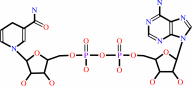 NADH
NADH
|
+
|
H(+)
|
|
|
|
|
|
|
|
|
|
|
|
|
Molecule diagrams generated from .mol files obtained from the
KEGG ftp site
|
|
|
|
|
|
|
|
|
|
|
|
|
|
 |
|
|
|
|
|
|
| |
|
|
| |
|
DOI no:
|
J Biol Chem
279:31429-31439
(2004)
|
|
PubMed id:
|
|
|
|
|
|
| |
|
Identification and activity of a series of azole-based compounds with lactate dehydrogenase-directed anti-malarial activity.
|
|
A.Cameron,
J.Read,
R.Tranter,
V.J.Winter,
R.B.Sessions,
R.L.Brady,
L.Vivas,
A.Easton,
H.Kendrick,
S.L.Croft,
D.Barros,
J.L.Lavandera,
J.J.Martin,
F.Risco,
S.García-Ochoa,
F.J.Gamo,
L.Sanz,
L.Leon,
J.R.Ruiz,
R.Gabarró,
A.Mallo,
F.Gómez de las Heras.
|
|
|
|
|
| |
ABSTRACT
|
|
|
|
| |
|
|
Plasmodium falciparum, the causative agent of malaria, relies extensively on
glycolysis coupled with homolactic fermentation during its blood-borne stages
for energy production. Selective inhibitors of the parasite lactate
dehydrogenase (LDH), central to NAD(+) regeneration, therefore potentially
provide a route to new antimalarial drugs directed against a novel molecular
target. A series of heterocyclic, azole-based compounds are described that
preferentially inhibit P. falciparum LDH at sub-micromolar concentrations,
typically at concentrations about 100-fold lower than required for human lactate
dehydrogenase inhibition. Crystal structures show these competitive inhibitors
form a network of interactions with amino acids within the active site of the
enzyme, stacking alongside the nicotinamide ring of the NAD(+) cofactor. These
compounds display modest activity against parasitized erythrocytes, including
parasite strains with known resistance to existing anti-malarials and against
Plasmodium berghei in BALB/c mice. Initial toxicity data suggest the azole
derivatives have generally low cytotoxicity, and preliminary pharmoco-kinetic
data show favorable bioavailability and circulation times. These encouraging
results suggest that further enhancement of these structures may yield
candidates suitable for consideration as new therapeutics for the treatment of
malaria. In combination these studies also provide strong support for the
validity of targeting the Plasmodium glycolytic pathway and, in particular, LDH
in the search for novel anti-malarials.
|
|
|
|
|
|
| |
Selected figure(s)
|
|
|
|
| |
|
|

|
|

|
|
Figure 1.
FIG. 1. Azole-based inhibitors of pfLDH. Schematic showing
chemical structures of OXD1, IOA1, and TDA1 parent compounds.
|
|
Figure 3.
FIG. 3. Azole-based inhibitors at the active site of pfLDH.
Figure shows the active site region in the crystal structures of
pfLDH co-crystallized with NAD^+ and OXD1 (green), NADH and IOA1
(blue), and NADH with TDA1 (magenta).
|
|
|
|
|
|
| |
The above figures are
reprinted
by permission from the ASBMB:
J Biol Chem
(2004,
279,
31429-31439)
copyright 2004.
|
|
| |
Figures were
selected
by the author.
|
|
|
|
|
|
|
|
|
|
|
|
|
|
|
|
 |
 |
 |
|
Literature references that cite this PDB file's key reference
|
|
|
| |
PubMed id
|
|
Reference
|
|
|
|
|
|
N.K.Sahu,
S.Sahu,
and
D.V.Kohli
(2008).
Novel molecular targets for antimalarial drug development.
|
| |
Chem Biol Drug Des,
71,
287-297.
|
|
|
|
|
|
|
D.K.Shoemark,
M.J.Cliff,
R.B.Sessions,
and
A.R.Clarke
(2007).
Enzymatic properties of the lactate dehydrogenase enzyme from Plasmodium falciparum.
|
| |
FEBS J,
274,
2738-2748.
|
|
|
|
|
|
|
T.Stoeck,
J.Kasper,
J.Bunge,
C.Leslin,
V.Ilyin,
and
S.Epstein
(2007).
Protistan diversity in the arctic: a case of paleoclimate shaping modern biodiversity?
|
| |
PLoS ONE,
2,
e728.
|
|
|
|
|
|
|
R.Pink,
A.Hudson,
M.A.Mouriès,
and
M.Bendig
(2005).
Opportunities and challenges in antiparasitic drug discovery.
|
| |
Nat Rev Drug Discov,
4,
727-740.
|
|
|
|
|
|
The most recent references are shown first.
Citation data come partly from CiteXplore and partly
from an automated harvesting procedure. Note that this is likely to be
only a partial list as not all journals are covered by
either method. However, we are continually building up the citation data
so more and more references will be included with time.
|
|


 Links
Links


