 |
PDBsum entry 1s3n

|
|
|
|
|
|

|

|

|

|
|

|
|

|
|

|
|

|
|

|
|
|
 |

|

|
|
|
|
|
|
|
|
|
|
|
|
|
|
|
|
|
|
|
|
|
|
|
|
|
|
|
|
|
|
|
|
|
|
Phosphodiesterase
|
PDB id
|
|
|
|
1s3n
|
|
|
|
|
|
|
|
|
|
|
|
|
|
|

|

|

|
|
|
|
|
|
|
|
 |
Contents |
 |
|
|
|
|
|
|
|
|
|
|
|
|
* Residue conservation analysis
|
|
|
|
|
|
PDB id:
|
|
|
|
| Name: |
|
Phosphodiesterase
|
|
|
Title:
|
|
Structural and functional characterization of a novel archaeal phosphodiesterase
|
|
Structure:
|
|
Hypothetical protein mj0936. Chain: a, b. Engineered: yes
|
|
Source:
|
|
Methanocaldococcus jannaschii. Organism_taxid: 2190. Expressed in: escherichia coli. Expression_system_taxid: 562.
|
|
Biol. unit:
|
|
Dimer (from
)
|
|
Resolution:
|
|
|
2.50Å
|
R-factor:
|
0.220
|
R-free:
|
0.253
|
|
|
Authors:
|
|
S.Chen,D.Busso,A.F.Yakunin,E.Kuznetsova,M.Proudfoot,J.Jancrick,R.Kim, S.-H.Kim,Berkeley Structural Genomics Center (Bsgc)
|
Key ref:

|
|
S.Chen
et al.
(2004).
Structural and functional characterization of a novel phosphodiesterase from Methanococcus jannaschii.
J Biol Chem,
279,
31854-31862.
PubMed id:
DOI:

|
|
|
Date:
|
|
|
13-Jan-04
|
Release date:
|
10-Aug-04
|
|
|
|
|
|
|
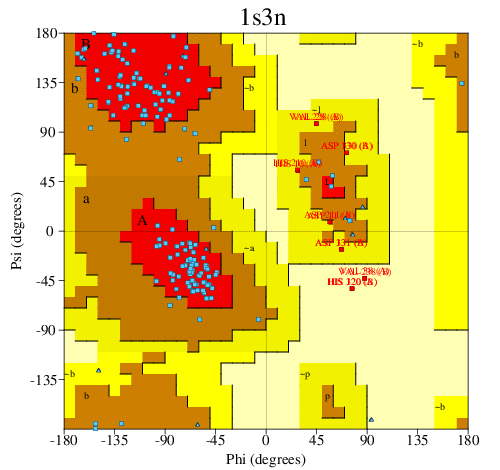
PROCHECK
|
|
|
|
|
|
Headers
|
|
|
|
References
|
|
|
|
|
|

|
|
Q58346
(P936_METJA) -
Phosphodiesterase MJ0936 from Methanocaldococcus jannaschii (strain ATCC 43067 / DSM 2661 / JAL-1 / JCM 10045 / NBRC 100440)
|
|
|
|
Seq:
Struc:
|
|
|
|
166 a.a.
165 a.a.
|
|

|

|
|
|
|
|
|
|
|
|
|
|
|
Key: |
 |
PfamA domain |
|
|
 |
Secondary structure |
|
 |
CATH domain |
|
|
|
|
|
|
|
|
|
|
|
|
|
|
|
|
|
 |
|
|
|
|
|
|
| |
|
DOI no:
|
J Biol Chem
279:31854-31862
(2004)
|
|
PubMed id:
|
|
|
|
|
|
| |
|
Structural and functional characterization of a novel phosphodiesterase from Methanococcus jannaschii.
|
|
S.Chen,
A.F.Yakunin,
E.Kuznetsova,
D.Busso,
R.Pufan,
M.Proudfoot,
R.Kim,
S.H.Kim.
|
|
|
|
|
| |
ABSTRACT
|
|
|
|
| |
|
|
Methanococcus jannaschii MJ0936 is a hypothetical protein of unknown function
with over 50 homologs found in many bacteria and Archaea. To help define the
molecular (biochemical and biophysical) function of MJ0936, we determined its
crystal structure at 2.4-A resolution and performed a series of biochemical
screens for catalytic activity. The overall fold of this single domain protein
consists of a four-layered structure formed by two beta-sheets flanked by
alpha-helices on both sides. The crystal structure suggested its biochemical
function to be a nuclease, phosphatase, or nucleotidase, with a requirement for
some metal ions. Crystallization in the presence of Ni(2+) or Mn(2+) produced a
protein containing a binuclear metal center in the putative active site formed
by a cluster of conserved residues. Analysis of MJ0936 against a panel of
general enzymatic assays revealed catalytic activity toward bis-p-nitrophenyl
phosphate, an indicator substrate for phosphodiesterases and nucleases.
Significant activity was also found with two other phosphodiesterase substrates,
thymidine 5'-monophosphate p-nitrophenyl ester and
p-nitrophenylphosphorylcholine, but no activity was found for cAMP or cGMP.
Phosphodiesterase activity of MJ0936 had an absolute requirement for divalent
metal ions with Ni(2+) and Mn(2+) being most effective. Thus, our structural and
enzymatic studies have identified the biochemical function of MJ0936 as that of
a novel phosphodiesterase.
|
|
|
|
|
|
| |
Selected figure(s)
|
|
|
|
| |
|
|

|
|

|
|
Figure 4.
FIG. 4. A, ribbon representation of the MJ0936 monomer
structure. Secondary structure elements are numbered
accordingly. B, topology of the monomer structure. Helices are
represented as green cylinders and strands are represented as
yellow arrows. C, electrostatic potential surface of MJ0936
(red, negatively charged surface; blue, positively charged
surface; white, uncharged surface).
|
|
Figure 5.
FIG. 5. A, superimposition of the overall structure in
three crystal forms: native crystal (colored as blue), nickel
complex (colored as red), and manganese complex (colored as
green). The figure is shown in stereo diagram. Bound metals/ions
are represented as a sphere model using the same color schemes
as the corresponding protein backbones. B, superimposition of
the active site residues in three crystal forms: native crystal
(colored as blue), nickel complex (colored as red), and
manganese complex (colored as green). The figure is shown in
stereo diagram. Bound metals/ions are represented as a sphere
model. Three residues in the native crystal form (His-120,
Thr-121, and His-122) are individually labeled in blue. Three
arrows in the figure indicate the conformation change of these
three residues between native crystal structure and complex
structures.
|
|
|
|
|
|
| |
The above figures are
reprinted
by permission from the ASBMB:
J Biol Chem
(2004,
279,
31854-31862)
copyright 2004.
|
|
| |
Figures were
selected
by an automated process.
|
|
|
|
|
|
|
|
|
|
|
|
|
|
|
|
 |
 |
 |
|
Literature references that cite this PDB file's key reference
|
|
|
| |
PubMed id
|
|
Reference
|
|
|
|
|
|
A.G.Baranovskiy,
N.D.Babayeva,
V.G.Liston,
I.B.Rogozin,
E.V.Koonin,
Y.I.Pavlov,
D.G.Vassylyev,
and
T.H.Tahirov
(2008).
X-ray structure of the complex of regulatory subunits of human DNA polymerase delta.
|
| |
Cell Cycle,
7,
3026-3036.
|
|
|
PDB code:
|
|
|
|
|
|
|
|
F.E.Jenney,
and
M.W.Adams
(2008).
The impact of extremophiles on structural genomics (and vice versa).
|
| |
Extremophiles,
12,
39-50.
|
|
|
|
|
|
|
J.C.Ebert,
and
R.B.Altman
(2008).
Robust recognition of zinc binding sites in proteins.
|
| |
Protein Sci,
17,
54-65.
|
|
|
|
|
|
|
N.Keppetipola,
and
S.Shuman
(2008).
A phosphate-binding histidine of binuclear metallophosphodiesterase enzymes is a determinant of 2',3'-cyclic nucleotide phosphodiesterase activity.
|
| |
J Biol Chem,
283,
30942-30949.
|
|
|
|
|
|
|
D.H.Shin,
J.Hou,
J.M.Chandonia,
D.Das,
I.G.Choi,
R.Kim,
and
S.H.Kim
(2007).
Structure-based inference of molecular functions of proteins of unknown function from Berkeley Structural Genomics Center.
|
| |
J Struct Funct Genomics,
8,
99.
|
|
|
|
|
|
|
N.Keppetipola,
and
S.Shuman
(2007).
Characterization of the 2',3' cyclic phosphodiesterase activities of Clostridium thermocellum polynucleotide kinase-phosphatase and bacteriophage lambda phosphatase.
|
| |
Nucleic Acids Res,
35,
7721-7732.
|
|
|
|
|
|
|
N.Keppetipola,
and
S.Shuman
(2006).
Mechanism of the phosphatase component of Clostridium thermocellum polynucleotide kinase-phosphatase.
|
| |
RNA,
12,
73-82.
|
|
|
|
|
|
|
A.G.Bobrov,
O.Kirillina,
and
R.D.Perry
(2005).
The phosphodiesterase activity of the HmsP EAL domain is required for negative regulation of biofilm formation in Yersinia pestis.
|
| |
FEMS Microbiol Lett,
247,
123-130.
|
|
|
|
|
|
|
B.M.Collins,
C.F.Skinner,
P.J.Watson,
M.N.Seaman,
and
D.J.Owen
(2005).
Vps29 has a phosphoesterase fold that acts as a protein interaction scaffold for retromer assembly.
|
| |
Nat Struct Mol Biol,
12,
594-602.
|
|
|
PDB codes:
|
|
|
|
|
|
|
|
E.Kuznetsova,
M.Proudfoot,
S.A.Sanders,
J.Reinking,
A.Savchenko,
C.H.Arrowsmith,
A.M.Edwards,
and
A.F.Yakunin
(2005).
Enzyme genomics: Application of general enzymatic screens to discover new enzymes.
|
| |
FEMS Microbiol Rev,
29,
263-279.
|
|
|
|
|
|
|
M.F.Khalid,
M.J.Damha,
S.Shuman,
and
B.Schwer
(2005).
Structure-function analysis of yeast RNA debranching enzyme (Dbr1), a manganese-dependent phosphodiesterase.
|
| |
Nucleic Acids Res,
33,
6349-6360.
|
|
|
|
|
|
|
S.H.Kim,
D.H.Shin,
J.Liu,
V.Oganesyan,
S.Chen,
Q.S.Xu,
J.S.Kim,
D.Das,
U.Schulze-Gahmen,
S.R.Holbrook,
E.L.Holbrook,
B.A.Martinez,
N.Oganesyan,
A.DeGiovanni,
Y.Lou,
M.Henriquez,
C.Huang,
J.Jancarik,
R.Pufan,
I.G.Choi,
J.M.Chandonia,
J.Hou,
B.Gold,
H.Yokota,
S.E.Brenner,
P.D.Adams,
and
R.Kim
(2005).
Structural genomics of minimal organisms and protein fold space.
|
| |
J Struct Funct Genomics,
6,
63-70.
|
|
|
|
|
|
|
M.Y.Galperin,
and
E.V.Koonin
(2004).
'Conserved hypothetical' proteins: prioritization of targets for experimental study.
|
| |
Nucleic Acids Res,
32,
5452-5463.
|
|
|
|
|
|
The most recent references are shown first.
Citation data come partly from CiteXplore and partly
from an automated harvesting procedure. Note that this is likely to be
only a partial list as not all journals are covered by
either method. However, we are continually building up the citation data
so more and more references will be included with time.
Where a reference describes a PDB structure, the PDB
code is
shown on the right.
|
|


 Links
Links


