|
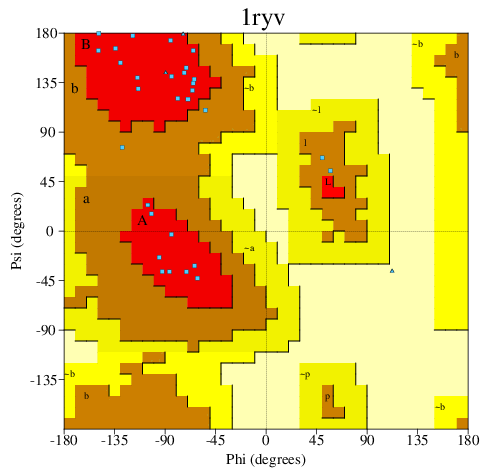
PDBsum entry 1ryv
 |
|
|
|
|
|
|
|
|
|
|
 |
|
|
|
|
|
|
| |
|
DOI no:
|
J Biol Chem
279:37734-37740
(2004)
|
|
PubMed id:
|
|
|
|
|
|
| |
|
Structure--activity relationships of hainantoxin-IV and structure determination of active and inactive sodium channel blockers.
|
|
D.Li,
Y.Xiao,
X.Xu,
X.Xiong,
S.Lu,
Z.Liu,
Q.Zhu,
M.Wang,
X.Gu,
S.Liang.
|
|
|
|
|
| |
ABSTRACT
|
|
|
|
| |
|
|
Hainantoxin-IV (HNTX-IV) can specifically inhibit the neuronal
tetrodotoxin-sensitive sodium channels and defines a new class of depressant
spider toxin. The sequence of native HNTX-IV is
ECLGFGKGCNPSNDQCCKSSNLVCSRKHRWCKYEI-NH(2). In the present study, to obtain
further insight into the primary and tertiary structural requirements of
neuronal sodium channel blockers, we determined the solution structure of
HNTX-IV as a typical inhibitor cystine knot motif and synthesized four mutants
designed based on the predicted sites followed by structural elucidation of two
inactive mutants. Pharmacological studies indicated that the S12A and R26A
mutants had activities near that of native HNTX-IV, while K27A and R29A
demonstrated activities reduced by 2 orders of magnitude. (1)H MR analysis
showed the similar molecular conformations for native HNTX-IV and four synthetic
mutants. Furthermore, in the determined structures of K27A and R29A, the side
chains of residues 27 and 29 were located in the identical spatial position to
those of native HNTX-IV. These results suggested that residues Ser(12), Arg(26),
Lys(27), and Arg(29) were not responsible for stabilizing the distinct
conformation of HNTX-IV, but Lys(27) and Arg(29) were critical for the
bioactivities. The potency reductions produced by Ala substitutions were
primarily due to the direct interaction of the essential residues Lys(27) and
Arg(29) with sodium channels rather than to a conformational change. After
comparison of these structures and activities with correlated toxins, we
hypothesized that residues Lys(27), Arg(29), His(28), Lys(32), Phe(5), and
Trp(30) clustered on one face of HNTX-IV were responsible for ligand binding.
|
|
|
|
|
|
| |
Selected figure(s)
|
|
|
|
| |
|
|

|
|

|
|
Figure 2.
FIG. 2. Structural comparison of HNTX-IV and correlated
toxin molecules. A, ensembles of 20 energy-refined conformers
representing the solution structures of native HNTX-IV, K27A,
and R29A. The backbones are shown in cyan, green, and gray,
respectively. Positively charged side chains are shown in blue,
and negatively charged side chains are shown in red. B,
comparison of HNTX-IV to conotoxin GS (CTX-GS) and
µ-conotoxin GIIIA (CTX-GIIIA) (conotoxin GS, Protein Data
Bank code 1AG7 [PDB]
; µ-conotoxin GIIIA, Protein Data Bank code 1TCG [PDB]
). The  -sheet is shown in
yellow, the turn is shown in blue, and the random coil structure
is shown in green. Three disulfide bonds of each molecule are
indicated. The letters N and C refer to the amino and carboxyl
termini, respectively. -sheet is shown in
yellow, the turn is shown in blue, and the random coil structure
is shown in green. Three disulfide bonds of each molecule are
indicated. The letters N and C refer to the amino and carboxyl
termini, respectively.
|
|
Figure 7.
FIG. 7. Solution structure characterization of HNTX-IV. A,
surface profile of HNTX-IV. a, surface profile of predicted
active sites. b, surface profile of putative active sites. Blue,
mauve, and cyan regions represent positively charged, polar, and
hydrophobic residues, respectively. B, backbone superposition of
native HNTX-IV (blue), K27A (green), and R29A (red). 27 and 29
indicate the positions of substituted amino acid residues. The
fit was done using the common secondary structure elements. The
letters N and C refer to the amino and carboxyl termini,
respectively.
|
|
|
|
|
|
| |
The above figures are
reprinted
by permission from the ASBMB:
J Biol Chem
(2004,
279,
37734-37740)
copyright 2004.
|
|
| |
Figures were
selected
by an automated process.
|
|
|
|
|
|
|
|
|
|
|
|
|
|
|
|
 |
 |
 |
|
Literature references that cite this PDB file's key reference
|
|
|
| |
PubMed id
|
|
Reference
|
|
|
|
|
|
R.L.Wang,
S.Yi,
and
S.P.Liang
(2010).
Mechanism of action of two insect toxins huwentoxin-III and hainantoxin-VI on voltage-gated sodium channels.
|
| |
J Zhejiang Univ Sci B,
11,
451-457.
|
|
|
|
|
|
|
G.Estrada,
E.Villegas,
and
G.Corzo
(2007).
Spider venoms: a rich source of acylpolyamines and peptides as new leads for CNS drugs.
|
| |
Nat Prod Rep,
24,
145-161.
|
|
|
|
|
|
The most recent references are shown first.
Citation data come partly from CiteXplore and partly
from an automated harvesting procedure. Note that this is likely to be
only a partial list as not all journals are covered by
either method. However, we are continually building up the citation data
so more and more references will be included with time.
|
|


 Links
Links