|
|
|
|
|
 |
Contents |
 |
|
|
|
|
|
|
|
|
|
|
|
|
* Residue conservation analysis
|
|
|
|
|
|
|
|
|
|
Enzyme class:
|
|
Chains X, Y:
E.C.2.7.10.1
- receptor protein-tyrosine kinase.
|
|
|
|
|
|
|
Reaction:
|
|
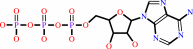
L-tyrosyl-[protein] + ATP = O-phospho-L-tyrosyl-[protein] + ADP + H+
|
|
|
|
|
|
L-tyrosyl-[protein]
|
+
|
 ATP
ATP
|
=
|
O-phospho-L-tyrosyl-[protein]
|
+
|
 ADP
ADP
|
+
|
H(+)
|
|
|
|
|
|
|
|
|
|
|
|
|
Molecule diagrams generated from .mol files obtained from the
KEGG ftp site
|
|
|
|
|
|
|
|
|
|
|
|
|
|
 |
|
|
|
|
|
|
| |
|
|
| |
|
DOI no:
|
J Biol Chem
279:10382-10388
(2004)
|
|
PubMed id:
|
|
|
|
|
|
| |
|
The crystal structure of placental growth factor in complex with domain 2 of vascular endothelial growth factor receptor-1.
|
|
H.W.Christinger,
G.Fuh,
A.M.de Vos,
C.Wiesmann.
|
|
|
|
|
| |
ABSTRACT
|
|
|
|
| |
|
|
Placental growth factor (PlGF) is a member of the vascular endothelial growth
factor (VEGF) family and plays an important role in pathological angiogenic
events. PlGF exerts its biological activities through binding to VEGFR1, a
receptor tyrosine kinase that consists of seven immunoglobulin-like domains in
its extracellular portion. Here we report the crystal structure of PlGF bound to
the second immunoglobulin-like domain of VEGFR1 at 2.5 A resolution and compare
the complex to the closely related structure of VEGF bound to the same receptor
domain. The two growth factors, PlGF and VEGF, share a sequence identity of
approximately 50%. Despite this moderate sequence conservation, they bind to the
same binding interface of VEGFR1 in a very similar fashion, suggesting that both
growth factors could induce very similar if not identical signaling events.
|
|
|
|
|
|
| |
Selected figure(s)
|
|
|
|
| |
|
|

|
|

|
|
Figure 5.
FIG. 5. Sequence alignment of the PlGF and VEGF
receptor-binding domain. Secondary structure elements are
depicted at the top with dark gray arrows referring to  -strands
and light gray boxes to -strands
and light gray boxes to  -helices. Numbers at
top refer to human PlGF and numbers at bottom to human VEGF
sequence. green, strictly conserved in all shown sequences;
yellow, conserved in VEGF or PlGF only; orange, conserved among
PlGF and among VEGF as different residues; bold font, monomer 1
receptor binding interface; bold font and underlined, monomer 2
receptor binding interface; boxed residues, core of receptor
interface; italics, residues involved in dimer interface. -helices. Numbers at
top refer to human PlGF and numbers at bottom to human VEGF
sequence. green, strictly conserved in all shown sequences;
yellow, conserved in VEGF or PlGF only; orange, conserved among
PlGF and among VEGF as different residues; bold font, monomer 1
receptor binding interface; bold font and underlined, monomer 2
receptor binding interface; boxed residues, core of receptor
interface; italics, residues involved in dimer interface.
|
|
Figure 6.
FIG. 6. Schematic representation of VEGF and PlGF homo- and
heterodimers. A, PlGF homodimer; B, VEGF homodimer; C, PlGF/VEGF
heterodimer. Note the asymmetric nature of the PlGF/VEGF
heterodimer.
|
|
|
|
|
|
| |
The above figures are
reprinted
by permission from the ASBMB:
J Biol Chem
(2004,
279,
10382-10388)
copyright 2004.
|
|
| |
Figures were
selected
by an automated process.
|
|
|
|
|
|
|
|
|
|
|
|
|
|
|
|
 |
 |
 |
|
Literature references that cite this PDB file's key reference
|
|
|
| |
PubMed id
|
|
Reference
|
|
|
|
|
|
F.Boyaud,
and
N.Inguimbert
(2011).
Soluble fms-like tyrosine kinase-1 antibody for diagnosis purposes (WO2010075475).
|
| |
Expert Opin Ther Pat,
21,
971-975.
|
|
|
|
|
|
|
V.M.Leppänen,
M.Jeltsch,
A.Anisimov,
D.Tvorogov,
K.Aho,
N.Kalkkinen,
P.Toivanen,
S.Ylä-Herttuala,
K.Ballmer-Hofer,
and
K.Alitalo
(2011).
Structural determinants of vascular endothelial growth factor-D receptor binding and specificity.
|
| |
Blood,
117,
1507-1515.
|
|
|
PDB code:
|
|
|
|
|
|
|
|
R.Di Stasi,
D.Diana,
D.Capasso,
R.Palumbo,
A.Romanelli,
C.Pedone,
R.Fattorusso,
and
L.D.D'Andrea
(2010).
VEGFR1(D2) in drug discovery: Expression and molecular characterization.
|
| |
Biopolymers,
94,
800-809.
|
|
|
|
|
|
|
S.Iyer,
P.I.Darley,
and
K.R.Acharya
(2010).
Structural insights into the binding of vascular endothelial growth factor-B by VEGFR-1(D2): recognition and specificity.
|
| |
J Biol Chem,
285,
23779-23789.
|
|
|
PDB code:
|
|
|
|
|
|
|
|
V.M.Leppänen,
A.E.Prota,
M.Jeltsch,
A.Anisimov,
N.Kalkkinen,
T.Strandin,
H.Lankinen,
A.Goldman,
K.Ballmer-Hofer,
and
K.Alitalo
(2010).
Structural determinants of growth factor binding and specificity by VEGF receptor 2.
|
| |
Proc Natl Acad Sci U S A,
107,
2425-2430.
|
|
|
PDB codes:
|
|
|
|
|
|
|
|
E.Stuttfeld,
and
K.Ballmer-Hofer
(2009).
Structure and function of VEGF receptors.
|
| |
IUBMB Life,
61,
915-922.
|
|
|
|
|
|
|
P.I.Toivanen,
T.Nieminen,
L.Viitanen,
A.Alitalo,
M.Roschier,
S.Jauhiainen,
J.E.Markkanen,
O.H.Laitinen,
T.T.Airenne,
T.A.Salminen,
M.S.Johnson,
K.J.Airenne,
and
S.Ylä-Herttuala
(2009).
Novel vascular endothelial growth factor D variants with increased biological activity.
|
| |
J Biol Chem,
284,
16037-16048.
|
|
|
|
|
|
|
V.Goncalves,
B.Gautier,
F.Huguenot,
P.Leproux,
C.Garbay,
M.Vidal,
and
N.Inguimbert
(2009).
Total chemical synthesis of the D2 domain of human VEGF receptor 1.
|
| |
J Pept Sci,
15,
417-422.
|
|
|
|
|
|
|
S.Soro,
A.Orecchia,
L.Morbidelli,
P.M.Lacal,
V.Morea,
K.Ballmer-Hofer,
F.Ruffini,
M.Ziche,
S.D'Atri,
G.Zambruno,
A.Tramontano,
and
C.M.Failla
(2008).
A proangiogenic peptide derived from vascular endothelial growth factor receptor-1 acts through alpha5beta1 integrin.
|
| |
Blood,
111,
3479-3488.
|
|
|
|
|
|
|
C.Ruch,
G.Skiniotis,
M.O.Steinmetz,
T.Walz,
and
K.Ballmer-Hofer
(2007).
Structure of a VEGF-VEGF receptor complex determined by electron microscopy.
|
| |
Nat Struct Mol Biol,
14,
249-250.
|
|
|
|
|
|
|
N.Miyamoto,
Y.de Kozak,
J.C.Jeanny,
A.Glotin,
F.Mascarelli,
P.Massin,
D.BenEzra,
and
F.Behar-Cohen
(2007).
Placental growth factor-1 and epithelial haemato-retinal barrier breakdown: potential implication in the pathogenesis of diabetic retinopathy.
|
| |
Diabetologia,
50,
461-470.
|
|
|
|
|
|
|
A.K.Olsson,
A.Dimberg,
J.Kreuger,
and
L.Claesson-Welsh
(2006).
VEGF receptor signalling - in control of vascular function.
|
| |
Nat Rev Mol Cell Biol,
7,
359-371.
|
|
|
|
|
|
|
M.Pieren,
A.E.Prota,
C.Ruch,
D.Kostrewa,
A.Wagner,
K.Biedermann,
F.K.Winkler,
and
K.Ballmer-Hofer
(2006).
Crystal structure of the Orf virus NZ2 variant of vascular endothelial growth factor-E. Implications for receptor specificity.
|
| |
J Biol Chem,
281,
19578-19587.
|
|
|
PDB code:
|
|
|
|
|
|
|
|
S.Cébe-Suarez,
A.Zehnder-Fjällman,
and
K.Ballmer-Hofer
(2006).
The role of VEGF receptors in angiogenesis; complex partnerships.
|
| |
Cell Mol Life Sci,
63,
601-615.
|
|
|
|
|
|
|
Y.Yamazaki,
and
T.Morita
(2006).
Molecular and functional diversity of vascular endothelial growth factors.
|
| |
Mol Divers,
10,
515-527.
|
|
|
|
|
|
|
D.I.Holmes,
and
I.Zachary
(2005).
The vascular endothelial growth factor (VEGF) family: angiogenic factors in health and disease.
|
| |
Genome Biol,
6,
209.
|
|
|
|
|
|
|
R.L.Rich,
and
D.G.Myszka
(2005).
Survey of the year 2004 commercial optical biosensor literature.
|
| |
J Mol Recognit,
18,
431-478.
|
|
|
|
|
|
The most recent references are shown first.
Citation data come partly from CiteXplore and partly
from an automated harvesting procedure. Note that this is likely to be
only a partial list as not all journals are covered by
either method. However, we are continually building up the citation data
so more and more references will be included with time.
Where a reference describes a PDB structure, the PDB
code is
shown on the right.
|
 |


 Links
Links