 |
PDBsum entry 1r6f

|
|
|
|
|
|

|

|

|

|
|

|
|

|
|

|
|
|
 |

|

|
|
|
|
|
|
|
|
|
|
|
|
|
|
|
|
|
|
|
|
|
|
|
|
|
|
|
|
|
|
|
|
Protein binding
|
PDB id
|
|
|
|
1r6f
|
|
|
|
|
|
|
|
|
|
|
|
|
|
|

|

|

|
|
|
|
|
|
|
|
 |
Contents |
 |
|
|
|
|
|
|
|
|
* Residue conservation analysis
|
|
|
|
|
|
PDB id:
|
|
|
|
| Name: |
|
Protein binding
|
|
|
Title:
|
|
The structure of yersinia pestis v-antigen, an essential virulence factor and mediator of immunity against plague
|
|
Structure:
|
|
Virulence-associated v antigen. Chain: a. Fragment: lcrv fragment 24-323. Synonym: low calcium response locus protein v. Engineered: yes. Mutation: yes
|
|
Source:
|
|
Yersinia pestis. Organism_taxid: 632. Expressed in: escherichia coli. Expression_system_taxid: 562.
|
|
Resolution:
|
|
|
2.17Å
|
R-factor:
|
0.224
|
R-free:
|
0.284
|
|
|
Authors:
|
|
U.Derewenda,A.Mateja,Y.Devedjiev,K.M.Routzahn,A.G.Evdokimov, Z.S.Derewenda,D.S.Waugh
|
Key ref:

|
|
U.Derewenda
et al.
(2004).
The structure of Yersinia pestis V-antigen, an essential virulence factor and mediator of immunity against plague.
Structure,
12,
301-306.
PubMed id:
DOI:

|
|
|
Date:
|
|
|
15-Oct-03
|
Release date:
|
09-Mar-04
|
|
|
|
|
|
|
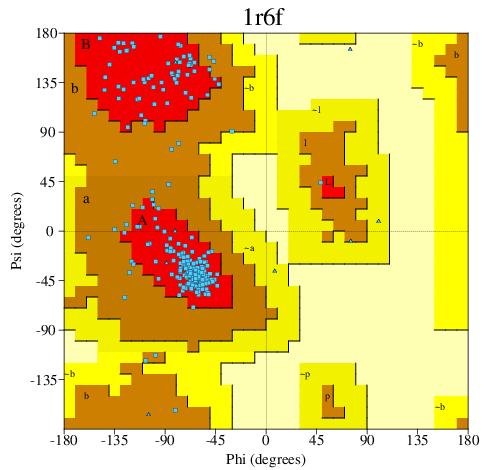
PROCHECK
|
|
|
|
|
|
Headers
|
|
|
|
References
|
|
|
|
|
|

|
|
P0C7U7
(LCRV_YERPE) -
Virulence-associated V antigen from Yersinia pestis
|
|
|
|
Seq:
Struc:
|
|
|
|
326 a.a.
272 a.a.*
|
|

|

|

|
|
|
|
|
|
|
|
|
|
|
Key: |
|
 |
Secondary structure |
|
|
*
PDB and UniProt seqs differ
at 3 residue positions (black
crosses)
|
|
|
|
|
|
|
|
|
|
|
|
|
|
|
|
|
 |
|
|
|
|
|
|
| |
|
DOI no:
|
Structure
12:301-306
(2004)
|
|
PubMed id:
|
|
|
|
|
|
| |
|
The structure of Yersinia pestis V-antigen, an essential virulence factor and mediator of immunity against plague.
|
|
U.Derewenda,
A.Mateja,
Y.Devedjiev,
K.M.Routzahn,
A.G.Evdokimov,
Z.S.Derewenda,
D.S.Waugh.
|
|
|
|
|
| |
ABSTRACT
|
|
|
|
| |
|
|
The LcrV protein (V-antigen) is a multifunctional virulence factor in Yersinia
pestis, the causative agent of plague. LcrV regulates the translocation of
cytotoxic effector proteins from the bacterium into the cytosol of mammalian
cells via a type III secretion system, possesses antihost activities of its own,
and is also an active and passive mediator of resistance to disease. Although a
crystal structure of this protein has been actively sought for better
understanding of its role in pathogenesis, the wild-type LcrV was found to be
recalcitrant to crystallization. We employed a surface entropy reduction
mutagenesis strategy to obtain crystals of LcrV that diffract to 2.2 A and
determined its structure. The refined model reveals a dumbbell-like molecule
with a novel fold that includes an unexpected coiled-coil motif, and provides a
detailed three-dimensional roadmap for exploring structure-function
relationships in this essential virulence determinant.
|
|
|
|
|
|
| |
Selected figure(s)
|
|
|
|
| |
|
|

|
|
Figure 3.
Figure 3. Front and Back Views of the Surface of LcrVAmino
acid residues that are conserved in P. aeruginosa PcrV are
colored brown.
|
|
|
|
|
|
| |
The above figure is
reprinted
by permission from Cell Press:
Structure
(2004,
12,
301-306)
copyright 2004.
|
|
| |
Figure was
selected
by an automated process.
|
|
|
|
|
|
|
|
|
|
|
|
|
|
|
|
 |
 |
 |
|
Literature references that cite this PDB file's key reference
|
|
|
| |
PubMed id
|
|
Reference
|
|
|
|
|
|
L.J.Worrall,
E.Lameignere,
and
N.C.Strynadka
(2011).
Structural overview of the bacterial injectisome.
|
| |
Curr Opin Microbiol,
14,
3-8.
|
|
|
|
|
|
|
P.J.Matteï,
E.Faudry,
V.Job,
T.Izoré,
I.Attree,
and
A.Dessen
(2011).
Membrane targeting and pore formation by the type III secretion system translocon.
|
| |
FEBS J,
278,
414-426.
|
|
|
|
|
|
|
S.Chatterjee,
D.Zhong,
B.A.Nordhues,
K.P.Battaile,
S.Lovell,
and
R.N.De Guzman
(2011).
The crystal structures of the Salmonella type III secretion system tip protein SipD in complex with deoxycholate and chenodeoxycholate.
|
| |
Protein Sci,
20,
75-86.
|
|
|
PDB codes:
|
|
|
|
|
|
|
|
A.P.Anisimov,
S.V.Dentovskaya,
E.A.Panfertsev,
T.E.Svetoch,
P.K.h.Kopylov,
B.W.Segelke,
A.Zemla,
M.V.Telepnev,
and
V.L.Motin
(2010).
Amino acid and structural variability of Yersinia pestis LcrV protein.
|
| |
Infect Genet Evol,
10,
137-145.
|
|
|
|
|
|
|
A.P.Markham,
B.S.Barrett,
R.Esfandiary,
W.L.Picking,
W.D.Picking,
S.B.Joshi,
and
C.R.Middaugh
(2010).
Formulation and immunogenicity of a potential multivalent type III secretion system-based protein vaccine.
|
| |
J Pharm Sci,
99,
4497-4509.
|
|
|
|
|
|
|
A.Torres-Escobar,
M.D.Juárez-Rodríguez,
B.M.Gunn,
C.G.Branger,
S.A.Tinge,
and
R.Curtiss
(2010).
Fine-tuning synthesis of Yersinia pestis LcrV from runaway-like replication balanced-lethal plasmid in a Salmonella enterica serovar typhimurium vaccine induces protection against a lethal Y. pestis challenge in mice.
|
| |
Infect Immun,
78,
2529-2543.
|
|
|
|
|
|
|
L.E.Quenee,
B.J.Berube,
J.Segal,
D.Elli,
N.A.Ciletti,
D.Anderson,
and
O.Schneewind
(2010).
Amino acid residues 196-225 of LcrV represent a plague protective epitope.
|
| |
Vaccine,
28,
1870-1876.
|
|
|
|
|
|
|
Z.S.Derewenda
(2010).
Application of protein engineering to enhance crystallizability and improve crystal properties.
|
| |
Acta Crystallogr D Biol Crystallogr,
66,
604-615.
|
|
|
|
|
|
|
B.Medhekar,
R.Shrivastava,
S.Mattoo,
M.Gingery,
and
J.F.Miller
(2009).
Bordetella Bsp22 forms a filamentous type III secretion system tip complex and is immunoprotective in vitro and in vivo.
|
| |
Mol Microbiol,
71,
492-504.
|
|
|
|
|
|
|
M.Cieślik,
and
Z.S.Derewenda
(2009).
The role of entropy and polarity in intermolecular contacts in protein crystals.
|
| |
Acta Crystallogr D Biol Crystallogr,
65,
500-509.
|
|
|
|
|
|
|
N.A.Eisele,
and
D.M.Anderson
(2009).
Dual-function antibodies to Yersinia pestis LcrV required for pulmonary clearance of plague.
|
| |
Clin Vaccine Immunol,
16,
1720-1727.
|
|
|
|
|
|
|
A.A.Khan,
J.P.Babu,
G.Gupta,
and
D.N.Rao
(2008).
Identifying B and T cell epitopes and studying humoral, mucosal and cellular immune responses of peptides derived from V antigen of Yersinia pestis.
|
| |
Vaccine,
26,
316-332.
|
|
|
|
|
|
|
A.J.Blocker,
J.E.Deane,
A.K.Veenendaal,
P.Roversi,
J.L.Hodgkinson,
S.Johnson,
and
S.M.Lea
(2008).
What's the point of the type III secretion system needle?
|
| |
Proc Natl Acad Sci U S A,
105,
6507-6513.
|
|
|
|
|
|
|
C.A.Mueller,
P.Broz,
and
G.R.Cornelis
(2008).
The type III secretion system tip complex and translocon.
|
| |
Mol Microbiol,
68,
1085-1095.
|
|
|
|
|
|
|
G.Caroline,
F.Eric,
Y.S.Bohn,
E.Sylvie,
and
I.Attree
(2008).
Oligomerization of PcrV and LcrV, Protective Antigens of Pseudomonas aeruginosa and Yersinia pestis.
|
| |
J Biol Chem,
283,
23940-23949.
|
|
|
|
|
|
|
R.Fronzes,
H.Remaut,
and
G.Waksman
(2008).
Architectures and biogenesis of non-flagellar protein appendages in Gram-negative bacteria.
|
| |
EMBO J,
27,
2271-2280.
|
|
|
|
|
|
|
T.F.Moraes,
T.Spreter,
and
N.C.Strynadka
(2008).
Piecing together the type III injectisome of bacterial pathogens.
|
| |
Curr Opin Struct Biol,
18,
258-266.
|
|
|
|
|
|
|
A.J.Davis,
and
J.Mecsas
(2007).
Mutations in the Yersinia pseudotuberculosis type III secretion system needle protein, YscF, that specifically abrogate effector translocation into host cells.
|
| |
J Bacteriol,
189,
83-97.
|
|
|
|
|
|
|
K.Pouliot,
N.Pan,
S.Wang,
S.Lu,
E.Lien,
and
J.D.Goguen
(2007).
Evaluation of the role of LcrV-Toll-like receptor 2-mediated immunomodulation in the virulence of Yersinia pestis.
|
| |
Infect Immun,
75,
3571-3580.
|
|
|
|
|
|
|
M.A.Hamad,
and
M.L.Nilles
(2007).
Structure-function analysis of the C-terminal domain of LcrV from Yersinia pestis.
|
| |
J Bacteriol,
189,
6734-6739.
|
|
|
|
|
|
|
M.Espina,
S.F.Ausar,
C.R.Middaugh,
M.A.Baxter,
W.D.Picking,
and
W.L.Picking
(2007).
Conformational stability and differential structural analysis of LcrV, PcrV, BipD, and SipD from type III secretion systems.
|
| |
Protein Sci,
16,
704-714.
|
|
|
|
|
|
|
P.Broz,
C.A.Mueller,
S.A.Müller,
A.Philippsen,
I.Sorg,
A.Engel,
and
G.R.Cornelis
(2007).
Function and molecular architecture of the Yersinia injectisome tip complex.
|
| |
Mol Microbiol,
65,
1311-1320.
|
|
|
|
|
|
|
S.Johnson,
P.Roversi,
M.Espina,
A.Olive,
J.E.Deane,
S.Birket,
T.Field,
W.D.Picking,
A.J.Blocker,
E.E.Galyov,
W.L.Picking,
and
S.M.Lea
(2007).
Self-chaperoning of the type III secretion system needle tip proteins IpaD and BipD.
|
| |
J Biol Chem,
282,
4035-4044.
|
|
|
PDB codes:
|
|
|
|
|
|
|
|
C.K.Yip,
and
N.C.Strynadka
(2006).
New structural insights into the bacterial type III secretion system.
|
| |
Trends Biochem Sci,
31,
223-230.
|
|
|
|
|
|
|
H.K.Shim,
J.A.Musson,
H.M.Harper,
H.V.McNeill,
N.Walker,
H.Flick-Smith,
A.von Delwig,
E.D.Williamson,
and
J.H.Robinson
(2006).
Mechanisms of major histocompatibility complex class II-restricted processing and presentation of the V antigen of Yersinia pestis.
|
| |
Immunology,
119,
385-392.
|
|
|
|
|
|
|
J.Heesemann,
A.Sing,
and
K.Trülzsch
(2006).
Yersinia's stratagem: targeting innate and adaptive immune defense.
|
| |
Curr Opin Microbiol,
9,
55-61.
|
|
|
|
|
|
|
L.J.Mota
(2006).
Type III secretion gets an LcrV tip.
|
| |
Trends Microbiol,
14,
197-200.
|
|
|
|
|
|
|
M.V.Lasker,
S.M.Kuruvilla,
M.M.Gajjar,
A.Kapoor,
and
S.K.Nair
(2006).
Metal ion-mediated reduction in surface entropy improves diffraction quality of crystals of the IRAK-4 death domain.
|
| |
J Biomol Tech,
17,
114-121.
|
|
|
|
|
|
|
P.Roversi,
S.Johnson,
T.Field,
J.E.Deane,
E.E.Galyov,
and
S.M.Lea
(2006).
Expression, purification, crystallization and preliminary crystallographic analysis of BipD, a component of the Burkholderia pseudomallei type III secretion system.
|
| |
Acta Crystallogr Sect F Struct Biol Cryst Commun,
62,
861-864.
|
|
|
|
|
|
|
S.Johnson,
P.Roversi,
M.Espina,
J.E.Deane,
S.Birket,
W.D.Picking,
A.Blocker,
W.L.Picking,
and
S.M.Lea
(2006).
Expression, limited proteolysis and preliminary crystallographic analysis of IpaD, a component of the Shigella flexneri type III secretion system.
|
| |
Acta Crystallogr Sect F Struct Biol Cryst Commun,
62,
865-868.
|
|
|
|
|
|
|
Z.S.Derewenda,
and
P.G.Vekilov
(2006).
Entropy and surface engineering in protein crystallization.
|
| |
Acta Crystallogr D Biol Crystallogr,
62,
116-124.
|
|
|
|
|
|
|
D.M.Anstrom,
L.Colip,
B.Moshofsky,
E.Hatcher,
and
S.J.Remington
(2005).
Systematic replacement of lysine with glutamine and alanine in Escherichia coli malate synthase G: effect on crystallization.
|
| |
Acta Crystallogr Sect F Struct Biol Cryst Commun,
61,
1069-1074.
|
|
|
|
|
|
|
D.Schlatter,
R.Thoma,
E.Küng,
M.Stihle,
F.Müller,
E.Borroni,
A.Cesura,
and
M.Hennig
(2005).
Crystal engineering yields crystals of cyclophilin D diffracting to 1.7 A resolution.
|
| |
Acta Crystallogr D Biol Crystallogr,
61,
513-519.
|
|
|
PDB codes:
|
|
|
|
|
|
|
|
K.A.Overheim,
R.W.Depaolo,
K.L.Debord,
E.M.Morrin,
D.M.Anderson,
N.M.Green,
R.R.Brubaker,
B.Jabri,
and
O.Schneewind
(2005).
LcrV plague vaccine with altered immunomodulatory properties.
|
| |
Infect Immun,
73,
5152-5159.
|
|
|
|
|
|
|
A.P.Tampakaki,
V.E.Fadouloglou,
A.D.Gazi,
N.J.Panopoulos,
and
M.Kokkinidis
(2004).
Conserved features of type III secretion.
|
| |
Cell Microbiol,
6,
805-816.
|
|
|
|
|
|
|
F.D.Schubot,
and
D.S.Waugh
(2004).
A pivotal role for reductive methylation in the de novo crystallization of a ternary complex composed of Yersinia pestis virulence factors YopN, SycN and YscB.
|
| |
Acta Crystallogr D Biol Crystallogr,
60,
1981-1986.
|
|
|
|
|
|
|
J.Phan,
J.E.Tropea,
and
D.S.Waugh
(2004).
Structure of the Yersinia pestis type III secretion chaperone SycH in complex with a stable fragment of YscM2.
|
| |
Acta Crystallogr D Biol Crystallogr,
60,
1591-1599.
|
|
|
PDB code:
|
|
|
|
|
|
|
|
Z.S.Derewenda
(2004).
Rational protein crystallization by mutational surface engineering.
|
| |
Structure,
12,
529-535.
|
|
|
|
|
|
The most recent references are shown first.
Citation data come partly from CiteXplore and partly
from an automated harvesting procedure. Note that this is likely to be
only a partial list as not all journals are covered by
either method. However, we are continually building up the citation data
so more and more references will be included with time.
Where a reference describes a PDB structure, the PDB
codes are
shown on the right.
|
|


 Links
Links


