 |
PDBsum entry 1qnh

|
|
|
|
|
|

|

|

|

|
|

|
|

|
|

|
|

|
|

|
|
|
 |

|

|
|
|
|
|
|
|
|
|
|
|
|
|
|
|
|
|
|
|
|
|
|
|
|
|
|
|
|
|
|
|
|
|
|
Isomerase/immunosuppressant
|
PDB id
|
|
|
|
1qnh
|
|
|
|
|
|
|
|
|
|
|
|
|
|
|

|

|

|
|
|
|
|
|
|
|
 |
Contents |
 |
|
|
|
|
|
|
|
|
|
|
* Residue conservation analysis
|
|
|
|
|
|
PDB id:
|
|
|
|
| Name: |
|
Isomerase/immunosuppressant
|
|
|
Title:
|
|
Plasmodium falciparum cyclophilin (double mutant) complexed with cyclosporin a
|
|
Structure:
|
|
Peptidyl-prolyl cis-trans isomerase. Chain: a, b. Synonym: ppiase, rotamase, cyclophilin a. Engineered: yes. Cyclosporin a. Chain: c, d. Synonym: cyclosporine, ciclosporin, ciclosporine. Engineered: yes
|
|
Source:
|
|
Plasmodium falciparum. Organism_taxid: 5833. Expressed in: escherichia coli. Expression_system_taxid: 469008. Synthetic: yes. Tolypocladium inflatum. Organism_taxid: 29910
|
|
Biol. unit:
|
|
 Dimer (from
)
Dimer (from
)
|
|
Resolution:
|
|
|
2.10Å
|
R-factor:
|
0.170
|
R-free:
|
0.210
|
|
|
Authors:
|
|
M.R.Peterson,D.R.Hall,W.N.Hunter
|
Key ref:

|
|
M.R.Peterson
et al.
(2000).
The three-dimensional structure of a Plasmodium falciparum cyclophilin in complex with the potent anti-malarial cyclosporin A.
J Mol Biol,
298,
123-133.
PubMed id:
DOI:

|
|
|
Date:
|
|
|
14-Oct-99
|
Release date:
|
13-Oct-00
|
|
|
|
|
|
|
PROCHECK
|

|
|
|
|
|
Headers
|
|
|
|
References
|
|
|
|
|
|
|
|
|
|
|
|
Enzyme class:
|
|
Chains A, B:
E.C.5.2.1.8
- peptidylprolyl isomerase.
|
|
|
|
|
|
|
Reaction:
|
|
[protein]-peptidylproline (omega=180) = [protein]-peptidylproline (omega=0)
|
|
|
|
|
|
 Peptidylproline (omega=180)
|
=
|
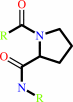 peptidylproline (omega=0)
|
|
|
|
|
|
|
|
|
|
|
|
|
Molecule diagrams generated from .mol files obtained from the
KEGG ftp site
|
|
|
|
|
|
|
|
|
|
|
|
|
|
 |
|
|
|
|
|
|
| |
|
|
| |
|
DOI no:
|
J Mol Biol
298:123-133
(2000)
|
|
PubMed id:
|
|
|
|
|
|
| |
|
The three-dimensional structure of a Plasmodium falciparum cyclophilin in complex with the potent anti-malarial cyclosporin A.
|
|
M.R.Peterson,
D.R.Hall,
M.Berriman,
J.A.Nunes,
G.A.Leonard,
A.H.Fairlamb,
W.N.Hunter.
|
|
|
|
|
| |
ABSTRACT
|
|
|
|
| |
|
|
Cyclosporin A (CsA) is a potent anti-malarial compound in vitro and in vivo in
mice though better known for its immunosuppressive properties in humans. Crystal
structures of wild-type and a double mutant Plasmodium falciparum cyclophilin
(PfCyP19 and mPfCyP19) complexed with CsA have been determined using diffraction
terms to a resolution of 2.1 A (1 A=0.1 nm). The wild-type has a single
PfCyP19/CsA complex per asymmetric unit in space group P1 and refined to an
R-work of 0.15 and R-free of 0.19. An altered cyclophilin, with two accidental
mutations, Phe120 to Leu in the CsA binding pocket and Leu171 to Trp at the C
terminus, presents two complexes per asymmetric unit in the orthorhombic space
group P2(1)2(1)2. This refined to an R-work of 0.18 and R-free 0.21. The
mutations were identified from the crystallographic analysis and the C-terminal
alteration helps to explain the different crystal forms obtained. PfCyP19 shares
approximately 61 % sequence identity with human cyclophilin A (hCyPA) and the
structures are similar, consisting of an eight-stranded antiparallel beta-barrel
core capped by two alpha-helices. The fold creates a hydrophobic active-site,
the floor of which is formed by side-chains of residues from four antiparallel
beta-strands and the walls from loops and turns. We identified C-H.O hydrogen
bonds between the drug and protein that may be an important feature of
cyclophilins and suggest a general mode of interaction between hydrophobic
molecules. Comparisons with cyclophilin-dipeptide complexes suggests that a
specific C-H.O hydrogen bonding interaction may contribute to ligand binding.
Residues Ser106, His99 and Asp130, located close to the active site and
conserved in most cyclophilins, are arranged in a manner reminiscent of a serine
protease catalytic triad. A Ser106Ala mutant was engineered to test the
hypothesis that this triad contributes to CyP function. Mutant and wild-type
enzymes were found to have similar catalytic properties.
|
|
|
|
|
|
| |
Selected figure(s)
|
|
|
|
| |
|
|

|
|

|
|
Figure 2.
Figure 2. The PfCyP19/CsA complex. Protein is represented
in ribbon form with secondary structure elements helices (red);
C-terminal direction, for b-strands (yellow arrows), a section
of 3[10] helix (cyan ribbon). The loop segments are numbered 1
to 5. CsA is illustrated as a stick model where carbon positions
(black), nitrogen (blue), and oxygen (red). Figure 2, Figure 3,
Figure 4, Figure 5 and Figure 6 inclusive were constructed using
MOLSCRIPT [Kraulis 1991] and RASTER3D [Merritt and Bacon 1997].
|
|
Figure 6.
Figure 6. The difference in the active site between the
native (stick model) and the mutant (ball and stick model)
highlighting the Phe120Leu mutation in relation to MeVal11 of
CsA.
|
|
|
|
|
|
| |
The above figures are
reprinted
by permission from Elsevier:
J Mol Biol
(2000,
298,
123-133)
copyright 2000.
|
|
| |
Figures were
selected
by the author.
|
|
|
|
|
|
|
|
|
|
|
|
|
|
|
|
 |
 |
 |
|
Literature references that cite this PDB file's key reference
|
|
|
| |
PubMed id
|
|
Reference
|
|
|
|
|
|
P.Gayathri,
H.Balaram,
and
M.R.Murthy
(2007).
Structural biology of plasmodial proteins.
|
| |
Curr Opin Struct Biol,
17,
744-754.
|
|
|
|
|
|
|
V.Venugopal,
B.Sen,
A.K.Datta,
and
R.Banerjee
(2007).
Structure of cyclophilin from Leishmania donovani at 1.97 A resolution.
|
| |
Acta Crystallogr Sect F Struct Biol Cryst Commun,
63,
60-64.
|
|
|
PDB code:
|
|
|
|
|
|
|
|
L.L.Huang,
X.M.Zhao,
C.Q.Huang,
L.Yu,
and
Z.X.Xia
(2005).
Structure of recombinant human cyclophilin J, a novel member of the cyclophilin family.
|
| |
Acta Crystallogr D Biol Crystallogr,
61,
316-321.
|
|
|
PDB code:
|
|
|
|
|
|
|
|
F.Yarovinsky,
J.F.Andersen,
L.R.King,
P.Caspar,
J.Aliberti,
H.Golding,
and
A.Sher
(2004).
Structural determinants of the anti-HIV activity of a CCR5 antagonist derived from Toxoplasma gondii.
|
| |
J Biol Chem,
279,
53635-53642.
|
|
|
|
|
|
The most recent references are shown first.
Citation data come partly from CiteXplore and partly
from an automated harvesting procedure. Note that this is likely to be
only a partial list as not all journals are covered by
either method. However, we are continually building up the citation data
so more and more references will be included with time.
Where a reference describes a PDB structure, the PDB
code is
shown on the right.
|
|
|


 Links
Links


