 |
PDBsum entry 1qa7

|
|
|
|
|
|

|

|

|

|
|

|
|

|
|

|
|

|
|

|
|

|
|
|
 |

|

|
|
|
|
|
|
|
|
|
|
|
|
|
|
|
|
|
|
|
|
|
|
|
|
|
|
|
|
|
|
|
|
|
|
|
Hydrolase/hydrolase inhibitor
|
PDB id
|
|
|
|
1qa7
|
|
|
|
|
|
|
|
|
|
|
|
|
|
|

|

|

|
|
|
|
|
|
|
|
 |
Contents |
 |
|
|
|
|
|
|
|
|
|
|
|
|
* Residue conservation analysis
|
|
|
|
|
|
|
|
|
|
|
Enzyme class 2:
|
|
E.C.2.7.7.48
- RNA-directed Rna polymerase.
|
|
|
|
|
|
|
Reaction:
|
|
RNA(n) + a ribonucleoside 5'-triphosphate = RNA(n+1) + diphosphate
|
|
|
|
|
|
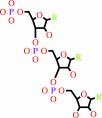 RNA(n)
|
+
|
ribonucleoside 5'-triphosphate
|
=
|
RNA(n+1)
|
+
|
 diphosphate
|
|
|
|
|
|
|
|
|
|
Enzyme class 3:
|
|
E.C.3.4.22.28
- picornain 3C.
|
|
|
|
|
|
|
Reaction:
|
|
Selective cleavage of Gln-|-Gly bond in the poliovirus polyprotein. In other picornavirus reactions Glu may be substituted for Gln, and Ser or Thr for Gly.
|
|
|
|
|
|
Enzyme class 4:
|
|
E.C.3.6.1.15
- nucleoside-triphosphate phosphatase.
|
|
|
|
|
|
|
Reaction:
|
|
a ribonucleoside 5'-triphosphate + H2O = a ribonucleoside 5'-diphosphate + phosphate + H+
|
|
|
|
|
|
ribonucleoside 5'-triphosphate
|
+
|
H2O
|
=
|
ribonucleoside 5'-diphosphate
|
+
|
 phosphate
|
+
|
H(+)
|
|
|
|
|
|
|
|
|
|
|
|
|
Note, where more than one E.C. class is given (as above), each may
correspond to a different protein domain or, in the case of polyprotein
precursors, to a different mature protein.
|
|
|
|
Molecule diagrams generated from .mol files obtained from the
KEGG ftp site
|
|
|
|
|
|
|
|
|
|
|
|
|
|
 |
|
|
|
|
|
|
| |
|
|
| |
|
|
Virology
265:153-163
(1999)
|
|
PubMed id:
|
|
|
|
|
|
| |
|
Crystal structure of an inhibitor complex of the 3C proteinase from hepatitis A virus (HAV) and implications for the polyprotein processing in HAV.
|
|
E.M.Bergmann,
M.M.Cherney,
J.Mckendrick,
S.Frormann,
C.Luo,
B.A.Malcolm,
J.C.Vederas,
M.N.James.
|
|
|
|
|
| |
ABSTRACT
|
|
|
|
| |
|
|
The proteolytic processing of the viral polyprotein is an essential step during
the life cycle of hepatitis A virus (HAV), as it is in all positive-sense,
single-stranded RNA viruses of animals. In HAV the 3C proteinase is the only
proteolytic activity involved in the polyprotein processing. The specific
recognition of the cleavage sites by the 3C proteinase depends on the amino acid
sequence of the cleavage site. The structure of the complex of the HAV 3C
proteinase and a dipeptide inhibitor has been determined by X-ray
crystallography. The double-mutant of HAV 3C (C24S, F82A) was inhibited with the
specific inhibitor iodoacetyl-valyl-phenylalanyl-amide. The resulting complex
had an acetyl-Val-Phe-amide group covalently attached to the S(gamma) atom of
the nucleophilic Cys 172 of the enzyme. Crystals of the complex of HAV 3C (C24S,
F82A) acetyl-Val-Phe-amide were found to be monoclinic, space group P2(1),
having 4 molecules in the asymmetric unit and diffracting to 1.9-A resolution.
The final refined structure consists of 4 molecules of HAV 3C (C24S,F82A)
acetyl-Val-Phe-amide, 1 molecule of DMSO, 1 molecule of glycerol, and 514 water
molecules. There are considerable conformational differences among the four
molecules in the asymmetric unit. The final R-factor is 20.4% for all observed
reflections between 15.0- and 1.9-A resolution and the corresponding R(free) is
29.8%. The dipeptide inhibitor is bound to the S(1)(') and S(2)(') specificity
subsites of the proteinase. The crystal structure reveals that the HAV 3C
proteinase possesses a well-defined S(2)(') specificity pocket and suggests that
the P(2)(') residue could be an important determinant for the selection of the
primary cleavage site during the polyprotein processing in HAV.
|
|
|
|
|
|
|
|
|
|
|
|
|
|
|
|
|
|
 |
 |
 |
|
Literature references that cite this PDB file's key reference
|
|
|
| |
PubMed id
|
|
Reference
|
|
|
|
|
|
S.Cui,
J.Wang,
T.Fan,
B.Qin,
L.Guo,
X.Lei,
J.Wang,
M.Wang,
and
Q.Jin
(2011).
Crystal structure of human enterovirus 71 3C protease.
|
| |
J Mol Biol,
408,
449-461.
|
|
|
PDB code:
|
|
|
|
|
|
|
|
S.Curry,
N.Roqué-Rosell,
P.A.Zunszain,
and
R.J.Leatherbarrow
(2007).
Foot-and-mouth disease virus 3C protease: recent structural and functional insights into an antiviral target.
|
| |
Int J Biochem Cell Biol,
39,
1-6.
|
|
|
|
|
|
|
T.Oka,
M.Yamamoto,
M.Yokoyama,
S.Ogawa,
G.S.Hansman,
K.Katayama,
K.Miyashita,
H.Takagi,
Y.Tohya,
H.Sato,
and
N.Takeda
(2007).
Highly conserved configuration of catalytic amino acid residues among calicivirus-encoded proteases.
|
| |
J Virol,
81,
6798-6806.
|
|
|
|
|
|
|
T.R.Sweeney,
N.Roqué-Rosell,
J.R.Birtley,
R.J.Leatherbarrow,
and
S.Curry
(2007).
Structural and mutagenic analysis of foot-and-mouth disease virus 3C protease reveals the role of the beta-ribbon in proteolysis.
|
| |
J Virol,
81,
115-124.
|
|
|
PDB code:
|
|
|
|
|
|
|
|
J.R.Mesters,
J.Tan,
and
R.Hilgenfeld
(2006).
Viral enzymes.
|
| |
Curr Opin Struct Biol,
16,
776-786.
|
|
|
|
|
|
|
M.N.James
(2006).
The peptidases from fungi and viruses.
|
| |
Biol Chem,
387,
1023-1029.
|
|
|
|
|
|
|
J.R.Birtley,
S.R.Knox,
A.M.Jaulent,
P.Brick,
R.J.Leatherbarrow,
and
S.Curry
(2005).
Crystal structure of foot-and-mouth disease virus 3C protease. New insights into catalytic mechanism and cleavage specificity.
|
| |
J Biol Chem,
280,
11520-11527.
|
|
|
PDB code:
|
|
|
|
|
|
|
|
J.Phan,
A.Zdanov,
A.G.Evdokimov,
J.E.Tropea,
H.K.Peters,
R.B.Kapust,
M.Li,
A.Wlodawer,
and
D.S.Waugh
(2002).
Structural basis for the substrate specificity of tobacco etch virus protease.
|
| |
J Biol Chem,
277,
50564-50572.
|
|
|
PDB codes:
|
|
|
|
|
|
|
|
K.Hara,
M.Shiota,
H.Kido,
Y.Ohtsu,
T.Kashiwagi,
J.Iwahashi,
N.Hamada,
K.Mizoue,
N.Tsumura,
H.Kato,
and
T.Toyoda
(2001).
Influenza virus RNA polymerase PA subunit is a novel serine protease with Ser624 at the active site.
|
| |
Genes Cells,
6,
87-97.
|
|
|
|
|
|
The most recent references are shown first.
Citation data come partly from CiteXplore and partly
from an automated harvesting procedure. Note that this is likely to be
only a partial list as not all journals are covered by
either method. However, we are continually building up the citation data
so more and more references will be included with time.
Where a reference describes a PDB structure, the PDB
code is
shown on the right.
|
|


 Links
Links


