 |
PDBsum entry 1q4l

|
|
|
|
|
 |
Contents |
 |
|
|
|
|
|
|
|
|
|
|
|
|
* Residue conservation analysis
|
|
|
|
|
|
PDB id:
|
|
|
|
| Name: |
|
Transferase
|
|
|
Title:
|
|
Gsk-3 beta complexed with inhibitor i-5
|
|
Structure:
|
|
Glycogen synthase kinase-3 beta. Chain: a, b. Synonym: gsk-3 beta. Engineered: yes
|
|
Source:
|
|
Homo sapiens. Human. Organism_taxid: 9606. Gene: gsk3b. Expressed in: spodoptera frugiperda. Expression_system_taxid: 7108. Expression_system_cell_line: h5.
|
|
Resolution:
|
|
|
2.77Å
|
R-factor:
|
0.212
|
R-free:
|
0.251
|
|
|
Authors:
|
|
J.A.Bertrand,S.Thieffine,A.Vulpetti,C.Cristiani,B.Valsasina,S.Knapp, H.M.Kalisz,M.Flocco
|
Key ref:

|
|
J.A.Bertrand
et al.
(2003).
Structural characterization of the GSK-3beta active site using selective and non-selective ATP-mimetic inhibitors.
J Mol Biol,
333,
393-407.
PubMed id:
DOI:

|
|
|
Date:
|
|
|
04-Aug-03
|
Release date:
|
14-Oct-03
|
|
|
|
|
|
|
PROCHECK
|

|
|
|
|
|
Headers
|
|
|
|
References
|
|
|
|
|
|

|
|
P49841
(GSK3B_HUMAN) -
Glycogen synthase kinase-3 beta from Homo sapiens
|
|
|
|
Seq:
Struc:
|
|
|
|
420 a.a.
342 a.a.
|
|

|

|

|
|
|
|
|
|
|
|
|
|
|
Key: |
 |
PfamA domain |
|
|
 |
Secondary structure |
|
 |
CATH domain |
|
|
|
|
|
|
|
|
|
|
|
|
|
Enzyme class:
|
|
E.C.2.7.11.26
- [tau protein] kinase.
|
|
|
|
|
|
|
Reaction:
|
|
|
1.
|
L-seryl-[tau protein] + ATP = O-phospho-L-seryl-[tau protein] + ADP + H+
|
|
2.
|
L-threonyl-[tau protein] + ATP = O-phospho-L-threonyl-[tau protein] + ADP + H+
|
|
|
|
|
|
|
L-seryl-[tau protein]
|
+
|
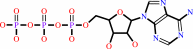 ATP
ATP
|
=
|
O-phospho-L-seryl-[tau protein]
|
+
|
 ADP
ADP
|
+
|
H(+)
|
|
|
|
|
|
|
L-threonyl-[tau protein]
|
+
|
ATP
|
=
|
O-phospho-L-threonyl-[tau protein]
|
+
|
ADP
|
+
|
H(+)
|
|
|
|
|
|
|
|
|
|
|
|
|
Molecule diagrams generated from .mol files obtained from the
KEGG ftp site
|
|
|
|
|
|
|
|
|
|
|
|
|
|
 |
|
|
|
|
|
|
| |
|
|
| |
|
DOI no:
|
J Mol Biol
333:393-407
(2003)
|
|
PubMed id:
|
|
|
|
|
|
| |
|
Structural characterization of the GSK-3beta active site using selective and non-selective ATP-mimetic inhibitors.
|
|
J.A.Bertrand,
S.Thieffine,
A.Vulpetti,
C.Cristiani,
B.Valsasina,
S.Knapp,
H.M.Kalisz,
M.Flocco.
|
|
|
|
|
| |
ABSTRACT
|
|
|
|
| |
|
|
GSK-3beta is a regulatory serine/threonine kinase with a plethora of cellular
targets. Consequently, selective small molecule inhibitors of GSK-3beta may have
a variety of therapeutic uses including the treatment of neurodegenerative
diseases, type II diabetes and cancer. In order to characterize the active site
of GSK-3beta, we determined crystal structures of unphosphorylated GSK-3beta in
complex with selective and non-selective ATP-mimetic inhibitors. Analysis of the
inhibitors' interactions with GSK-3beta in the structures reveals how the enzyme
can accommodate a number of diverse molecular scaffolds. In addition, a
conserved water molecule near Thr138 is identified that can serve a functional
role in inhibitor binding. Finally, a comparison of the interactions made by
selective and non-selective inhibitors highlights residues on the edge of the
ATP binding-site that can be used to obtain inhibitor selectivity. Information
gained from these structures provides a promising route for the design of
second-generation GSK-3beta inhibitors.
|
|
|
|
|
|
| |
Selected figure(s)
|
|
|
|
| |
|
|

|
|

|
|
Figure 4.
Figure 4. Diagram showing the binding of (a) AMP-PNP, (b)
staurosporine, (c) indirubin-3-monoxime and (d) alsterpaullone
to GSK-3b. Residues playing a direct or indirect role in
inhibitor binding are shown in a ball-and-stick representation.
Inhibitor molecules are shown in tan; water molecules and Mg2+
are shown in red and yellow, respectively. The C^a trace of
GSK-3b is shown in blue and green for the N- and C-terminal
domains, respectively. To avoid "cluttering" in the AMP-PNP
diagram, the two water molecules coordinating Mg1 are omitted
and Asp200, the residue coordinating Mg1 and Mg2, is unlabelled.
|
|
Figure 6.
Figure 6. Stereo view showing I-5 bound in the GSK-3b
active site. Residues playing a direct or indirect role in
inhibitor binding are shown in a ball-and-stick representation.
I-5 is shown in light brown; chlorine atoms are in green and
water molecules are in red. The C^a trace of GSK-3b is shown in
blue and green for the N- and C-terminal domains, respectively.
For the sake of clarity, Leu132 and Tyr134 are unlabelled and
Val110 has been omitted from the Figure.
|
|
|
|
|
|
| |
The above figures are
reprinted
by permission from Elsevier:
J Mol Biol
(2003,
333,
393-407)
copyright 2003.
|
|
| |
Figures were
selected
by an automated process.
|
|
|
|
|
|
|
|
|
|
|
|
|
|
|
|
 |
 |
 |
|
Literature references that cite this PDB file's key reference
|
|
|
| |
PubMed id
|
|
Reference
|
|
|
|
|
|
A.Licht-Murava,
B.Plotkin,
M.Eisenstein,
and
H.Eldar-Finkelman
(2011).
Elucidating substrate and inhibitor binding sites on the surface of GSK-3β and the refinement of a competitive inhibitor.
|
| |
J Mol Biol,
408,
366-378.
|
|
|
|
|
|
|
G.E.Atilla-Gokcumen,
L.Di Costanzo,
and
E.Meggers
(2011).
Structure of anticancer ruthenium half-sandwich complex bound to glycogen synthase kinase 3β.
|
| |
J Biol Inorg Chem,
16,
45-50.
|
|
|
PDB code:
|
|
|
|
|
|
|
|
J.L.Johnson,
S.G.Rupasinghe,
F.Stefani,
M.A.Schuler,
and
E.Gonzalez de Mejia
(2011).
Citrus flavonoids luteolin, apigenin, and quercetin inhibit glycogen synthase kinase-3β enzymatic activity by lowering the interaction energy within the binding cavity.
|
| |
J Med Food,
14,
325-333.
|
|
|
|
|
|
|
K.Saeki,
M.Machida,
Y.Kinoshita,
R.Takasawa,
and
S.Tanuma
(2011).
Glycogen synthase kinase-3β2 has lower phosphorylation activity to tau than glycogen synthase kinase-3β1.
|
| |
Biol Pharm Bull,
34,
146-149.
|
|
|
|
|
|
|
Q.Chen,
W.Cui,
Y.Cheng,
F.Zhang,
and
M.Ji
(2011).
Studying the mechanism that enables paullones to selectively inhibit glycogen synthase kinase 3 rather than cyclin-dependent kinase 5 by molecular dynamics simulations and free-energy calculations.
|
| |
J Mol Model,
17,
795-803.
|
|
|
|
|
|
|
S.Y.Lu,
Y.J.Jiang,
J.Lv,
J.W.Zou,
and
T.X.Wu
(2011).
Role of bridging water molecules in GSK3β-inhibitor complexes: insights from QM/MM, MD, and molecular docking studies.
|
| |
J Comput Chem,
32,
1907-1918.
|
|
|
|
|
|
|
S.Y.Lu,
Y.J.Jiang,
J.W.Zou,
and
T.X.Wu
(2011).
Dissection of the difference between the group I metal ions in inhibiting GSK3β: a computational study.
|
| |
Phys Chem Chem Phys,
13,
7014-7023.
|
|
|
|
|
|
|
X.N.Tang,
C.W.Lo,
Y.C.Chuang,
C.T.Chen,
Y.C.Sun,
Y.R.Hong,
and
C.N.Yang
(2011).
Prediction of the binding mode between GSK3β and a peptide derived from GSKIP using molecular dynamics simulation.
|
| |
Biopolymers,
95,
461-471.
|
|
|
|
|
|
|
I.Buch,
D.Fishelovitch,
N.London,
B.Raveh,
H.J.Wolfson,
and
R.Nussinov
(2010).
Allosteric regulation of glycogen synthase kinase 3β: a theoretical study.
|
| |
Biochemistry,
49,
10890-10901.
|
|
|
|
|
|
|
M.Laronze-Cochard,
F.Cochard,
E.Daras,
A.Lansiaux,
B.Brassart,
E.Vanquelef,
E.Prost,
J.M.Nuzillard,
B.Baldeyrou,
J.F.Goosens,
O.Lozach,
L.Meijer,
J.F.Riou,
E.Henon,
and
J.Sapi
(2010).
Synthesis and biological evaluation of new penta- and heptacyclic indolo- and quinolinocarbazole ring systems obtained via Pd(0) catalysed reductive N-heteroannulation.
|
| |
Org Biomol Chem,
8,
4625-4636.
|
|
|
|
|
|
|
F.Robert,
C.Williams,
Y.Yan,
E.Donohue,
R.Cencic,
S.K.Burley,
and
J.Pelletier
(2009).
Blocking UV-induced eIF2alpha phosphorylation with small molecule inhibitors of GCN2.
|
| |
Chem Biol Drug Des,
74,
57-67.
|
|
|
|
|
|
|
K.H.Kim,
I.Gaisina,
F.Gallier,
D.Holzle,
S.Y.Blond,
A.Mesecar,
and
A.P.Kozikowski
(2009).
Use of molecular modeling, docking, and 3D-QSAR studies for the determination of the binding mode of benzofuran-3-yl-(indol-3-yl)maleimides as GSK-3beta inhibitors.
|
| |
J Mol Model,
15,
1463-1479.
|
|
|
|
|
|
|
M.A.Khanfar,
B.A.Asal,
M.Mudit,
A.Kaddoumi,
and
K.A.El Sayed
(2009).
The marine natural-derived inhibitors of glycogen synthase kinase-3beta phenylmethylene hydantoins: In vitro and in vivo activities and pharmacophore modeling.
|
| |
Bioorg Med Chem,
17,
6032-6039.
|
|
|
|
|
|
|
N.Zhang,
Y.Jiang,
J.Zou,
Q.Yu,
and
W.Zhao
(2009).
Structural basis for the complete loss of GSK3beta catalytic activity due to R96 mutation investigated by molecular dynamics study.
|
| |
Proteins,
75,
671-681.
|
|
|
|
|
|
|
S.Kruggel,
and
T.Lemcke
(2009).
Generation and evaluation of a homology model of PfGSK-3.
|
| |
Arch Pharm (Weinheim),
342,
327-332.
|
|
|
|
|
|
|
S.Prasanna,
P.R.Daga,
A.Xie,
and
R.J.Doerksen
(2009).
Glycogen synthase kinase-3 inhibition by 3-anilino-4-phenylmaleimides: insights from 3D-QSAR and docking.
|
| |
J Comput Aided Mol Des,
23,
113-127.
|
|
|
|
|
|
|
A.Kannoji,
S.Phukan,
V.Sudher Babu,
and
V.N.Balaji
(2008).
GSK3beta: a master switch and a promising target.
|
| |
Expert Opin Ther Targets,
12,
1443-1455.
|
|
|
|
|
|
|
G.E.Atilla-Gokcumen,
N.Pagano,
C.Streu,
J.Maksimoska,
P.Filippakopoulos,
S.Knapp,
and
E.Meggers
(2008).
Extremely tight binding of a ruthenium complex to glycogen synthase kinase 3.
|
| |
Chembiochem,
9,
2933-2936.
|
|
|
PDB code:
|
|
|
|
|
|
|
|
J.Eswaran,
A.Bernad,
J.M.Ligos,
B.Guinea,
J.E.Debreczeni,
F.Sobott,
S.A.Parker,
R.Najmanovich,
B.E.Turk,
and
S.Knapp
(2008).
Structure of the human protein kinase MPSK1 reveals an atypical activation loop architecture.
|
| |
Structure,
16,
115-124.
|
|
|
|
|
|
|
K.Vougogiannopoulou,
Y.Ferandin,
K.Bettayeb,
V.Myrianthopoulos,
O.Lozach,
Y.Fan,
C.H.Johnson,
P.Magiatis,
A.L.Skaltsounis,
E.Mikros,
and
L.Meijer
(2008).
Soluble 3',6-substituted indirubins with enhanced selectivity toward glycogen synthase kinase -3 alter circadian period.
|
| |
J Med Chem,
51,
6421-6431.
|
|
|
|
|
|
|
P.Filippakopoulos,
M.Kofler,
O.Hantschel,
G.D.Gish,
F.Grebien,
E.Salah,
P.Neudecker,
L.E.Kay,
B.E.Turk,
G.Superti-Furga,
T.Pawson,
and
S.Knapp
(2008).
Structural coupling of SH2-kinase domains links Fes and Abl substrate recognition and kinase activation.
|
| |
Cell,
134,
793-803.
|
|
|
PDB codes:
|
|
|
|
|
|
|
|
G.Bunkoczi,
E.Salah,
P.Filippakopoulos,
O.Fedorov,
S.Müller,
F.Sobott,
S.A.Parker,
H.Zhang,
W.Min,
B.E.Turk,
and
S.Knapp
(2007).
Structural and functional characterization of the human protein kinase ASK1.
|
| |
Structure,
15,
1215-1226.
|
|
|
PDB code:
|
|
|
|
|
|
|
|
M.P.Mazanetz,
and
P.M.Fischer
(2007).
Untangling tau hyperphosphorylation in drug design for neurodegenerative diseases.
|
| |
Nat Rev Drug Discov,
6,
464-479.
|
|
|
|
|
|
|
N.Acevedo,
X.Wang,
R.L.Dunn,
and
G.D.Smith
(2007).
Glycogen synthase kinase-3 regulation of chromatin segregation and cytokinesis in mouse preimplantation embryos.
|
| |
Mol Reprod Dev,
74,
178-188.
|
|
|
|
|
|
|
O.Fedorov,
B.Marsden,
V.Pogacic,
P.Rellos,
S.Müller,
A.N.Bullock,
J.Schwaller,
M.Sundström,
and
S.Knapp
(2007).
A systematic interaction map of validated kinase inhibitors with Ser/Thr kinases.
|
| |
Proc Natl Acad Sci U S A,
104,
20523-20528.
|
|
|
PDB code:
|
|
|
|
|
|
|
|
A.P.Kozikowski,
I.N.Gaisina,
P.A.Petukhov,
J.Sridhar,
L.T.King,
S.Y.Blond,
T.Duka,
M.Rusnak,
and
A.Sidhu
(2006).
Highly potent and specific GSK-3beta inhibitors that block tau phosphorylation and decrease alpha-synuclein protein expression in a cellular model of Parkinson's disease.
|
| |
ChemMedChem,
1,
256-266.
|
|
|
|
|
|
|
C.S.Page,
and
P.A.Bates
(2006).
Can MM-PBSA calculations predict the specificities of protein kinase inhibitors?
|
| |
J Comput Chem,
27,
1990-2007.
|
|
|
|
|
|
|
D.S.Patel,
and
P.V.Bharatam
(2006).
New leads for selective GSK-3 inhibition: pharmacophore mapping and virtual screening studies.
|
| |
J Comput Aided Mol Des,
20,
55-66.
|
|
|
|
|
|
|
J.Ribas,
K.Bettayeb,
Y.Ferandin,
M.Knockaert,
X.Garrofé-Ochoa,
F.Totzke,
C.Schächtele,
J.Mester,
P.Polychronopoulos,
P.Magiatis,
A.L.Skaltsounis,
J.Boix,
and
L.Meijer
(2006).
7-Bromoindirubin-3'-oxime induces caspase-independent cell death.
|
| |
Oncogene,
25,
6304-6318.
|
|
|
|
|
|
|
N.Dessalew,
and
P.V.Bharatam
(2006).
Investigation of potential glycogen synthase kinase 3 inhibitors using pharmacophore mapping and virtual screening.
|
| |
Chem Biol Drug Des,
68,
154-165.
|
|
|
|
|
|
|
R.Ilouz,
N.Kowalsman,
M.Eisenstein,
and
H.Eldar-Finkelman
(2006).
Identification of novel glycogen synthase kinase-3beta substrate-interacting residues suggests a common mechanism for substrate recognition.
|
| |
J Biol Chem,
281,
30621-30630.
|
|
|
|
|
|
|
C.Kunick,
Z.Zeng,
R.Gussio,
D.Zaharevitz,
M.Leost,
F.Totzke,
C.Schächtele,
M.H.Kubbutat,
L.Meijer,
and
T.Lemcke
(2005).
Structure-aided optimization of kinase inhibitors derived from alsterpaullone.
|
| |
Chembiochem,
6,
541-549.
|
|
|
|
|
|
|
D.G.Covell,
A.Wallqvist,
R.Huang,
N.Thanki,
A.A.Rabow,
and
X.J.Lu
(2005).
Linking tumor cell cytotoxicity to mechanism of drug action: an integrated analysis of gene expression, small-molecule screening and structural databases.
|
| |
Proteins,
59,
403-433.
|
|
|
|
|
|
|
F.Artiguenave,
A.Lins,
W.D.Maciel,
A.C.Junior,
C.Nacif-Coelho,
M.M.de Souza Linhares,
G.C.de Oliveira,
L.H.Barbosa,
J.C.Lopes,
and
C.N.Junior
(2005).
The Tropical Biominer Project: mining old sources for new drugs.
|
| |
OMICS,
9,
130-138.
|
|
|
|
|
|
|
F.Yi,
P.L.Brubaker,
and
T.Jin
(2005).
TCF-4 mediates cell type-specific regulation of proglucagon gene expression by beta-catenin and glycogen synthase kinase-3beta.
|
| |
J Biol Chem,
280,
1457-1464.
|
|
|
|
|
|
|
G.Zhu,
K.Fujii,
N.Belkina,
Y.Liu,
M.James,
J.Herrero,
and
S.Shaw
(2005).
Exceptional disfavor for proline at the P + 1 position among AGC and CAMK kinases establishes reciprocal specificity between them and the proline-directed kinases.
|
| |
J Biol Chem,
280,
10743-10748.
|
|
|
|
|
|
|
J.Liu,
X.Wu,
B.Mitchell,
C.Kintner,
S.Ding,
and
P.G.Schultz
(2005).
A small-molecule agonist of the Wnt signaling pathway.
|
| |
Angew Chem Int Ed Engl,
44,
1987-1990.
|
|
|
|
|
|
|
R.Paulini,
K.Müller,
and
F.Diederich
(2005).
Orthogonal multipolar interactions in structural chemistry and biology.
|
| |
Angew Chem Int Ed Engl,
44,
1788-1805.
|
|
|
|
|
|
|
M.N.Kosmopoulou,
D.D.Leonidas,
E.D.Chrysina,
N.Bischler,
G.Eisenbrand,
C.E.Sakarellos,
R.Pauptit,
and
N.G.Oikonomakos
(2004).
Binding of the potential antitumour agent indirubin-5-sulphonate at the inhibitor site of rabbit muscle glycogen phosphorylase b. Comparison with ligand binding to pCDK2-cyclin A complex.
|
| |
Eur J Biochem,
271,
2280-2290.
|
|
|
PDB code:
|
|
|
|
|
|
|
|
L.Meijer,
A.L.Skaltsounis,
P.Magiatis,
P.Polychronopoulos,
M.Knockaert,
M.Leost,
X.P.Ryan,
C.A.Vonica,
A.Brivanlou,
R.Dajani,
C.Crovace,
C.Tarricone,
A.Musacchio,
S.M.Roe,
L.Pearl,
and
P.Greengard
(2003).
GSK-3-selective inhibitors derived from Tyrian purple indirubins.
|
| |
Chem Biol,
10,
1255-1266.
|
|
|
PDB code:
|
|
|
|
|
|
|
|
P.M.Fischer
(2003).
CDK versus GSK-3 inhibition: a purple haze no longer?
|
| |
Chem Biol,
10,
1144-1146.
|
|
|
|
|
|
The most recent references are shown first.
Citation data come partly from CiteXplore and partly
from an automated harvesting procedure. Note that this is likely to be
only a partial list as not all journals are covered by
either method. However, we are continually building up the citation data
so more and more references will be included with time.
Where a reference describes a PDB structure, the PDB
code is
shown on the right.
|
|


 Links
Links


