 |
PDBsum entry 1pv3

|
|
|
|
|
 |
Contents |
 |
|
|
|
|
|
|
|
|
* Residue conservation analysis
|
|
|
|
|
|
|
|
|
|
|
Enzyme class:
|
|
E.C.2.7.10.2
- non-specific protein-tyrosine kinase.
|
|
|
|
|
|
|
Reaction:
|
|
L-tyrosyl-[protein] + ATP = O-phospho-L-tyrosyl-[protein] + ADP + H+
|
|
|
|
|
|
L-tyrosyl-[protein]
|
+
|
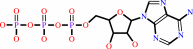 ATP
ATP
|
=
|
O-phospho-L-tyrosyl-[protein]
|
+
|
 ADP
ADP
|
+
|
H(+)
|
|
|
|
|
|
|
|
|
|
|
|
|
Molecule diagrams generated from .mol files obtained from the
KEGG ftp site
|
|
|
|
|
|
|
|
|
|
|
|
|
|
 |
|
|
|
|
|
|
| |
|
|
| |
|
DOI no:
|
Structure
12:881-891
(2004)
|
|
PubMed id:
|
|
|
|
|
|
| |
|
The focal adhesion targeting domain of focal adhesion kinase contains a hinge region that modulates tyrosine 926 phosphorylation.
|
|
K.C.Prutzman,
G.Gao,
M.L.King,
V.V.Iyer,
G.A.Mueller,
M.D.Schaller,
S.L.Campbell.
|
|
|
|
|
| |
ABSTRACT
|
|
|
|
| |
|
|
The focal adhesion targeting (FAT) domain of focal adhesion kinase (FAK) is
critical for recruitment of FAK to focal adhesions and contains tyrosine 926,
which, when phosphorylated, binds the SH2 domain of Grb2. Structural studies
have shown that the FAT domain is a four-helix bundle that exists as a monomer
and a dimer due to domain swapping of helix 1. Here, we report the NMR solution
structure of the avian FAT domain, which is similar in overall structure to the
X-ray crystal structures of monomeric forms of the FAT domain, except that loop
1 is longer and less structured in solution. Residues in this region undergo
temperature-dependent exchange broadening and sample aberrant phi and psi
angles, which suggests that this region samples multiple conformations. We have
also identified a mutant that dimerizes approximately 8 fold more than WT FAT
domain and exhibits increased phosphorylation of tyrosine 926 both in vitro and
in vivo.
|
|
|
|
|
|
| |
Selected figure(s)
|
|
|
|
| |
|
|

|
|
Figure 1.
Figure 1. Solution Structure of the Avian FAT Domain(A)
Backbone atom trace of the 20 lowest energy solution structures
of the avian FAT domain (residues 920-1053), with a 12 amino
acid linker at the amino terminus remaining from
purification.(B) The backbone trace of the avian FAT domain
minus the 12 amino acid linker. The proposed hinge region
(residues 941-951) is colored red.(C) Expanded view of the hinge
region, which contains three prolines (P945, P947, and P948, in
red).
|
|
|
|
|
|
| |
The above figure is
reprinted
by permission from Cell Press:
Structure
(2004,
12,
881-891)
copyright 2004.
|
|
| |
Figure was
selected
by an automated process.
|
|
|
|
|
|
|
|
|
|
|
|
|
|
|
|
 |
 |
 |
|
Literature references that cite this PDB file's key reference
|
|
|
| |
PubMed id
|
|
Reference
|
|
|
|
|
|
C.F.Dibble,
J.A.Horst,
M.H.Malone,
K.Park,
B.Temple,
H.Cheeseman,
J.R.Barbaro,
G.L.Johnson,
and
S.Bencharit
(2010).
Defining the functional domain of programmed cell death 10 through its interactions with phosphatidylinositol-3,4,5-trisphosphate.
|
| |
PLoS One,
5,
e11740.
|
|
|
|
|
|
|
D.M.Scheswohl,
J.R.Harrell,
Z.Rajfur,
G.Gao,
S.L.Campbell,
and
M.D.Schaller
(2008).
Multiple paxillin binding sites regulate FAK function.
|
| |
J Mol Signal,
3,
1.
|
|
|
|
|
|
|
P.M.Siesser,
L.M.Meenderink,
L.Ryzhova,
K.E.Michael,
D.W.Dumbauld,
A.J.García,
I.Kaverina,
and
S.K.Hanks
(2008).
A FAK/Src chimera with gain-of-function properties promotes formation of large peripheral adhesions associated with dynamic actin assembly.
|
| |
Cell Motil Cytoskeleton,
65,
25-39.
|
|
|
|
|
|
|
Z.M.Zhang,
J.A.Simmerman,
C.D.Guibao,
and
J.J.Zheng
(2008).
GIT1 paxillin-binding domain is a four-helix bundle, and it binds to both paxillin LD2 and LD4 motifs.
|
| |
J Biol Chem,
283,
18685-18693.
|
|
|
PDB code:
|
|
|
|
|
|
|
|
F.Chang,
C.A.Lemmon,
D.Park,
and
L.H.Romer
(2007).
FAK potentiates Rac1 activation and localization to matrix adhesion sites: a role for betaPIX.
|
| |
Mol Biol Cell,
18,
253-264.
|
|
|
|
|
|
|
D.M.Pirone,
W.F.Liu,
S.A.Ruiz,
L.Gao,
S.Raghavan,
C.A.Lemmon,
L.H.Romer,
and
C.S.Chen
(2006).
An inhibitory role for FAK in regulating proliferation: a link between limited adhesion and RhoA-ROCK signaling.
|
| |
J Cell Biol,
174,
277-288.
|
|
|
|
|
|
|
F.Ding,
K.C.Prutzman,
S.L.Campbell,
and
N.V.Dokholyan
(2006).
Topological determinants of protein domain swapping.
|
| |
Structure,
14,
5.
|
|
|
|
|
|
|
K.Briknarová,
F.Nasertorabi,
M.L.Havert,
E.Eggleston,
D.W.Hoyt,
C.Li,
A.J.Olson,
K.Vuori,
and
K.R.Ely
(2005).
The serine-rich domain from Crk-associated substrate (p130cas) is a four-helix bundle.
|
| |
J Biol Chem,
280,
21908-21914.
|
|
|
PDB code:
|
|
|
|
|
|
|
|
S.K.Mitra,
D.A.Hanson,
and
D.D.Schlaepfer
(2005).
Focal adhesion kinase: in command and control of cell motility.
|
| |
Nat Rev Mol Cell Biol,
6,
56-68.
|
|
|
|
|
|
|
R.D.Dixon,
Y.Chen,
F.Ding,
S.D.Khare,
K.C.Prutzman,
M.D.Schaller,
S.L.Campbell,
and
N.V.Dokholyan
(2004).
New insights into FAK signaling and localization based on detection of a FAT domain folding intermediate.
|
| |
Structure,
12,
2161-2171.
|
|
|
|
|
|
The most recent references are shown first.
Citation data come partly from CiteXplore and partly
from an automated harvesting procedure. Note that this is likely to be
only a partial list as not all journals are covered by
either method. However, we are continually building up the citation data
so more and more references will be included with time.
Where a reference describes a PDB structure, the PDB
code is
shown on the right.
|
|


 Links
Links


