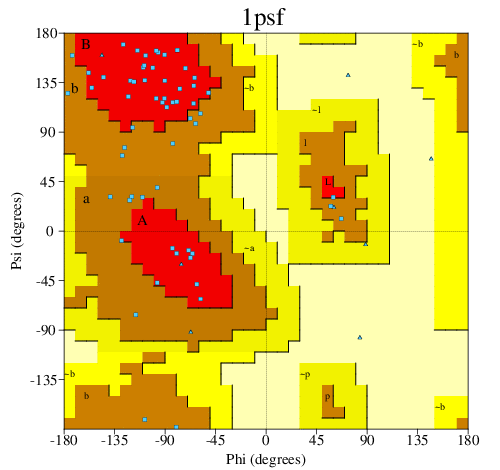
|
PDBsum entry 1psf

|
|
|
|
|
|

|

|

|

|
|

|
|

|
|
|
 |

|

|
|
|
|
|
|
|
|
|
|
|
|
|
|
|
|
|
|
|
|
|
|
|
|
|
|
|
|
|
|
|
Photosystem i
|
PDB id
|
|
|
|
1psf
|
|
|
|
|
|
|
|
|
|
|
|
|
|
|

|

|

|
|
|
|
|
|
|
|
 |
Contents |
 |
|
|
|
|
|
|
|
|
* Residue conservation analysis
|
|
|
|
|
|
|
|
|
|
|
|
|
|
|
 |
|
|
|
|
|
|
| |
|
DOI no:
|
Biochemistry
33:6052-6062
(1994)
|
|
PubMed id:
|
|
|
|
|
|
| |
|
Three-dimensional solution structure of PsaE from the cyanobacterium Synechococcus sp. strain PCC 7002, a photosystem I protein that shows structural homology with SH3 domains.
|
|
C.J.Falzone,
Y.H.Kao,
J.Zhao,
D.A.Bryant,
J.T.Lecomte.
|
|
|
|
|
| |
ABSTRACT
|
|
|
|
| |
|
|
PsaE is a 69 amino acid polypeptide from photosystem I present on the stromal
side of the thylakoid membrane. The three-dimensional solution structure of this
protein from the cyanobacterium Synechococcus sp. strain PCC 7002 was determined
at pH 5.8 and room temperature using over 900 experimental restraints derived
from two- and three-dimensional NMR experiments. The structure is comprised of a
well-defined five-stranded beta-sheet with (+1, +1, +1, -4 alpha) topology.
There is no helical region except for a single turn of 3(10) helix between the
beta D and beta E strands. PsaE also exhibits a large unrestrained loop spanning
residues 42-56. A comparison to known protein structures revealed similarity
with the Src homology 3 (SH3) domain, a membrane-associated protein involved in
signal transduction in eukaryotes. The match is remarkable as 47 of the
alpha-carbons of PsaE can be superimposed onto those of the SH3 domain from
chicken brain alpha-spectrin with a root-mean-square deviation of 2.3 A.
Although the amino acid sequences have low identity and the loops are different
in both proteins, the topology of the beta-sheet and the 3(10) turn is
conserved. SH3 domains from other sources show a similar structural homology.
The structure of PsaE was used to suggest approaches for elucidating its roles
within photosystem I.
|
|
|
|
|
|
|
|
|
|
|
|
|
|
|
|
|
|
 |
 |
 |
|
Literature references that cite this PDB file's key reference
|
|
|
| |
PubMed id
|
|
Reference
|
|
|
|
|
|
J.Niklas,
O.Gopta,
B.Epel,
W.Lubitz,
and
M.L.Antonkine
(2010).
Investigation of the Stationary and Transient A(1) Radical in Trp --> Phe Mutants of Photosystem I.
|
| |
Appl Magn Reson,
38,
187-203.
|
|
|
|
|
|
|
J.A.Knappenberger,
and
J.T.Lecomte
(2007).
Loop anchor modification causes the population of an alternative native state in an SH3-like domain.
|
| |
Protein Sci,
16,
863-879.
|
|
|
|
|
|
|
L.Zolla,
S.Rinalducci,
and
A.M.Timperio
(2007).
Proteomic analysis of photosystem I components from different plant species.
|
| |
Proteomics,
7,
1866-1876.
|
|
|
|
|
|
|
V.Bondarenko,
S.Dewilde,
L.Moens,
and
G.N.La Mar
(2006).
Solution 1H NMR characterization of the axial bonding of the two His in oxidized human cytoglobin.
|
| |
J Am Chem Soc,
128,
12988-12999.
|
|
|
|
|
|
|
J.A.Knappenberger,
C.M.Kraemer-Pecore,
and
J.T.Lecomte
(2004).
Insertion of the cytochrome b5 heme-binding loop into an SH3 domain. Effects on structure and stability, and clues about the cytochrome's architecture.
|
| |
Protein Sci,
13,
2899-2908.
|
|
|
|
|
|
|
J.A.D'Aquino,
and
D.Ringe
(2003).
Determinants of the SRC homology domain 3-like fold.
|
| |
J Bacteriol,
185,
4081-4086.
|
|
|
PDB code:
|
|
|
|
|
|
|
|
R.Stoll,
C.Renner,
R.Buettner,
W.Voelter,
A.K.Bosserhoff,
and
T.A.Holak
(2003).
Backbone dynamics of the human MIA protein studied by (15)N NMR relaxation: implications for extended interactions of SH3 domains.
|
| |
Protein Sci,
12,
510-519.
|
|
|
|
|
|
|
A.Lushy,
L.Verchovsky,
and
R.Nechushtai
(2002).
The stable assembly of newly synthesized PsaE into the photosystem I complex occurring via the exchange mechanism is facilitated by electrostatic interactions.
|
| |
Biochemistry,
41,
11192-11199.
|
|
|
|
|
|
|
G.S.Heffelfinger,
A.Martino,
A.Gorin,
Y.Xu,
M.D.Rintoul,
A.Geist,
H.M.Al-Hashimi,
G.S.Davidson,
J.L.Faulon,
L.J.Frink,
D.M.Haaland,
W.E.Hart,
E.Jakobsson,
T.Lane,
M.Li,
P.Locascio,
F.Olken,
V.Olman,
B.Palenik,
S.J.Plimpton,
D.C.Roe,
N.F.Samatova,
M.Shah,
A.Shoshoni,
C.E.Strauss,
E.V.Thomas,
J.A.Timlin,
and
D.Xu
(2002).
Carbon sequestration in Synechococcus Sp.: from molecular machines to hierarchical modeling.
|
| |
OMICS,
6,
305-330.
|
|
|
|
|
|
|
H.Delbrück,
G.Ziegelin,
E.Lanka,
and
U.Heinemann
(2002).
An Src homology 3-like domain is responsible for dimerization of the repressor protein KorB encoded by the promiscuous IncP plasmid RP4.
|
| |
J Biol Chem,
277,
4191-4198.
|
|
|
PDB codes:
|
|
|
|
|
|
|
|
V.Grantcharova,
E.J.Alm,
D.Baker,
and
A.L.Horwich
(2001).
Mechanisms of protein folding.
|
| |
Curr Opin Struct Biol,
11,
70-82.
|
|
|
|
|
|
|
L.Zolla,
and
A.M.Timperio
(2000).
High performance liquid chromatography-electrospray mass spectrometry for the simultaneous resolution and identification of intrinsic thylakoid membrane proteins.
|
| |
Proteins,
41,
398-406.
|
|
|
|
|
|
|
P.Barth,
I.Guillouard,
P.Sétif,
and
B.Lagoutte
(2000).
Essential role of a single arginine of photosystem I in stabilizing the electron transfer complex with ferredoxin.
|
| |
J Biol Chem,
275,
7030-7036.
|
|
|
|
|
|
|
S.Dai,
C.Schwendtmayer,
P.Schürmann,
S.Ramaswamy,
and
H.Eklund
(2000).
Redox signaling in chloroplasts: cleavage of disulfides by an iron-sulfur cluster.
|
| |
Science,
287,
655-658.
|
|
|
PDB code:
|
|
|
|
|
|
|
|
J.C.Whisstock,
and
A.M.Lesk
(1999).
SH3 domains in prokaryotes.
|
| |
Trends Biochem Sci,
24,
132-133.
|
|
|
|
|
|
|
O.Klukas,
W.D.Schubert,
P.Jordan,
N.Krauss,
P.Fromme,
H.T.Witt,
and
W.Saenger
(1999).
Photosystem I, an improved model of the stromal subunits PsaC, PsaD, and PsaE.
|
| |
J Biol Chem,
274,
7351-7360.
|
|
|
PDB code:
|
|
|
|
|
|
|
|
P.Barth,
B.Lagoutte,
and
P.Sétif
(1998).
Ferredoxin reduction by photosystem I from Synechocystis sp. PCC 6803: toward an understanding of the respective roles of subunits PsaD and PsaE in ferredoxin binding.
|
| |
Biochemistry,
37,
16233-16241.
|
|
|
|
|
|
|
S.Knapp,
P.T.Mattson,
P.Christova,
K.D.Berndt,
A.Karshikoff,
M.Vihinen,
C.I.Smith,
and
R.Ladenstein
(1998).
Thermal unfolding of small proteins with SH3 domain folding pattern.
|
| |
Proteins,
31,
309-319.
|
|
|
|
|
|
|
J.E.Gready,
S.Ranganathan,
P.R.Schofield,
Y.Matsuo,
and
K.Nishikawa
(1997).
Predicted structure of the extracellular region of ligand-gated ion-channel receptors shows SH2-like and SH3-like domains forming the ligand-binding site.
|
| |
Protein Sci,
6,
983-998.
|
|
|
|
|
|
|
J.Kruip,
P.R.Chitnis,
B.Lagoutte,
M.Rögner,
and
E.J.Boekema
(1997).
Structural organization of the major subunits in cyanobacterial photosystem 1. Localization of subunits PsaC, -D, -E, -F, and -J.
|
| |
J Biol Chem,
272,
17061-17069.
|
|
|
|
|
|
|
C.J.Morton,
D.J.Pugh,
E.L.Brown,
J.D.Kahmann,
D.A.Renzoni,
and
I.D.Campbell
(1996).
Solution structure and peptide binding of the SH3 domain from human Fyn.
|
| |
Structure,
4,
705-714.
|
|
|
PDB codes:
|
|
|
|
|
|
|
|
J.H.Nugent
(1996).
Oxygenic photosynthesis. Electron transfer in photosystem I and photosystem II.
|
| |
Eur J Biochem,
237,
519-531.
|
|
|
|
|
|
|
N.Krauss,
W.D.Schubert,
O.Klukas,
P.Fromme,
H.T.Witt,
and
W.Saenger
(1996).
Photosystem I at 4 A resolution represents the first structural model of a joint photosynthetic reaction centre and core antenna system.
|
| |
Nat Struct Biol,
3,
965-973.
|
|
|
PDB code:
|
|
|
|
|
|
|
|
N.Narayana,
D.A.Matthews,
E.E.Howell,
and
X.Nguyen-huu
(1995).
A plasmid-encoded dihydrofolate reductase from trimethoprim-resistant bacteria has a novel D2-symmetric active site.
|
| |
Nat Struct Biol,
2,
1018-1025.
|
|
|
PDB codes:
|
|
|
|
|
|
|
|
H.Baumann,
S.Knapp,
T.Lundbäck,
R.Ladenstein,
and
T.Härd
(1994).
Solution structure and DNA-binding properties of a thermostable protein from the archaeon Sulfolobus solfataricus.
|
| |
Nat Struct Biol,
1,
808-819.
|
|
|
PDB code:
|
|
|
|
|
|
|
The most recent references are shown first.
Citation data come partly from CiteXplore and partly
from an automated harvesting procedure. Note that this is likely to be
only a partial list as not all journals are covered by
either method. However, we are continually building up the citation data
so more and more references will be included with time.
Where a reference describes a PDB structure, the PDB
code is
shown on the right.
|
|


 Links
Links