 |
PDBsum entry 1pg4

|
|
|
|
|
 |
Contents |
 |
|
|
|
|
|
|
|
|
|
|
|
|
|
|
* Residue conservation analysis
|
|
|
|
|
|
|
|
|
|
|
Enzyme class:
|
|
E.C.6.2.1.1
- acetate--CoA ligase.
|
|
|
|
|
|
|
Reaction:
|
|
acetate + ATP + CoA = acetyl-CoA + AMP + diphosphate
|
|
|
|
|
|
acetate
Bound ligand (Het Group name = )
matches with 60.00% similarity
|
+
|
 ATP
ATP
|
+
|
CoA
Bound ligand (Het Group name = )
corresponds exactly
|
=
|
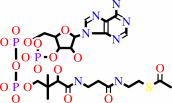 acetyl-CoA
|
+
|
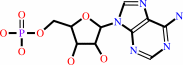 AMP
AMP
|
+
|
 diphosphate
|
|
|
|
|
|
|
|
|
|
|
|
|
Molecule diagrams generated from .mol files obtained from the
KEGG ftp site
|
|
|
|
|
|
|
|
|
|
|
|
|
|
 |
|
|
|
|
|
|
| |
|
|
| |
|
DOI no:
|
Biochemistry
42:2866-2873
(2003)
|
|
PubMed id:
|
|
|
|
|
|
| |
|
The 1.75 A crystal structure of acetyl-CoA synthetase bound to adenosine-5'-propylphosphate and coenzyme A.
|
|
A.M.Gulick,
V.J.Starai,
A.R.Horswill,
K.M.Homick,
J.C.Escalante-Semerena.
|
|
|
|
|
| |
ABSTRACT
|
|
|
|
| |
|
|
Acetyl-coenzyme A synthetase catalyzes the two-step synthesis of acetyl-CoA from
acetate, ATP, and CoA and belongs to a family of adenylate-forming enzymes that
generate an acyl-AMP intermediate. This family includes other acyl- and aryl-CoA
synthetases, firefly luciferase, and the adenylation domains of the modular
nonribosomal peptide synthetases. We have determined the X-ray crystal structure
of acetyl-CoA synthetase complexed with adenosine-5'-propylphosphate and CoA.
The structure identifies the CoA binding pocket as well as a new conformation
for members of this enzyme family in which the approximately 110-residue
C-terminal domain exhibits a large rotation compared to structures of peptide
synthetase adenylation domains. This domain movement presents a new set of
residues to the active site and removes a conserved lysine residue that was
previously shown to be important for catalysis of the adenylation half-reaction.
Comparison of our structure with kinetic and structural data of closely related
enzymes suggests that the members of the adenylate-forming family of enzymes may
adopt two different orientations to catalyze the two half-reactions.
Additionally, we provide a structural explanation for the recently shown control
of enzyme activity by acetylation of an active site lysine.
|
|
|
|
|
|
|
|
|
|
|
|
|
|
|
|
|
|
 |
 |
 |
|
Literature references that cite this PDB file's key reference
|
|
|
| |
PubMed id
|
|
Reference
|
|
|
|
|
|
A.J.Hughes,
and
A.Keatinge-Clay
(2011).
Enzymatic extender unit generation for in vitro polyketide synthase reactions: structural and functional showcasing of Streptomyces coelicolor MatB.
|
| |
Chem Biol,
18,
165-176.
|
|
|
PDB codes:
|
|
|
|
|
|
|
|
Y.Mao
(2011).
Dynamics studies of luciferase using elastic network model: how the sequence distribution of luciferase determines its color.
|
| |
Protein Eng Des Sel,
24,
341-349.
|
|
|
|
|
|
|
T.V.Lee,
L.J.Johnson,
R.D.Johnson,
A.Koulman,
G.A.Lane,
J.S.Lott,
and
V.L.Arcus
(2010).
Structure of a eukaryotic nonribosomal peptide synthetase adenylation domain that activates a large hydroxamate amino acid in siderophore biosynthesis.
|
| |
J Biol Chem,
285,
2415-2427.
|
|
|
PDB code:
|
|
|
|
|
|
|
|
A.M.Gulick
(2009).
Conformational dynamics in the Acyl-CoA synthetases, adenylation domains of non-ribosomal peptide synthetases, and firefly luciferase.
|
| |
ACS Chem Biol,
4,
811-827.
|
|
|
|
|
|
|
M.B.Shah,
C.Ingram-Smith,
L.L.Cooper,
J.Qu,
Y.Meng,
K.S.Smith,
and
A.M.Gulick
(2009).
The 2.1 A crystal structure of an acyl-CoA synthetase from Methanosarcina acetivorans reveals an alternate acyl-binding pocket for small branched acyl substrates.
|
| |
Proteins,
77,
685-698.
|
|
|
PDB code:
|
|
|
|
|
|
|
|
P.Arora,
A.Goyal,
V.T.Natarajan,
E.Rajakumara,
P.Verma,
R.Gupta,
M.Yousuf,
O.A.Trivedi,
D.Mohanty,
A.Tyagi,
R.Sankaranarayanan,
and
R.S.Gokhale
(2009).
Mechanistic and functional insights into fatty acid activation in Mycobacterium tuberculosis.
|
| |
Nat Chem Biol,
5,
166-173.
|
|
|
PDB code:
|
|
|
|
|
|
|
|
R.Wu,
A.S.Reger,
X.Lu,
A.M.Gulick,
and
D.Dunaway-Mariano
(2009).
The mechanism of domain alternation in the acyl-adenylate forming ligase superfamily member 4-chlorobenzoate: coenzyme A ligase.
|
| |
Biochemistry,
48,
4115-4125.
|
|
|
PDB code:
|
|
|
|
|
|
|
|
S.Schmelz,
N.Kadi,
S.A.McMahon,
L.Song,
D.Oves-Costales,
M.Oke,
H.Liu,
K.A.Johnson,
L.G.Carter,
C.H.Botting,
M.F.White,
G.L.Challis,
and
J.H.Naismith
(2009).
AcsD catalyzes enantioselective citrate desymmetrization in siderophore biosynthesis.
|
| |
Nat Chem Biol,
5,
174-182.
|
|
|
PDB codes:
|
|
|
|
|
|
|
|
A.S.Reger,
R.Wu,
D.Dunaway-Mariano,
and
A.M.Gulick
(2008).
Structural characterization of a 140 degrees domain movement in the two-step reaction catalyzed by 4-chlorobenzoate:CoA ligase.
|
| |
Biochemistry,
47,
8016-8025.
|
|
|
PDB codes:
|
|
|
|
|
|
|
|
A.Tanovic,
S.A.Samel,
L.O.Essen,
and
M.A.Marahiel
(2008).
Crystal structure of the termination module of a nonribosomal peptide synthetase.
|
| |
Science,
321,
659-663.
|
|
|
PDB code:
|
|
|
|
|
|
|
|
H.Yonus,
P.Neumann,
S.Zimmermann,
J.J.May,
M.A.Marahiel,
and
M.T.Stubbs
(2008).
Crystal structure of DltA. Implications for the reaction mechanism of non-ribosomal peptide synthetase adenylation domains.
|
| |
J Biol Chem,
283,
32484-32491.
|
|
|
PDB codes:
|
|
|
|
|
|
|
|
J.P.Coleman,
L.L.Hudson,
S.L.McKnight,
J.M.Farrow,
M.W.Calfee,
C.A.Lindsey,
and
E.C.Pesci
(2008).
Pseudomonas aeruginosa PqsA is an anthranilate-coenzyme A ligase.
|
| |
J Bacteriol,
190,
1247-1255.
|
|
|
|
|
|
|
T.Abe,
Y.Hashimoto,
H.Hosaka,
K.Tomita-Yokotani,
and
M.Kobayashi
(2008).
Discovery of amide (peptide) bond synthetic activity in Acyl-CoA synthetase.
|
| |
J Biol Chem,
283,
11312-11321.
|
|
|
|
|
|
|
V.Viviani
(2008).
Introduction to the themed issue on bioluminescence.
|
| |
Photochem Photobiol Sci,
7,
145.
|
|
|
|
|
|
|
X.Lu,
H.Zhang,
P.J.Tonge,
and
D.S.Tan
(2008).
Mechanism-based inhibitors of MenE, an acyl-CoA synthetase involved in bacterial menaquinone biosynthesis.
|
| |
Bioorg Med Chem Lett,
18,
5963-5966.
|
|
|
|
|
|
|
A.S.Reger,
J.M.Carney,
and
A.M.Gulick
(2007).
Biochemical and crystallographic analysis of substrate binding and conformational changes in acetyl-CoA synthetase.
|
| |
Biochemistry,
46,
6536-6546.
|
|
|
PDB codes:
|
|
|
|
|
|
|
|
A.Szarecka,
Y.Xu,
and
P.Tang
(2007).
Dynamics of firefly luciferase inhibition by general anesthetics: Gaussian and anisotropic network analyses.
|
| |
Biophys J,
93,
1895-1905.
|
|
|
|
|
|
|
C.Ingram-Smith,
and
K.S.Smith
(2007).
AMP-forming acetyl-CoA synthetases in Archaea show unexpected diversity in substrate utilization.
|
| |
Archaea,
2,
95.
|
|
|
|
|
|
|
S.P.Lim,
N.Roongsawang,
K.Washio,
and
M.Morikawa
(2007).
Functional analysis of a pyoverdine synthetase from Pseudomonas sp. MIS38.
|
| |
Biosci Biotechnol Biochem,
71,
2002-2009.
|
|
|
|
|
|
|
E.Arias-Barrau,
E.R.Olivera,
A.Sandoval,
G.Naharro,
and
J.M.Luengo
(2006).
Acetyl-CoA synthetase from Pseudomonas putida U is the only acyl-CoA activating enzyme induced by acetate in this bacterium.
|
| |
FEMS Microbiol Lett,
260,
36-46.
|
|
|
|
|
|
|
E.J.Drake,
D.A.Nicolai,
and
A.M.Gulick
(2006).
Structure of the EntB multidomain nonribosomal peptide synthetase and functional analysis of its interaction with the EntE adenylation domain.
|
| |
Chem Biol,
13,
409-419.
|
|
|
PDB code:
|
|
|
|
|
|
|
|
J.G.Gardner,
F.J.Grundy,
T.M.Henkin,
and
J.C.Escalante-Semerena
(2006).
Control of acetyl-coenzyme A synthetase (AcsA) activity by acetylation/deacetylation without NAD(+) involvement in Bacillus subtilis.
|
| |
J Bacteriol,
188,
5460-5468.
|
|
|
|
|
|
|
Y.Oba,
K.Tanaka,
and
S.Inouye
(2006).
Catalytic properties of domain-exchanged chimeric proteins between firefly luciferase and Drosophila fatty Acyl-CoA synthetase CG6178.
|
| |
Biosci Biotechnol Biochem,
70,
2739-2744.
|
|
|
|
|
|
|
Z.Pei,
Z.Jia,
and
P.A.Watkins
(2006).
The second member of the human and murine bubblegum family is a testis- and brainstem-specific acyl-CoA synthetase.
|
| |
J Biol Chem,
281,
6632-6641.
|
|
|
|
|
|
|
A.J.Wolfe
(2005).
The acetate switch.
|
| |
Microbiol Mol Biol Rev,
69,
12-50.
|
|
|
|
|
|
|
C.Bräsen,
and
P.Schönheit
(2005).
AMP-forming acetyl-CoA synthetase from the extremely halophilic archaeon Haloarcula marismortui: purification, identification and expression of the encoding gene, and phylogenetic affiliation.
|
| |
Extremophiles,
9,
355-365.
|
|
|
|
|
|
|
D.T.Huang,
A.Paydar,
M.Zhuang,
M.B.Waddell,
J.M.Holton,
and
B.A.Schulman
(2005).
Structural basis for recruitment of Ubc12 by an E2 binding domain in NEDD8's E1.
|
| |
Mol Cell,
17,
341-350.
|
|
|
PDB code:
|
|
|
|
|
|
|
|
S.K.Samanta,
and
C.S.Harwood
(2005).
Use of the Rhodopseudomonas palustris genome sequence to identify a single amino acid that contributes to the activity of a coenzyme A ligase with chlorinated substrates.
|
| |
Mol Microbiol,
55,
1151-1159.
|
|
|
|
|
|
|
V.J.Starai,
J.G.Gardner,
and
J.C.Escalante-Semerena
(2005).
Residue Leu-641 of Acetyl-CoA synthetase is critical for the acetylation of residue Lys-609 by the Protein acetyltransferase enzyme of Salmonella enterica.
|
| |
J Biol Chem,
280,
26200-26205.
|
|
|
|
|
|
|
O.A.Trivedi,
P.Arora,
V.Sridharan,
R.Tickoo,
D.Mohanty,
and
R.S.Gokhale
(2004).
Enzymic activation and transfer of fatty acids as acyl-adenylates in mycobacteria.
|
| |
Nature,
428,
441-445.
|
|
|
|
|
|
|
R.M.Morgan-Kiss,
and
J.E.Cronan
(2004).
The Escherichia coli fadK (ydiD) gene encodes an anerobically regulated short chain acyl-CoA synthetase.
|
| |
J Biol Chem,
279,
37324-37333.
|
|
|
|
|
|
|
V.J.Starai,
H.Takahashi,
J.D.Boeke,
and
J.C.Escalante-Semerena
(2004).
A link between transcription and intermediary metabolism: a role for Sir2 in the control of acetyl-coenzyme A synthetase.
|
| |
Curr Opin Microbiol,
7,
115-119.
|
|
|
|
|
|
|
Y.Hisanaga,
H.Ago,
N.Nakagawa,
K.Hamada,
K.Ida,
M.Yamamoto,
T.Hori,
Y.Arii,
M.Sugahara,
S.Kuramitsu,
S.Yokoyama,
and
M.Miyano
(2004).
Structural basis of the substrate-specific two-step catalysis of long chain fatty acyl-CoA synthetase dimer.
|
| |
J Biol Chem,
279,
31717-31726.
|
|
|
PDB codes:
|
|
|
|
|
|
|
The most recent references are shown first.
Citation data come partly from CiteXplore and partly
from an automated harvesting procedure. Note that this is likely to be
only a partial list as not all journals are covered by
either method. However, we are continually building up the citation data
so more and more references will be included with time.
Where a reference describes a PDB structure, the PDB
codes are
shown on the right.
|
|


 Links
Links


