 |
PDBsum entry 1o7c

|
|
|
|
|
|

|

|

|

|
|

|
|

|
|

|
|
|
 |

|

|
|
|
|
|
|
|
|
|
|
|
|
|
|
|
|
|
|
|
|
|
|
|
|
|
|
|
|
|
|
|
|
Cell adhesion
|
PDB id
|
|
|
|
1o7c
|
|
|
|
|
|
|
|
|
|
|
|
|
|
|

|

|

|
|
|
|
|
|
|
|
 |
Contents |
 |
|
|
|
|
|
|
|
|
* Residue conservation analysis
|
|
|
|
|
|
PDB id:
|
|
|
|
| Name: |
|
Cell adhesion
|
|
|
Title:
|
|
Solution structure of the human tsg-6 link module in the presence of a hyaluronan octasaccharide
|
|
Structure:
|
|
Tumor necrosis factor-inducible protein tsg-6. Chain: t. Fragment: link_module, residues 36-133. Synonym: human tsg-6, hyaluronate-binding protein, tnf-stimulated gene 6 protein. Engineered: yes
|
|
Source:
|
|
Homo sapiens. Human. Organism_taxid: 9606. Expressed in: escherichia coli. Expression_system_taxid: 469008. Other_details: extracellular, inflammation-associated
|
|
NMR struc:
|
|
20 models
|
|
|
Authors:
|
|
C.D.Blundell,P.Teriete,J.D.Kahmann,A.R.Pickford,I.D.Campbell,A.J.Day
|
Key ref:

|
|
C.D.Blundell
et al.
(2003).
The link module from ovulation- and inflammation-associated protein TSG-6 changes conformation on hyaluronan binding.
J Biol Chem,
278,
49261-49270.
PubMed id:
DOI:

|
|
|
Date:
|
|
|
29-Oct-02
|
Release date:
|
23-Oct-03
|
|
|
|
|
|
|
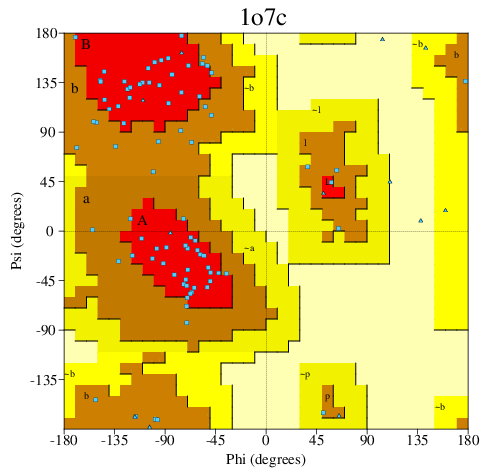
PROCHECK
|
|
|
|
|
|
Headers
|
|
|
|
References
|
|
|
|
|
|

|
|
P98066
(TSG6_HUMAN) -
Tumor necrosis factor-inducible gene 6 protein from Homo sapiens
|
|
|
|
Seq:
Struc:
|
|
|
|
277 a.a.
98 a.a.
|
|

|

|

|
|
|
|
|
|
|
|
|
|
|
Key: |
 |
PfamA domain |
|
|
 |
Secondary structure |
|
 |
CATH domain |
|
|
|
|
|
|
|
|
|
|
|
|
|
|
|
|
|
 |
|
|
|
|
|
|
| |
|
DOI no:
|
J Biol Chem
278:49261-49270
(2003)
|
|
PubMed id:
|
|
|
|
|
|
| |
|
The link module from ovulation- and inflammation-associated protein TSG-6 changes conformation on hyaluronan binding.
|
|
C.D.Blundell,
D.J.Mahoney,
A.Almond,
P.L.DeAngelis,
J.D.Kahmann,
P.Teriete,
A.R.Pickford,
I.D.Campbell,
A.J.Day.
|
|
|
|
|
| |
ABSTRACT
|
|
|
|
| |
|
|
The solution structure of the Link module from human TSG-6, a hyaladherin with
important roles in inflammation and ovulation, has been determined in both its
free and hyaluronan-bound conformations. This reveals a well defined
hyaluronan-binding groove on one face of the Link module that is closed in the
absence of ligand. The groove is lined with amino acids that have been
implicated in mediating the interaction with hyaluronan, including two tyrosine
residues that appear to form essential intermolecular hydrogen bonds and two
basic residues capable of supporting ionic interactions. This is the first
structure of a non-enzymic hyaladherin in its active state, and identifies a
ligand-induced conformational change that is likely to be conserved across the
Link module superfamily. NMR and isothermal titration calorimetry experiments
with defined oligosaccharides have allowed us to infer the minimum length of
hyaluronan that can be accommodated within the binding site and its polarity in
the groove; these data have been used to generate a model of the complex formed
between the Link module and a hyaluronan octasaccharide.
|
|
|
|
|
|
| |
Selected figure(s)
|
|
|
|
| |
|
|

|
|

|
|
Figure 2.
FIG. 2. Solution structures of the TSG-6 Link module in its
free (A and B) and HA[8]-bound states (C and D). A and C,
stereoviews of backbone traces for the family of 20 structures
superimposed on the backbone heavy atoms in the secondary
structure elements. B and D, secondary structure organization of
the Link module, shown on the lowest energy structure of each
family. The fold consists of two antiparallel  -sheets
SI (light blue; residues 2-6 ( 1), 29-31 ( 2), and
89-93 ( 6)) and SII (dark blue;
residues 49-52 ( 3), 56-61 ( 4), and
74-77 ( 5)), connected in a
parallel arrangement by two H-bonds between strands 3 and
6
(see Supplemental Material Fig. S1) and two helices (residues
16-25 ( -sheets
SI (light blue; residues 2-6 ( 1), 29-31 ( 2), and
89-93 ( 6)) and SII (dark blue;
residues 49-52 ( 3), 56-61 ( 4), and
74-77 ( 5)), connected in a
parallel arrangement by two H-bonds between strands 3 and
6
(see Supplemental Material Fig. S1) and two helices (residues
16-25 (  1) and 33-42 ( 2))
shown in red. 1) and 33-42 ( 2))
shown in red.
|
|
Figure 6.
FIG. 6. The interaction of HA with the TSG-6 Link module
induces the opening of the binding groove. A and B, atomic
spheres depiction of the lowest energy free (closed) and
HA[8]-bound (open) structures, in the same orientation, with the
bottom portion of each structure are shown in a ribbon
representation. The conformational change of the 4- 5 loop
opens a groove, exposing the key HA-binding residues (red); the
binding site can be extended by mutation of Glu6 (green) to Lys,
resulting in a higher affinity interaction with HA. The closed
(A) and open (B) states differ principally in the geometry of
the disulfide bridge (sulfur atoms in yellow) linking the 4- 5 loop
(Cys68) to the rigid connection between 2 and 4
(Cys47), as shown by sticks in C and D. E and F, the open
groove, which is lined with atoms that experience significant
shift perturbations on ligand binding (red), can accommodate an
HA octasaccharide (blue sticks and green atomic spheres) in a
favorable geometry without serious steric clashes; one possible
conformation of HA is shown. The polarity and register were
determined as described in text (see Fig. 7). F is rotated
90° toward the reader around the horizontal axis relative to
E.
|
|
|
|
|
|
| |
The above figures are
reprinted
by permission from the ASBMB:
J Biol Chem
(2003,
278,
49261-49270)
copyright 2003.
|
|
| |
Figures were
selected
by an automated process.
|
|
|
|
|
|
|
|
|
|
|
|
|
|
|
|
 |
 |
 |
|
Literature references that cite this PDB file's key reference
|
|
|
| |
PubMed id
|
|
Reference
|
|
|
|
|
|
D.J.Mahoney,
K.Mikecz,
T.Ali,
G.Mabilleau,
D.Benayahu,
A.Plaas,
C.M.Milner,
A.J.Day,
and
A.Sabokbar
(2008).
TSG-6 regulates bone remodeling through inhibition of osteoblastogenesis and osteoclast activation.
|
| |
J Biol Chem,
283,
25952-25962.
|
|
|
|
|
|
|
N.Volpi,
Z.Zhang,
and
R.J.Linhardt
(2008).
Mass spectrometry for the characterization of unsulfated chondroitin oligosaccharides from 2-mers to 16-mers. Comparison with hyaluronic acid oligomers.
|
| |
Rapid Commun Mass Spectrom,
22,
3526-3530.
|
|
|
|
|
|
|
Y.Morioka,
K.Yamasaki,
D.Leung,
and
R.L.Gallo
(2008).
Cathelicidin antimicrobial peptides inhibit hyaluronan-induced cytokine release and modulate chronic allergic dermatitis.
|
| |
J Immunol,
181,
3915-3922.
|
|
|
|
|
|
|
Z.Zhang,
J.Xie,
J.Liu,
and
R.J.Linhardt
(2008).
Tandem MS can distinguish hyaluronic acid from N-acetylheparosan.
|
| |
J Am Soc Mass Spectrom,
19,
82-90.
|
|
|
|
|
|
|
N.T.Seyfried,
J.A.Atwood,
A.Yongye,
A.Almond,
A.J.Day,
R.Orlando,
and
R.J.Woods
(2007).
Fourier transform mass spectrometry to monitor hyaluronan-protein interactions: use of hydrogen/deuterium amide exchange.
|
| |
Rapid Commun Mass Spectrom,
21,
121-131.
|
|
|
|
|
|
|
S.Banerji,
A.J.Wright,
M.Noble,
D.J.Mahoney,
I.D.Campbell,
A.J.Day,
and
D.G.Jackson
(2007).
Structures of the Cd44-hyaluronan complex provide insight into a fundamental carbohydrate-protein interaction.
|
| |
Nat Struct Mol Biol,
14,
234-239.
|
|
|
PDB codes:
|
|
|
|
|
|
|
|
W.Selbi,
C.A.de la Motte,
V.C.Hascall,
A.J.Day,
T.Bowen,
and
A.O.Phillips
(2006).
Characterization of hyaluronan cable structure and function in renal proximal tubular epithelial cells.
|
| |
Kidney Int,
70,
1287-1295.
|
|
|
|
|
|
|
A.J.Day,
and
C.A.de la Motte
(2005).
Hyaluronan cross-linking: a protective mechanism in inflammation?
|
| |
Trends Immunol,
26,
637-643.
|
|
|
|
|
|
|
A.N.Zelensky,
and
J.E.Gready
(2005).
The C-type lectin-like domain superfamily.
|
| |
FEBS J,
272,
6179-6217.
|
|
|
|
|
|
|
K.Drickamer,
and
M.E.Taylor
(2005).
Targeting diversity.
|
| |
Nat Struct Mol Biol,
12,
830-831.
|
|
|
|
|
|
|
S.A.Colebrooke,
C.D.Blundell,
P.L.DeAngelis,
I.D.Campbell,
and
A.Almond
(2005).
Exploiting the carboxylate chemical shift to resolve degenerate resonances in spectra of 13C-labelled glycosaminoglycans.
|
| |
Magn Reson Chem,
43,
805-815.
|
|
|
|
|
|
|
S.A.Kuznetsova,
A.J.Day,
D.J.Mahoney,
M.S.Rugg,
D.F.Mosher,
and
D.D.Roberts
(2005).
The N-terminal module of thrombospondin-1 interacts with the link domain of TSG-6 and enhances its covalent association with the heavy chains of inter-alpha-trypsin inhibitor.
|
| |
J Biol Chem,
280,
30899-30908.
|
|
|
|
|
|
|
S.Roberts,
H.Evans,
J.Menage,
J.P.Urban,
M.T.Bayliss,
S.M.Eisenstein,
M.S.Rugg,
C.M.Milner,
S.Griffin,
and
A.J.Day
(2005).
TNFalpha-stimulated gene product (TSG-6) and its binding protein, IalphaI, in the human intervertebral disc: new molecules for the disc.
|
| |
Eur Spine J,
14,
36-42.
|
|
|
|
|
|
|
M.J.Cliff,
A.Gutierrez,
and
J.E.Ladbury
(2004).
A survey of the year 2003 literature on applications of isothermal titration calorimetry.
|
| |
J Mol Recognit,
17,
513-523.
|
|
|
|
|
|
|
P.Teriete,
S.Banerji,
M.Noble,
C.D.Blundell,
A.J.Wright,
A.R.Pickford,
E.Lowe,
D.J.Mahoney,
M.I.Tammi,
J.D.Kahmann,
I.D.Campbell,
A.J.Day,
and
D.G.Jackson
(2004).
Structure of the regulatory hyaluronan binding domain in the inflammatory leukocyte homing receptor CD44.
|
| |
Mol Cell,
13,
483-496.
|
|
|
PDB codes:
|
|
|
|
|
|
|
The most recent references are shown first.
Citation data come partly from CiteXplore and partly
from an automated harvesting procedure. Note that this is likely to be
only a partial list as not all journals are covered by
either method. However, we are continually building up the citation data
so more and more references will be included with time.
Where a reference describes a PDB structure, the PDB
codes are
shown on the right.
|
|


 Links
Links


