|
PDBsum entry 1n4x

|
|
|
|
|
|

|

|

|

|
|

|
|

|
|

|
|

|
|
|
 |

|

|
|
|
|
|
|
|
|
|
|
|
|
|
|
|
|
|
|
|
|
|
|
|
|
|
|
|
|
|
|
|
|
|
Immune system
|
PDB id
|
|
|
|
1n4x
|
|
|
|
|
|
|
|
|
|
|
|
|
|
|

|

|

|
|
|
|
|
|
|
|
 |
Contents |
 |
|
|
|
|
|
|
|
|
|
|
|
|
* Residue conservation analysis
|
|
|
|
|
|
PDB id:
|
|
|
|
| Name: |
|
Immune system
|
|
|
Title:
|
|
Structure of scfv 1696 at acidic ph
|
|
Structure:
|
|
Immunoglobulin kappa chain variable region. Chain: l, m. Synonym: scfv 1696 molecule 1, monoclonal antibody 1696. Engineered: yes. Immunoglobulin heavy chain variable region. Chain: h, i. Synonym: scfv 1696 molecule 2, monoclonal antibody 1696. Engineered: yes
|
|
Source:
|
|
Mus musculus. House mouse. Organism_taxid: 10090. Expressed in: escherichia coli. Expression_system_taxid: 562. Expression_system_taxid: 562
|
|
Biol. unit:
|
|
 Dimer (from
)
Dimer (from
)
|
|
Resolution:
|
|
|
1.70Å
|
R-factor:
|
0.227
|
R-free:
|
0.256
|
|
|
Authors:
|
|
J.Lescar,J.Brynda,M.Fabry,M.Horejsi,P.Rezacova,J.Sedlacek,G.A.Bentley
|
Key ref:

|
|
J.Lescar
et al.
(2003).
Structure of a single-chain Fv fragment of an antibody that inhibits the HIV-1 and HIV-2 proteases.
Acta Crystallogr D Biol Crystallogr,
59,
955-957.
PubMed id:
DOI:

|
|
|
Date:
|
|
|
02-Nov-02
|
Release date:
|
10-Jun-03
|
|
|
|
|
|
|
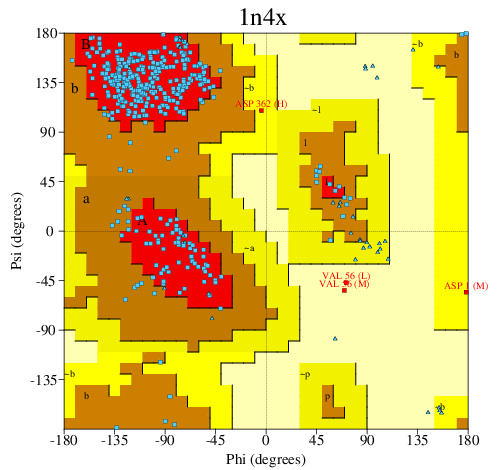
PROCHECK
|
|
|
|
|
|
Headers
|
|
|
|
References
|
|
|
|
|
|
|
|
|
|
|
|
|
|
|
|
 |
|
|
|
|
|
|
| |
|
DOI no:
|
Acta Crystallogr D Biol Crystallogr
59:955-957
(2003)
|
|
PubMed id:
|
|
|
|
|
|
| |
|
Structure of a single-chain Fv fragment of an antibody that inhibits the HIV-1 and HIV-2 proteases.
|
|
J.Lescar,
J.Brynda,
M.Fabry,
M.Horejsi,
P.Rezacova,
J.Sedlacek,
G.A.Bentley.
|
|
|
|
|
| |
ABSTRACT
|
|
|
|
| |
|
|
The monoclonal antibody 1696, which was raised against the HIV-1 protease,
inhibits the catalytic activity of the enzyme from both the HIV-1 and HIV-2
strains. The antibody cross-reacts with peptides containing the N-terminus of
the enzyme, which is highly conserved between these strains. The crystal
structure of a single-chain Fv fragment of 1696 (scFv-1696) in the non-complexed
form, solved at 1.7 A resolution, is compared with the previously reported
non-complexed Fab-1696 and antigen-bound scFv-1696 structures. Large
conformational changes in the third hypervariable region of the heavy chain and
differences in relative orientation of the variable domains are observed between
the different structures.
|
|
|
|
|
|
| |
Selected figure(s)
|
|
|
|
| |
|
|

|
|
Figure 2.
Figure 2 Comparison of the variable domains of non-complexed
Fab-1696 (PDB code [59]1cl7 , blue), molecule 1 of the
non-complexed scFv-1696 (this work, yellow) and complexed
scFv-1696 (PDB code [60]1jp5 , red). The peptide is shown in
green. Superposition has been made by optimizing the
correspondence between the main-chain atoms of the V[L] domains
of the three structures. Fv1696 is shown from the side of (a)
and from above (b) the antigen-bindng site. The V[L] domain is
shown on the left of the Fv fragment, while the V[H] domain is
on the right. The third CDR of V[H] (H3) is indicated.
|
|
|
|
|
|
| |
The above figure is
reprinted
by permission from the IUCr:
Acta Crystallogr D Biol Crystallogr
(2003,
59,
955-957)
copyright 2003.
|
|
| |
Figure was
selected
by an automated process.
|
|
|
|
|
|
|
|
|
|
|
|
|
|
|
|
 |
 |
 |
|
Literature references that cite this PDB file's key reference
|
|
|
| |
PubMed id
|
|
Reference
|
|
|
|
|
|
A.Honegger,
A.D.Malebranche,
D.Röthlisberger,
and
A.Plückthun
(2009).
The influence of the framework core residues on the biophysical properties of immunoglobulin heavy chain variable domains.
|
| |
Protein Eng Des Sel,
22,
121-134.
|
|
|
|
|
|
The most recent references are shown first.
Citation data come partly from CiteXplore and partly
from an automated harvesting procedure. Note that this is likely to be
only a partial list as not all journals are covered by
either method. However, we are continually building up the citation data
so more and more references will be included with time.
|
|
|


 Links
Links