 |
PDBsum entry 1n2a

|
|
|
|
|
 |
Contents |
 |
|
|
|
|
|
|
|
|
|
|
|
|
* Residue conservation analysis
|
|
|
|
|
|
|
|
|
|
Enzyme class:
|
|
Chains A, B:
E.C.2.5.1.18
- glutathione transferase.
|
|
|
|
|
|
|
Reaction:
|
|
RX + glutathione = an S-substituted glutathione + a halide anion + H+
|
|
|
|
|
|
RX
Bound ligand (Het Group name = )
matches with 86.96% similarity
|
+
|
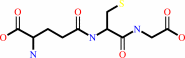 glutathione
|
=
|
S-substituted glutathione
|
+
|
halide anion
|
+
|
H(+)
|
|
|
|
|
|
|
|
|
|
|
|
|
Molecule diagrams generated from .mol files obtained from the
KEGG ftp site
|
|
|
|
|
|
|
|
|
|
|
|
|
|
 |
|
|
|
|
|
|
| |
|
|
| |
|
DOI no:
|
Proteins
53:777-782
(2003)
|
|
PubMed id:
|
|
|
|
|
|
| |
|
Conserved structural elements in glutathione transferase homologues encoded in the genome of Escherichia coli.
|
|
C.L.Rife,
J.F.Parsons,
G.Xiao,
G.L.Gilliland,
R.N.Armstrong.
|
|
|
|
|
| |
ABSTRACT
|
|
|
|
| |
|
|
Multiple sequence alignments of the eight glutathione (GSH) transferase
homologues encoded in the genome of Escherichia coli were used to define a
consensus sequence for the proteins. The consensus sequence was analyzed in the
context of the three-dimensional structure of the gst gene product (EGST)
obtained from two different crystal forms of the enzyme. The enzyme consists of
two domains. The N-terminal region (domain I) has a thioredoxin-like
alpha/beta-fold, while the C-terminal domain (domain II) is all alpha-helical.
The majority of the consensus residues (12/17) reside in the N-terminal domain.
Fifteen of the 17 residues are involved in hydrophobic core interactions, turns,
or electrostatic interactions between the two domains. The results suggest that
all of the homologues retain a well-defined group of structural elements both in
and between the N-terminal alpha/beta domain and the C-terminal domain. The
conservation of two key residues for the recognition motif for the
gamma-glutamyl-portion of GSH indicates that the homologues may interact with
GSH or GSH analogues such as glutathionylspermidine or alpha-amino acids. The
genome context of two of the homologues forms the basis for a hypothesis that
the b2989 and yibF gene products are involved in glutathionylspermidine and
selenium biochemistry, respectively.
|
|
|
|
|
|
| |
Selected figure(s)
|
|
|
|
| |
|
|

|
|

|
|
Figure 2.
Figure 2. Distribution of consensus residues in the gst gene
product from Escherichia coli. Ribbon diagram of monomer A of
EGST illustrating the distribution of conserved residues amongst
the homologues. Domains I and II are illustrated in orange and
light blue, respectively. The side chains of the 17 consensus
residues are highlighted in van der Waals representations.
|
|
Figure 5.
Figure 5. View of the  -glutamyl
binding motif at the turn between -glutamyl
binding motif at the turn between  -strand-4
and helix-2 in the N-terminal domain. The carboxylate of E65 and
the main-chain N-H of G66 are within hydrogen bonding distance
of the -strand-4
and helix-2 in the N-terminal domain. The carboxylate of E65 and
the main-chain N-H of G66 are within hydrogen bonding distance
of the  -amino
and -carboxyl
groups of the glutamyl residues of GSO [LaTeX2gif.pl?%5Cdocumentclass%7Bminimal%7D%5Cbegin%7Bdocument%7D%5C%28%5E%7B-%7D_%7B3%7D%5C%29%5Cend%7Bdocument%7D]
. -amino
and -carboxyl
groups of the glutamyl residues of GSO [LaTeX2gif.pl?%5Cdocumentclass%7Bminimal%7D%5Cbegin%7Bdocument%7D%5C%28%5E%7B-%7D_%7B3%7D%5C%29%5Cend%7Bdocument%7D]
.
|
|
|
|
|
|
| |
The above figures are
reprinted
by permission from John Wiley & Sons, Inc.:
Proteins
(2003,
53,
777-782)
copyright 2003.
|
|
| |
Figures were
selected
by the author.
|
|
|
|
|
|
|
|
|
|
|
|
|
|
|
|
 |
 |
 |
|
Literature references that cite this PDB file's key reference
|
|
|
| |
PubMed id
|
|
Reference
|
|
|
|
|
|
K.K.Desai,
and
B.G.Miller
(2010).
Recruitment of genes and enzymes conferring resistance to the nonnatural toxin bromoacetate.
|
| |
Proc Natl Acad Sci U S A,
107,
17968-17973.
|
|
|
|
|
|
|
M.Antunez-Lamas,
E.Cabrera,
E.Lopez-Solanilla,
R.Solano,
P.González-Melendi,
J.M.Chico,
I.Toth,
P.Birch,
L.Prichard,
H.Liu,
and
P.Rodriguez-Palenzuela
(2009).
Bacterial chemoattraction towards jasmonate plays a role in the entry of Dickeya dadantii through wounded tissues.
|
| |
Mol Microbiol,
74,
662-671.
|
|
|
|
|
|
|
M.C.Wadington,
J.E.Ladner,
N.V.Stourman,
J.M.Harp,
and
R.N.Armstrong
(2009).
Analysis of the structure and function of YfcG from Escherichia coli reveals an efficient and unique disulfide bond reductase.
|
| |
Biochemistry,
48,
6559-6561.
|
|
|
PDB code:
|
|
|
|
|
|
|
|
N.Allocati,
L.Federici,
M.Masulli,
and
C.Di Ilio
(2009).
Glutathione transferases in bacteria.
|
| |
FEBS J,
276,
58-75.
|
|
|
|
|
|
|
A.M.Hansen,
Y.Gu,
M.Li,
M.Andrykovitch,
D.S.Waugh,
D.J.Jin,
and
X.Ji
(2005).
Structural basis for the function of stringent starvation protein a as a transcription factor.
|
| |
J Biol Chem,
280,
17380-17391.
|
|
|
PDB code:
|
|
|
|
|
|
|
The most recent references are shown first.
Citation data come partly from CiteXplore and partly
from an automated harvesting procedure. Note that this is likely to be
only a partial list as not all journals are covered by
either method. However, we are continually building up the citation data
so more and more references will be included with time.
Where a reference describes a PDB structure, the PDB
code is
shown on the right.
|
|
|


 Links
Links


