 |
PDBsum entry 1mep

|
|
|
|
|
|

|

|

|

|
|

|
|

|
|

|
|

|
|

|
|

|
|
|
 |

|

|
|
|
|
|
|
|
|
|
|
|
|
|
|
|
|
|
|
|
|
|
|
|
|
|
|
|
|
|
|
|
|
|
|
|
Biotin-binding protein
|
PDB id
|
|
|
|
1mep
|
|
|
|
|
|
|
|
|
|
|
|
|
|
|

|

|

|
|
|
|
|
|
|
|
 |
Contents |
 |
|
|
|
|
|
|
|
|
|
|
|
|
* Residue conservation analysis
|
|
|
|
|
|
PDB id:
|
|
|
|
| Name: |
|
Biotin-binding protein
|
|
|
Title:
|
|
Crystal structure of streptavidin double mutant s45a/d128a with biotin: cooperative hydrogen-bond interactions in the streptavidin- biotin system.
|
|
Structure:
|
|
Streptavidin. Chain: a, b, c, d. Fragment: core streptavidin (residues 13-139). Engineered: yes. Mutation: yes
|
|
Source:
|
|
Streptomyces avidinii. Organism_taxid: 1895. Gene: core streptavidin. Expressed in: escherichia coli bl21. Expression_system_taxid: 511693.
|
|
Biol. unit:
|
|
Tetramer (from
)
|
|
Resolution:
|
|
|
1.65Å
|
R-factor:
|
0.204
|
R-free:
|
0.294
|
|
|
Authors:
|
|
D.E.Hyre,I.Le Trong,E.A.Merritt,R.E.Stenkamp,N.M.Green,P.S.Stayton
|
Key ref:

|
|
D.E.Hyre
et al.
(2006).
Cooperative hydrogen bond interactions in the streptavidin-biotin system.
Protein Sci,
15,
459-467.
PubMed id:
DOI:

|
|
|
Date:
|
|
|
08-Aug-02
|
Release date:
|
02-Sep-03
|
|
|
|
|
|
|
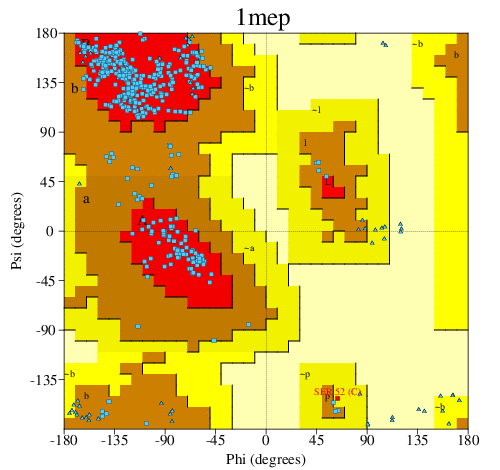
PROCHECK
|
|
|
|
|
|
Headers
|
|
|
|
References
|
|
|
|
|
|

|
|
P22629
(SAV_STRAV) -
Streptavidin from Streptomyces avidinii
|
|
|
|
Seq:
Struc:
|
|
|
|
183 a.a.
119 a.a.*
|
|

|

|
|
|
|
|
|
|
|
|
|
|
|
Key: |
 |
PfamA domain |
|
|
 |
Secondary structure |
|
 |
CATH domain |
|
|
*
PDB and UniProt seqs differ
at 2 residue positions (black
crosses)
|
|
|
|
|
|
|
|
|
|
|
|
|
|
|
|
|
 |
|
|
|
|
|
|
| |
|
DOI no:
|
Protein Sci
15:459-467
(2006)
|
|
PubMed id:
|
|
|
|
|
|
| |
|
Cooperative hydrogen bond interactions in the streptavidin-biotin system.
|
|
D.E.Hyre,
I.Le Trong,
E.A.Merritt,
J.F.Eccleston,
N.M.Green,
R.E.Stenkamp,
P.S.Stayton.
|
|
|
|
|
| |
ABSTRACT
|
|
|
|
| |
|
|
The thermodynamic and structural cooperativity between the Ser45- and
D128-biotin hydrogen bonds was measured by calorimetric and X-ray
crystallographic studies of the S45A/D128A double mutant of streptavidin. The
double mutant exhibits a binding affinity approximately 2x10(7) times lower than
that of wild-type streptavidin at 25 degrees C. The corresponding reduction in
binding free energy (DeltaDeltaG) of 10.1 kcal/mol was nearly completely due to
binding enthalpy losses at this temperature. The loss of binding affinity is
11-fold greater than that predicted by a linear combination of the single-mutant
energetic perturbations (8.7 kcal/mol), indicating that these two mutations
interact cooperatively. Crystallographic characterization of the double mutant
and comparison with the two single mutant structures suggest that structural
rearrangements at the S45 position, when the D128 carboxylate is removed, mask
the true energetic contribution of the D128-biotin interaction. Taken together,
the thermodynamic and structural analyses support the conclusion that the
wild-type hydrogen bond between D128-OD and biotin-N2 is thermodynamically
stronger than that between S45-OG and biotin-N1.
|
|
|
|
|
|
| |
Selected figure(s)
|
|
|
|
| |
|
|

|
|

|
|
Figure 1.
Structural superposition of bound wild-type (white), S45A
(blue), D128A (red), and S45A/D128A double-mutant (green)
streptavidin structures. (A) Stereoview of the overall
structures. (B). Details of the binding pocket described in the
text. The bound structures were superimposed by least-squares
fit of the 65 C[alpha] atoms in the [beta]-barrel core of each
monomer. The nearly identical structure of these cores can be
seen in the overlay of the [beta]-sheet backbone in the
[beta]-barrel core. The protein adjusts to the two mutations by
a combination of the shifts found in the individual mutants,
with the main-chain near S45A shifting toward biotin, the
main-chain near D128A shifting away from biotin, a water
molecule replacing the missing D128 carboxylate, and the biotin
shifting away from the bottom of the pocket (the new water in
the D128A structure is hidden by that in the double mutant due
to nearly complete overlap). Hydrogen bonds involving Q24, S45,
D128, and biotin in wild-type streptavidin are shown by dotted
lines.
|
|
Figure 4.
Thermodynamic cycles for stepwise mutation of wild-type
streptavidin to the S45A/D128A double mutant, showing
[Delta]G[298], [Delta]H[298], and T[Delta]S[298]. The cycle
starts with wild type in the upper left corner and proceeds to
the single mutants, with the thermodynamic perturbation shown
next to the arrows. The cycle continues to the double mutant,
with the difference in thermodynamic parameters between each
single mutant and the double mutant shown next to those arrows.
The units on the quantities in the figure are kcal/mol.
|
|
|
|
|
|
| |
The above figures are
reprinted
from an Open Access publication published by the Protein Society:
Protein Sci
(2006,
15,
459-467)
copyright 2006.
|
|
| |
Figures were
selected
by an automated process.
|
|
|
|
|
|
|
|
|
|
|
|
|
|
|
|
 |
 |
 |
|
Literature references that cite this PDB file's key reference
|
|
|
| |
PubMed id
|
|
Reference
|
|
|
|
|
|
R.Melero,
G.Buchwald,
R.Castaño,
M.Raabe,
D.Gil,
M.Lázaro,
H.Urlaub,
E.Conti,
and
O.Llorca
(2012).
The cryo-EM structure of the UPF-EJC complex shows UPF1 poised toward the RNA 3' end.
|
| |
Nat Struct Mol Biol,
19,
498.
|
|
|
|
|
|
|
C.E.Chivers,
A.L.Koner,
E.D.Lowe,
and
M.Howarth
(2011).
How the biotin-streptavidin interaction was made even stronger: investigation via crystallography and a chimaeric tetramer.
|
| |
Biochem J,
435,
55-63.
|
|
|
PDB codes:
|
|
|
|
|
|
|
|
J.M.Teulon,
Y.Delcuze,
M.Odorico,
S.W.Chen,
P.Parot,
and
J.L.Pellequer
(2011).
Single and multiple bonds in (strept)avidin-biotin interactions.
|
| |
J Mol Recognit,
24,
490-502.
|
|
|
|
|
|
|
M.A.Moosmeier,
J.Bulkescher,
J.Reed,
M.Schnölzer,
H.Heid,
K.Hoppe-Seyler,
and
F.Hoppe-Seyler
(2010).
Transtactin: a universal transmembrane delivery system for Strep-tag II-fused cargos.
|
| |
J Cell Mol Med,
14,
1935-1945.
|
|
|
|
|
|
|
M.J.Flagler,
S.S.Mahajan,
A.A.Kulkarni,
S.S.Iyer,
and
A.A.Weiss
(2010).
Comparison of binding platforms yields insights into receptor binding differences between shiga toxins 1 and 2.
|
| |
Biochemistry,
49,
1649-1657.
|
|
|
|
|
|
|
T.A.Aweda,
H.E.Beck,
A.M.Wu,
L.H.Wei,
W.A.Weber,
and
C.F.Meares
(2010).
Rates and equilibria for probe capture by an antibody with infinite affinity.
|
| |
Bioconjug Chem,
21,
784-791.
|
|
|
|
|
|
|
D.S.Cerutti,
I.Le Trong,
R.E.Stenkamp,
and
T.P.Lybrand
(2009).
Dynamics of the streptavidin-biotin complex in solution and in its crystal lattice: distinct behavior revealed by molecular simulations.
|
| |
J Phys Chem B,
113,
6971-6985.
|
|
|
|
|
|
|
D.S.Cerutti,
R.E.Duke,
T.A.Darden,
and
T.P.Lybrand
(2009).
Staggered Mesh Ewald: An extension of the Smooth Particle-Mesh Ewald method adding great versatility.
|
| |
J Chem Theory Comput,
5,
2322.
|
|
|
|
|
|
|
I.E.Dunlop,
S.Zorn,
G.Richter,
V.Srot,
M.Kelsch,
P.A.van Aken,
M.Skoda,
A.Gerlach,
J.P.Spatz,
and
F.Schreiber
(2009).
Titanium-silicon oxide film structures for polarization-modulated infrared reflection absorption spectroscopy.
|
| |
Thin Solid Films,
517,
2048-2054.
|
|
|
|
|
|
|
J.A.Määttä,
S.H.Helppolainen,
V.P.Hytönen,
M.S.Johnson,
M.S.Kulomaa,
T.T.Airenne,
and
H.R.Nordlund
(2009).
Structural and functional characteristics of xenavidin, the first frog avidin from Xenopus tropicalis.
|
| |
BMC Struct Biol,
9,
63.
|
|
|
PDB codes:
|
|
|
|
|
|
|
|
J.J.Panek,
T.R.Ward,
A.Jezierska,
and
M.Novic
(2009).
Effects of tryptophan residue fluorination on streptavidin stability and biotin-streptavidin interactions via molecular dynamics simulations.
|
| |
J Mol Model,
15,
257-266.
|
|
|
|
|
|
|
S.C.Wu,
K.K.Ng,
and
S.L.Wong
(2009).
Engineering monomeric streptavidin and its ligands with infinite affinity in binding but reversibility in interaction.
|
| |
Proteins,
77,
404-412.
|
|
|
|
|
|
|
Y.Takakura,
M.Tsunashima,
J.Suzuki,
S.Usami,
Y.Kakuta,
N.Okino,
M.Ito,
and
T.Yamamoto
(2009).
Tamavidins--novel avidin-like biotin-binding proteins from the Tamogitake mushroom.
|
| |
FEBS J,
276,
1383-1397.
|
|
|
PDB code:
|
|
|
|
|
|
|
|
D.S.Cerutti,
I.Le Trong,
R.E.Stenkamp,
and
T.P.Lybrand
(2008).
Simulations of a protein crystal: explicit treatment of crystallization conditions links theory and experiment in the streptavidin-biotin complex.
|
| |
Biochemistry,
47,
12065-12077.
|
|
|
|
|
|
|
D.X.Xu,
A.Densmore,
A.Delâge,
P.Waldron,
R.McKinnon,
S.Janz,
J.Lapointe,
G.Lopinski,
T.Mischki,
E.Post,
P.Cheben,
and
J.H.Schmid
(2008).
Folded cavity SOI microring sensors for high sensitivity and real time measurement of biomolecular binding.
|
| |
Opt Express,
16,
15137-15148.
|
|
|
|
|
|
|
J.A.Määttä,
T.T.Airenne,
H.R.Nordlund,
J.Jänis,
T.A.Paldanius,
P.Vainiotalo,
M.S.Johnson,
M.S.Kulomaa,
and
V.P.Hytönen
(2008).
Rational modification of ligand-binding preference of avidin by circular permutation and mutagenesis.
|
| |
Chembiochem,
9,
1124-1135.
|
|
|
PDB code:
|
|
|
|
|
|
|
|
M.Levy,
and
A.D.Ellington
(2008).
Directed evolution of streptavidin variants using in vitro compartmentalization.
|
| |
Chem Biol,
15,
979-989.
|
|
|
|
|
|
|
O.Okhrimenko,
and
I.Jelesarov
(2008).
A survey of the year 2006 literature on applications of isothermal titration calorimetry.
|
| |
J Mol Recognit,
21,
1.
|
|
|
|
|
|
|
F.Rico,
and
V.T.Moy
(2007).
Energy landscape roughness of the streptavidin-biotin interaction.
|
| |
J Mol Recognit,
20,
495-501.
|
|
|
|
|
|
|
J.DeChancie,
and
K.N.Houk
(2007).
The origins of femtomolar protein-ligand binding: hydrogen-bond cooperativity and desolvation energetics in the biotin-(strept)avidin binding site.
|
| |
J Am Chem Soc,
129,
5419-5429.
|
|
|
|
|
|
|
M.S.Marcus,
L.Shang,
B.Li,
J.A.Streifer,
J.D.Beck,
E.Perkins,
M.A.Eriksson,
and
R.J.Hamers
(2007).
Dielectrophoretic manipulation and real-time electrical detection of single-nanowire bridges in aqueous saline solutions.
|
| |
Small,
3,
1610-1617.
|
|
|
|
|
|
|
T.Young,
R.Abel,
B.Kim,
B.J.Berne,
and
R.A.Friesner
(2007).
Motifs for molecular recognition exploiting hydrophobic enclosure in protein-ligand binding.
|
| |
Proc Natl Acad Sci U S A,
104,
808-813.
|
|
|
|
|
|
|
J.K.Lassila,
H.K.Privett,
B.D.Allen,
and
S.L.Mayo
(2006).
Combinatorial methods for small-molecule placement in computational enzyme design.
|
| |
Proc Natl Acad Sci U S A,
103,
16710-16715.
|
|
|
|
|
|
The most recent references are shown first.
Citation data come partly from CiteXplore and partly
from an automated harvesting procedure. Note that this is likely to be
only a partial list as not all journals are covered by
either method. However, we are continually building up the citation data
so more and more references will be included with time.
Where a reference describes a PDB structure, the PDB
codes are
shown on the right.
|
|


 Links
Links


